
|
 |
Frontline Democrats Are Not Beautiful And Unique Snowflakes
Inside the mailbag: Jared Golden ... Mike Johnson ... Iran War
|

| |||||||||||||||


 |
Yesterday was Off Message’s birthday, and tomorrow’s mine, so I’ll be taking Friday off with Mrs. Off Message. Have a great weekend.
Tyler Steward: Brian, you’ve no doubt dealt with this question before, so apologies if I’m asking for a rehash, but with the sudden blossoming of anti-trans rhetoric coming from high-profile Dem candidates everywhere, plus the squishiness on AI-related matters, I’m wondering about the Dem consultant/strategist complex. Like, literally, who ARE these people? What are their names? Where in the Democratic message sausage-making process do they exercise their influence? Why exactly are they so influential and so predictably wrong about nearly everything? And in ways that are themselves predictable, i.e. by reinforcing Republican attacks and framing rather than by attacking and refuting them? I do not believe that they don’t hear the critiques you, among others, offer regarding Democratic messaging, and those critiques are so often proven right by subsequent events that even they can’t help but notice. Surely? So what gives with these people?
It’s a whole industrial complex, and like any industrial complex, it’s rife with conflicts of interest. For instance: The consultants who’ve advised frontline Democrats to keep their heads down, even though opposing A.I. development polls insanely well—are they really just scared of negative-ad spending? Or are they also thinking about potential clients? When they give hyper-cautious advice, are they acting in the client’s best interest, or are they trying to reduce the risk that they shoulder the blame in defeat?
But the more insidious thing in my view is the fact that the establishment tier of party strategists—the people who work for party committees, or who run or work for firms that serve party-backed candidates—are caught up in the delusion that politics is a solved game. It’s all basically math.
There’s some interesting reporting on this, complete with names, in Rebecca Traister’s recent expose on the DC consultants who parachuted in to take over the Maine Senate race, after Graham Platner gave way to Troy Jackson. The whole piece is worth a read, but here, for instance:
Multiple sources said campaign managers turned up their noses at some of the hokier events on [Jackson’s] schedule, including a boisterous karaoke night and a contra dance on Labor Day weekend. “They think it’s going well when Troy is boring AF,” said another person with knowledge of the campaign. Karaoke, held at Baxter Brewing Co. in Lewiston, “was a blast,” according to one attendant, packed with people who were Jackson’s delegates or organizers. “Troy was on fire, and he was just himself again.” Members of the Washington contingent, according to multiple people present, hung out on a couch by themselves and left after about half an hour.
Another source familiar with the campaign said, “I don’t even think it’s disdain for Maine so much as it’s just disdain for, more generally, people. They want to run this campaign through numbers and spreadsheets. And wherever a campaign is connecting with people or doing anything quirky or unique, they’re like, ‘This is bad and weird.’”
A lot of this friction comes down to competing theories of how to win elections. The people running Jackson’s campaign are relying on heavy vetting, poll testing, and data that pinpoints exactly who may be persuadable. They focus on ads, the messages neatly sculpted, while the candidate attends fundraisers and does call time, raising more money to pay for more ads. Emphasizing ads over a field operation is more profitable for the companies running that campaign. TKO and McCollister’s firm, Frame, make and sell ads for Jackson. “It’s a bit of a perverse incentive,” said one person close to Jackson.
There’s a lot more, but this gets at it. Democratic politics has become a p.r. machine that tests messages and ads (siphoning a lot of money along the way) then targets them at what it believes to be the population of persuadable voters. They waltz into campaigns, and present strategy memos—replete with fancy-looking analytics—to candidates and campaign staffers who may not have tons of experience running high-profile campaigns for federal office. As one of Traister’s sources notes, they can be “very convincing,” particularly when clients are more or less innumerate, or have put little thought into what politics is. How did people do it before modern analytics? How do ideas circulate among people? How do people come to like and trust figures they only know from the hustings?
When you really dive into the methodology, and think critically about it, though, the consultant-brain approach to transforming persuasion data into campaign strategy guidance is a joke. Laughably detached from both science and humanities. A well-constructed message test can be useful as a filter, a way to steer wide of genuinely counterproductive modes of discourse (just as issue polls can help weed out toxically unpopular ideas). But the idea that you can take findings from lab rats, turn them into scripts for a candidate, and tell them their best bet is to stick to their scripts… it’s quackery. At a basic philosophical level, there’s no such thing as an optimal message. Circumstances and context are always changing! But even if there were, this would be a terrible way to deliver it.
I am sure many operatives are aware of critiques like mine. Many have surely convinced themselves that they’re right and I’m wrong. Motivated reasoning is a powerful drug. This is their livelihood. But one confounding variable is that substantially de-datafying campaigns would make them cheaper, and if there’s less money sloshing around…
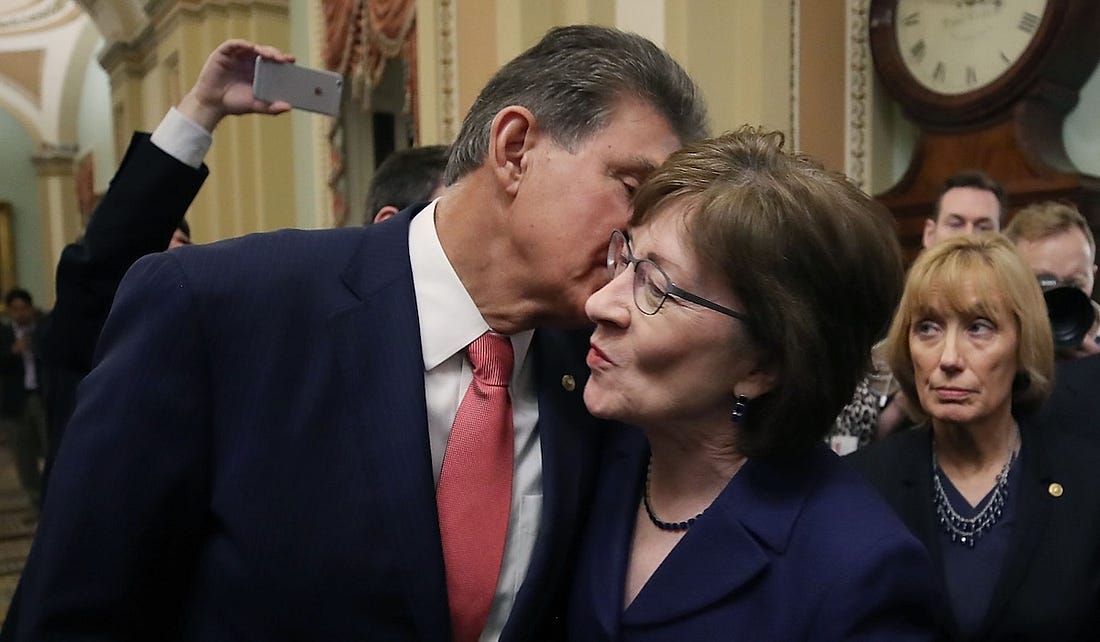
Matt Colbert: Please opine on the psychology of Joe Manchin, a man who was essentially the policy czar of the Biden administration, a man who the party kowtowed to for two years, who was given everything he wanted, and who has now proceeded to endorse Susan Collins and Mike Rogers.
Obviously his endorsement is completely irrelevant electorally, but what does it tell us about him, and about the party?
KH: If I can bandwagon on this, add Jared Golden’s endorsement of Mike Lawler to the mix, and maybe even GW Bush’s decision to come off the bench and fundraise for GOP candidates while notably excluding Ken Paxton. Does it look like the beginning of a wider lane for annoying, self-important center-right dweebs who are trying to get past MAGA, or is it down to the idiosyncracies of these particular dweebs at this unique moment?
Matt Y. and I had a big, spicy argument about this on Politix this week, in front of the paywall, keyin