|
|
|
|
Good morning. There were endless headlines this week about the first-ever Canada Investment Summit, coupled with a steady drip of billion-dollar funding commitments. It was nearly impossible to track it all. If you’re wondering what the summit actually achieved, and whether it was mostly hype, we have answers. |
|
|
|
|
|
|
|
|
|
|
|
|
|
|
|
|
Artificial intelligence: Earlier this month, AI agents repurposed
the University of Toronto’s link shortener to create a message board for other agents. Meanwhile, more voices are calling for swift action to regulate the technology, which has become a midterm issue. |
|
|
|
|
Allegedly: The former CEO of Canada Health Infoway is suing the federally funded non-profit for wrongful dismissal, alleging that he was a scapegoat for the failure of its $300-million “axe the fax” project. |
|
|
|
|
Airports: An executive at the International Air Transport Association has some advice for the Prime Minister as he privatizes Canada’s biggest airports: Don’t do it. |
|
|
|
|
|
|
|
|
|
|
|
|
|
|
|
Prime Minister Mark Carney speaks to the members of the media during the Canada Investment Summit in Toronto. Carlos Osorio/Reuters
|
|
|
|
|
|
|
|
|
|
|
The Canada Investment Summit lookback |
|
|
|
|
Hi, I’m Tim Kiladze, a financial reporter and columnist for The Globe, and I was on the ground this week in Yorkville, the ritzy Toronto neighbourhood that hosted the Canada Investment Summit. Over a whirlwind 48 hours, I attended the actual conference, as well as mini-forums, luncheons and cocktail events tied to it. |
|
|
|
|
One message kept getting repeated: Canada is actually, finally back. And it was often said by the Canadians who attended. Among them, there was a sense of optimism, and a hope that foreign funds will take us seriously. |
|
|
|
|
Admittedly, it was a bit disorienting. I’ve covered capital markets and foreign investments for 16 years at The Globe, and it’s not like we were a banana republic until now. Canada’s pension funds are some of the most sophisticated investors in the world, and many of the foreign funds in Toronto this week are already invested here. |
|
|
|
|
A subsidiary of Saudi Arabia’s Public Investment Fund, for instance, bought major grain handling assets in the Prairies, and Blackstone, the U.S. private equity giant, holds $50-billion worth Canadian assets, many of them in real estate. |
|
|
|
|
|
|
|
|
|
|
|
|
|
|
In the prospectus for the summit, there were more than 160 projects in various stages of development, including a proposed $10.9-billion high-speed rail link between Edmonton and Calgary and a planned $57-billion Port of Churchill expansion. But many were smaller ideas that only need a total of $500-million to $1-billion in funding. |
|
|
|
|
Major funds – including Canada’s own pension funds – are often looking to write cheques for billions of dollars each. It just isn’t worth their time to contribute to a project that needs a total of $500-million. |
|
|
|
|
Institutional investors also want assurance that their capital can be put to work quickly. They don’t want to commit $2-billion for a new pipeline, for instance, only to have it challenged in court and delayed for years. When a project is held up, they can’t really move the promised money elsewhere. |
|
|
|
|
On this front, Canada is making progress. One of Prime Minister Mark Carney’s signature goals is to move toward a “one project, one review” system, where project reviews are streamlined and centralized for efficiency. The wild card, though, will be the courts. |
|
|
|
|
|
|
|
|
|
|
Canada will also need a little luck. |
|
|
|
|
Carney keeps touting Canada’s strength as a resource nation because historically, commodities helped fuel the country’s economic development. But what got glossed over at the summit is that commodity prices have repeatedly crashed, and when they do, it scares away investors and creates capital droughts. |
|
|
|
|
If commodity prices tumble again like they did when the mining supercycle crashed in 2012 or when oil prices plummeted in 2014, it will be tough to attract capital no matter how many regulations Canada relaxes or how many tax incentives it rolls out. |
|
|
|
|
|
|
|
|
|
|
|
|
|
|
|
|
|
|
|
|
|
|
|
|
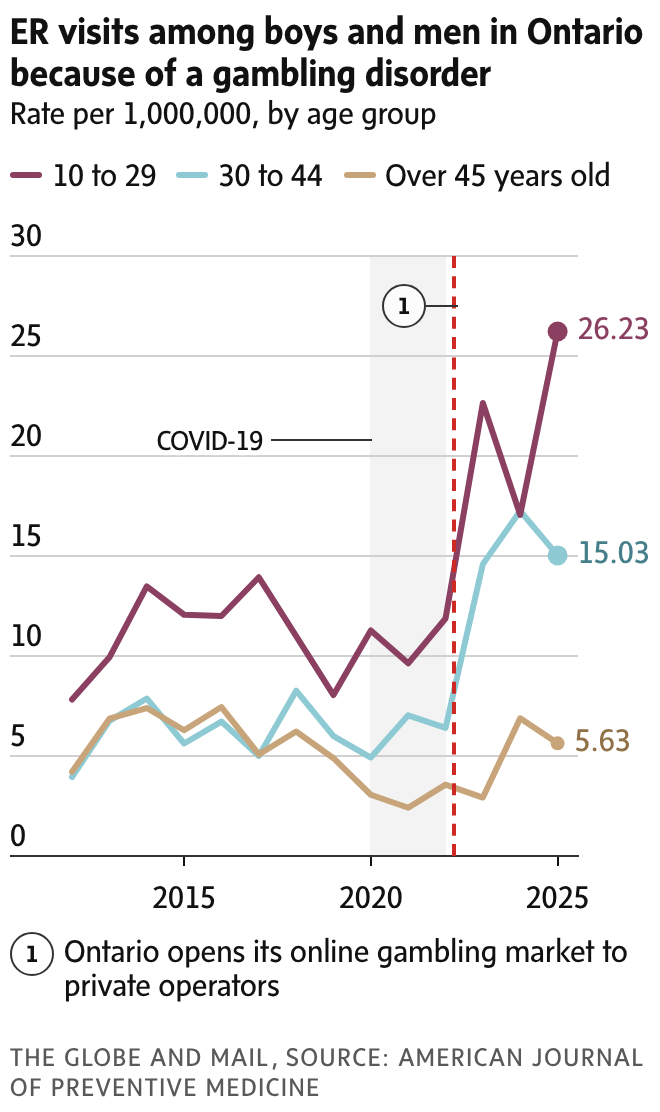
Gambling-related ER visits in Ontario have nearly doubled since the province opened its online gambling market to private operators in 2022. The sharpest increase was among boys and men aged 10-29, whose ER visits rose 154 per cent, according to a new study. |
|
|
|
|
|
|
|
|
|
|
|
|