| | New York Climate Week will take place in the midst of an historic energy crisis. ͏ ͏ ͏ ͏ ͏ ͏ |
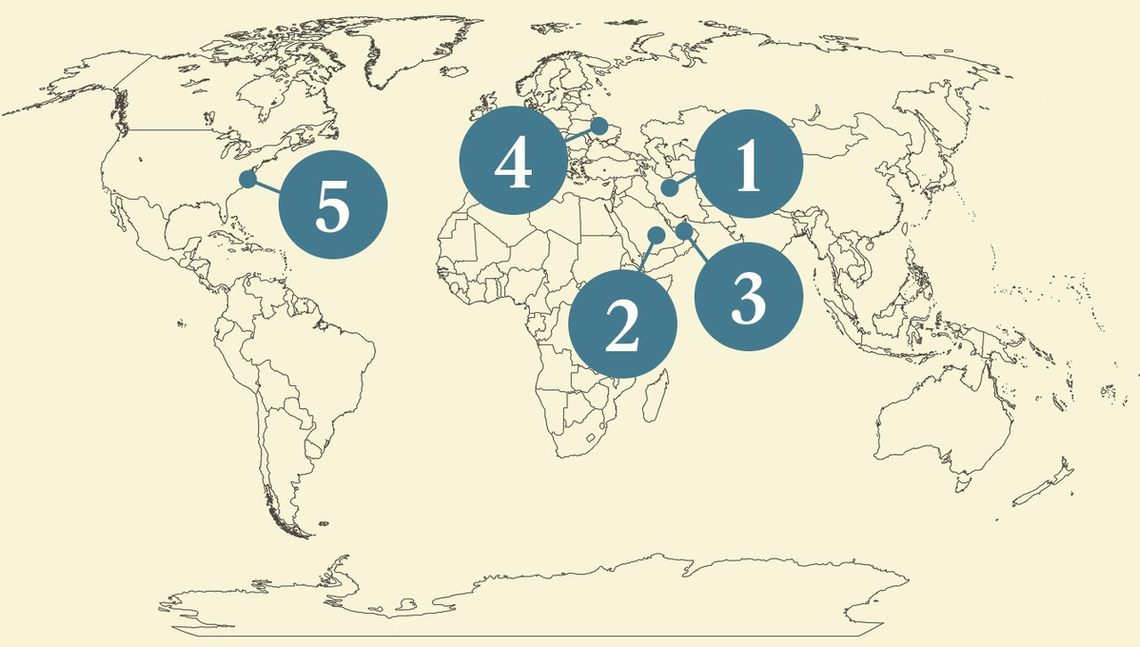
| |  New York City New York City | Kyiv |  Riyadh Riyadh |
 | Energy |  |
| |
|
 - Rising costs
- Aramco’s AI strategy
- Emirates’ power plans
- Russia sanctions advance
- Quantum climate fixes
 The Trump administration makes a big loan to Ukrainian clean tech, and China considers cutting US energy tariffs. |
|
 Next week’s UN General Assembly and New York Climate Week will happen against the backdrop of an historic global energy crisis, underscoring that the next chapter of the energy transition will be written in developing countries — not in China, the US, or Europe. “The deglobalization of global energy is happening right now,” S&P Global vice-chairman Dan Yergin told me. The biggest fossil fuel exporter, the US, and biggest importer, China, remain the principal movers of today’s energy market. But both will see the pace of energy demand growth slow to a crawl in coming decades, as the rising power needs of data centers and other tech are offset by efficiency gains, according to a new S&P Energy study. 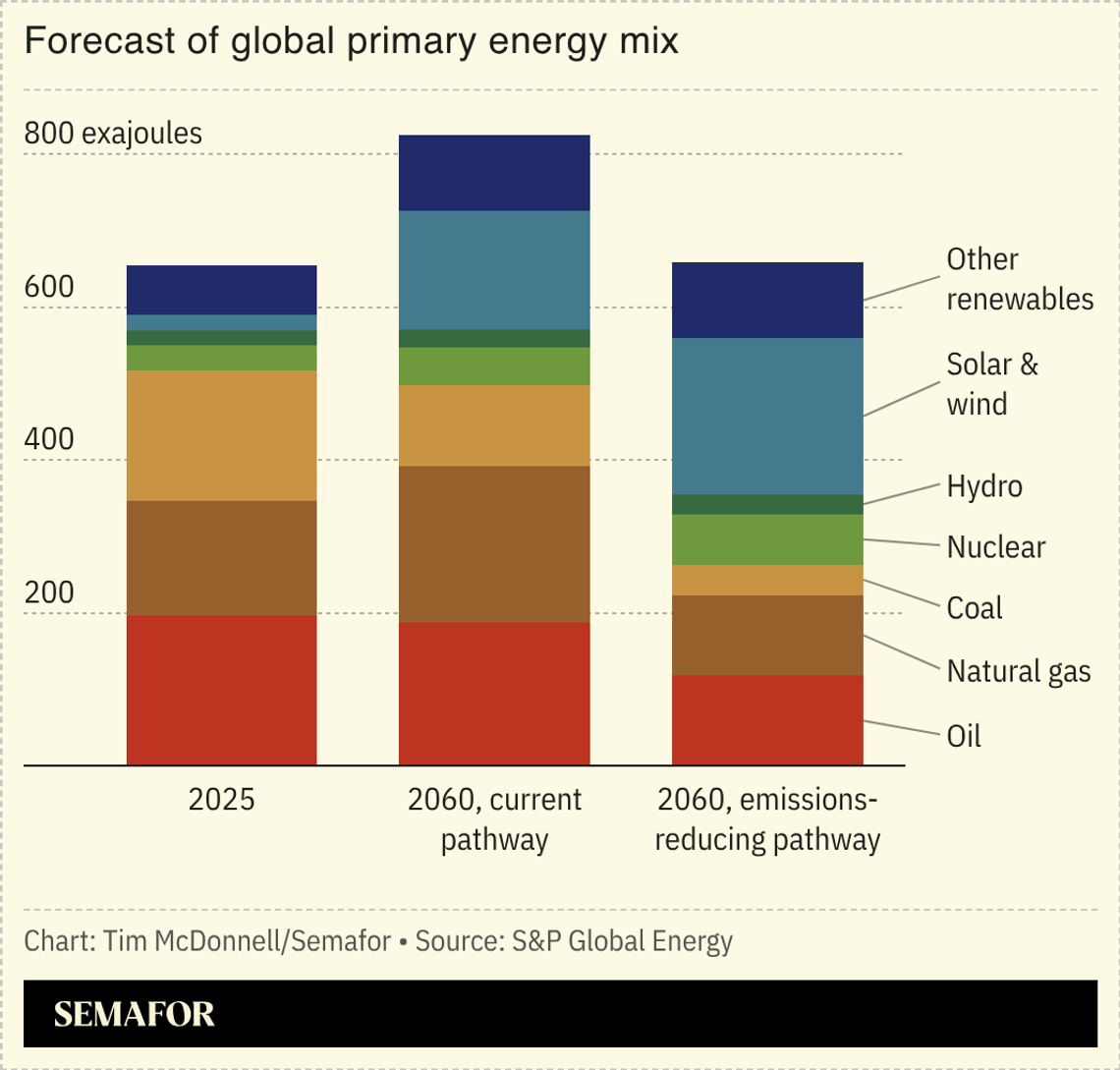 By contrast, energy demand in emerging markets is forecast to leap 60% by 2060, effectively adding another China to the global energy system. That will require tradeoffs between energy affordability, sustainability, and security. After the successive shocks of the past few years, the clear priority is security. In some cases, that means using less imported fossil fuels. But for many emerging economies, the study concludes, security and economic concerns will favor greater fossil fuel consumption, pushing total emissions to a point where global climate goals are entirely out of reach. The most important task ahead for the climate action community, therefore, is to find ways of making it cheaper and safer for developing countries to choose low-carbon energy. I have a number of interviews planned on this subject in New York next week with senior decisionmakers from governments, companies, and financial institutions. The next 50 years of global energy won’t look like the last 50. The countries navigating the fastest growth will have access to many new technologies and sources of finance. They will also face steeper trade barriers, new forms of conflict, and mounting climate impacts. “I hope this year’s Climate Week will broaden the aperture,” Yergin said, “and look at a broader picture rather than just staying in the same familiar lane.” Semafor Energy will go daily next week and I’ll be criss-crossing New York for meetings and events. Reply to this email to let me know if you’ll be in town, and make sure to RSVP for our fourth annual Happy Hour to cap Climate Week. → |
|
|
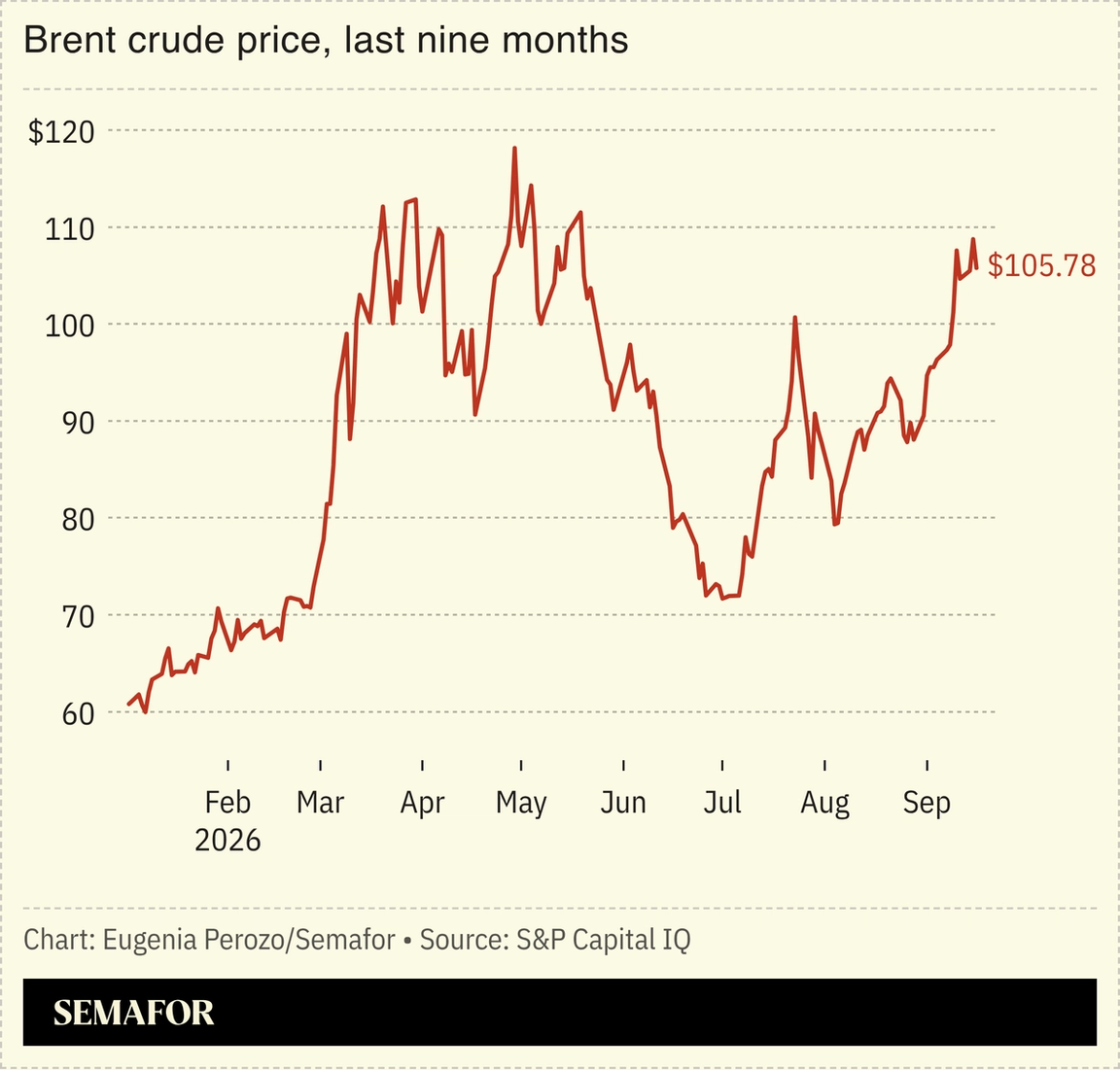 Oil prices eased on Thursday after reports that Saudi Arabia has rerouted additional crude shipments to Asian refiners from the coast of Oman to help offset some of the supply disruption caused by Houthi attacks on its East-West pipeline. But the escalation of the fighting risks worsening the energy supply crisis, as refiners chase alternatives. After Riyadh was forced to close the pipeline, oil prices in China jumped, trading at $129 a barrel on Wednesday. Beijing, which has so far cushioned the impact of the war by drawing down on its stocks and reducing oil imports — shielding the market from even higher prices — is returning to buying oil on the open markets, analysts say. Riyadh told some European customers that cargoes due to load this month have been delayed or cancelled, adding pain to the EU’s record low gas stocks. Since the start of the conflict, fossil fuel imports have cost the bloc an additional €90 billion. Meanwhile, Americans have spent an additional $100 billion on gasoline and diesel during the Iran conflict than they would have otherwise. |
|
| |  | Matthew Martin |
| |
 Hamad I Mohammed/Reuters Hamad I Mohammed/ReutersSaudi Aramco says its investments in artificial intelligence and other technologies are already paying off by cutting costs, boosting efficiency, and enhancing its response to disruptions from the regional war. The state-controlled oil producer’s “realized value” from technology — its measure of the financial impact of its tech investments — topped $5 billion last year. That exceeded Aramco’s targets and should grow further in coming years, senior vice president of digital and information technology Sami Al-Ajmi said in an interview at Aramco’s headquarters in Dhahran. Aramco is using historical data, digital twins, and network monitoring across its facilities to identify problems and speed up recovery times, Al-Ajmi said. Technology has helped the Saudi producer deal with disruptions to global shipping and restore operations at facilities struck by Iran and its proxies, he added. And in future, it plans to use a quantum computer for even more complex tasks. |
|
| |  | Kelsey Warner |
| |
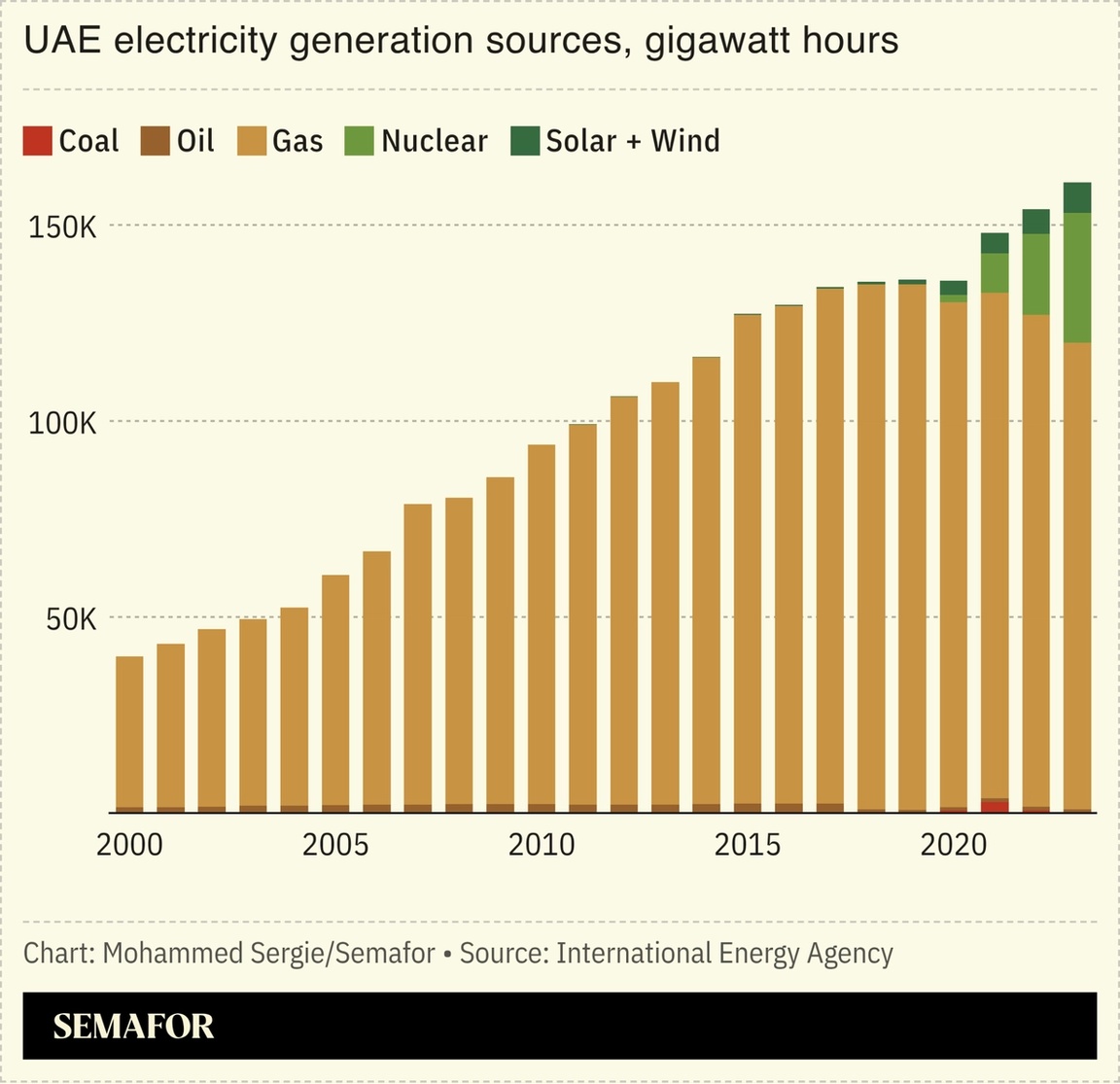 Electricity use in Abu Dhabi reached an all-time peak in August, despite a summer exodus of residents, and demand on the emirate’s power grid remains on pace to nearly double between 2025 and 2035, Department of Energy Chairman Abdulla Humaid Al Jarwan told Semafor. To meet the requirements of a growing population, industrial expansion, and AI infrastructure ambitions, Abu Dhabi is investing 300 billion dirhams ($81.7 billion) by 2035 to boost capacity and shift to cleaner sources, Al Jarwan said, while aiming to hit net-zero carbon emissions by 2050. It’s also transforming its water system to reduce reliance on gas and make seawater desalination cheaper and more efficient. The UAE was the Gulf country most heavily targeted by Iranian drones and missiles in the early months of the war. This was a major challenge for power and water suppliers, Al Jarwan said. “I think it’s a privilege that we managed to test our system under real disruption in real time, and we perform[ed],” adding that the services weren’t interrupted during the conflict. |
|
 Anastasia Barashkova/Reuters Anastasia Barashkova/ReutersUS President Donald Trump is expected to sign new legislation to step up economic pressure on Russia’s energy sector, over the objections of Democrats worried about handing him new trade powers. The House of Representatives passed the sanctions bill, which had been championed by the late Sen. Lindsay Graham, on Wednesday. Among other measures, it allows Trump to impose tariffs of up to 100% on the top buyers and “facilitators” of Russian oil and gas (a list that includes China and, opponents like Rep. Greg Meeks (D-NY) say, could be manipulated to include any country on Trump’s bad side). With some exceptions, the Trump administration has so far been reluctant to use its existing authority to escalate sanctions against Russia, fearing doing so could exacerbate the global oil and gas crunch. The bill, experts told Semafor, will make future penalties less discretionary for the president. But whether US officials will be willing and able to enforce them remains to be seen. “How meaningful [this bill is] depends entirely on implementation,” Vladyslav Vlasiuk, a sanctions official in the office of President Volodymyr Zelenskyy who had pushed for its passage, told Semafor. “What we want to see next is straightforward: Full and prompt use of the tariff authority on Russian oil and gas revenue, and tight coordination with the EU and G7 so there’s no easy way around sanctions.” |
|
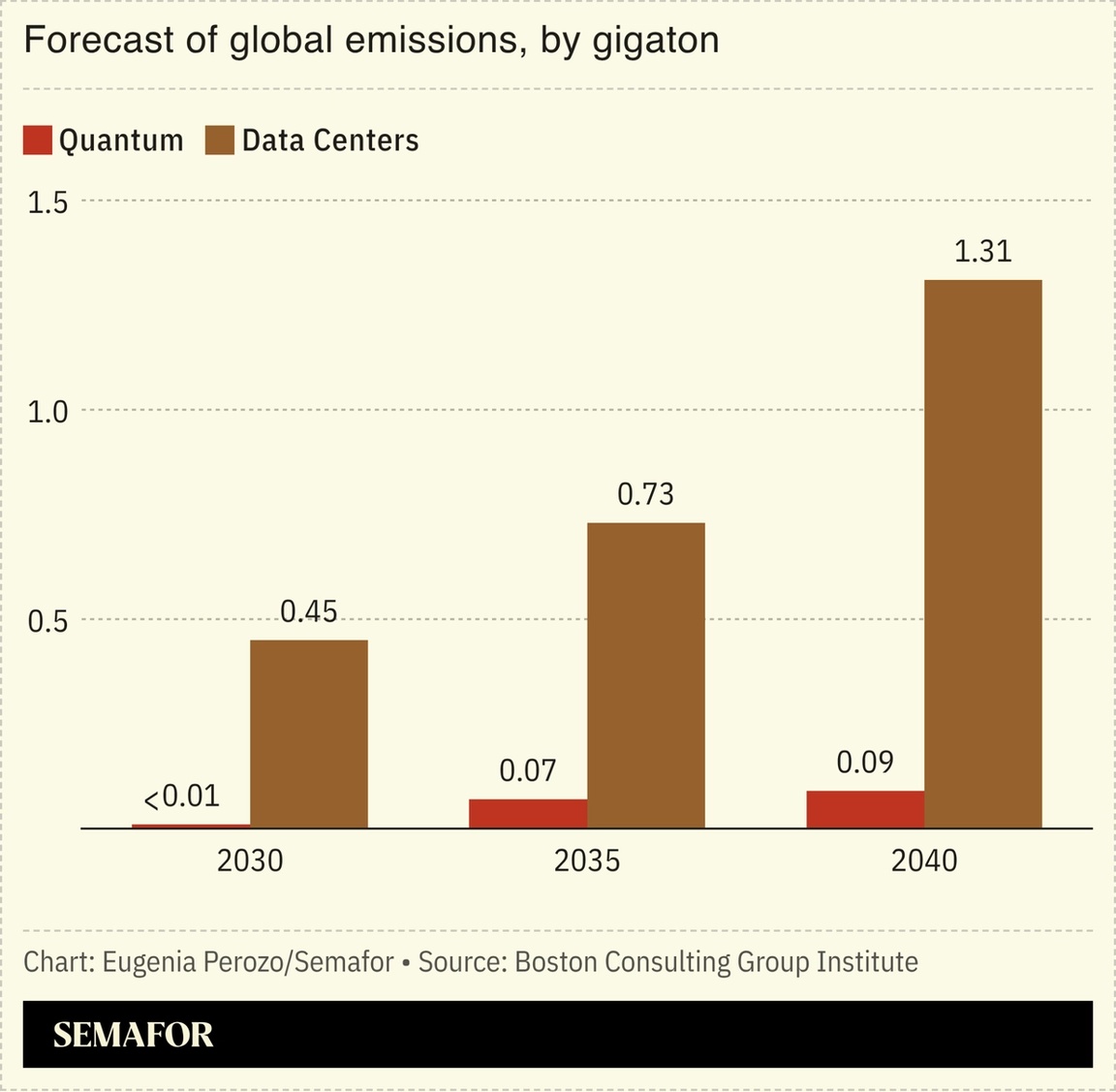 Quantum computing could eventually address 20-40% of emissions from sectors like steel and cement that are otherwise hard to abate, according to a report shared first with Semafor. To be sure, commercially viable applications will have to enter the market, old industrial equipment will need replacing, and computing power will need to be built. However, the BCG Institute argued in its analysis that these long deployment cycles are more reason to plan ahead. “Many of the industrial assets that we’re going to need or deploy are being built now,” Maurice Berns, one of the report’s authors, told Semafor. The study estimates the sector’s carbon footprint will be relatively small compared to the AI industry’s because quantum is more likely to be used to address specific problems rather than as a general purpose technology. In terms of climate applications, the report highlighted carbon capture, green hydrogen and ammonia, and batteries. —Eugenia Perozo |
|
 MIT Technology Review’s 35 Innovators Under 35 features young scientists, entrepreneurs, and inventors who are driving meaningful progress in AI, climate tech, biotech, computing, and more. Subscribe to save 17% and find out who made this year’s list, plus get bonus AI content. |
|
 New Energy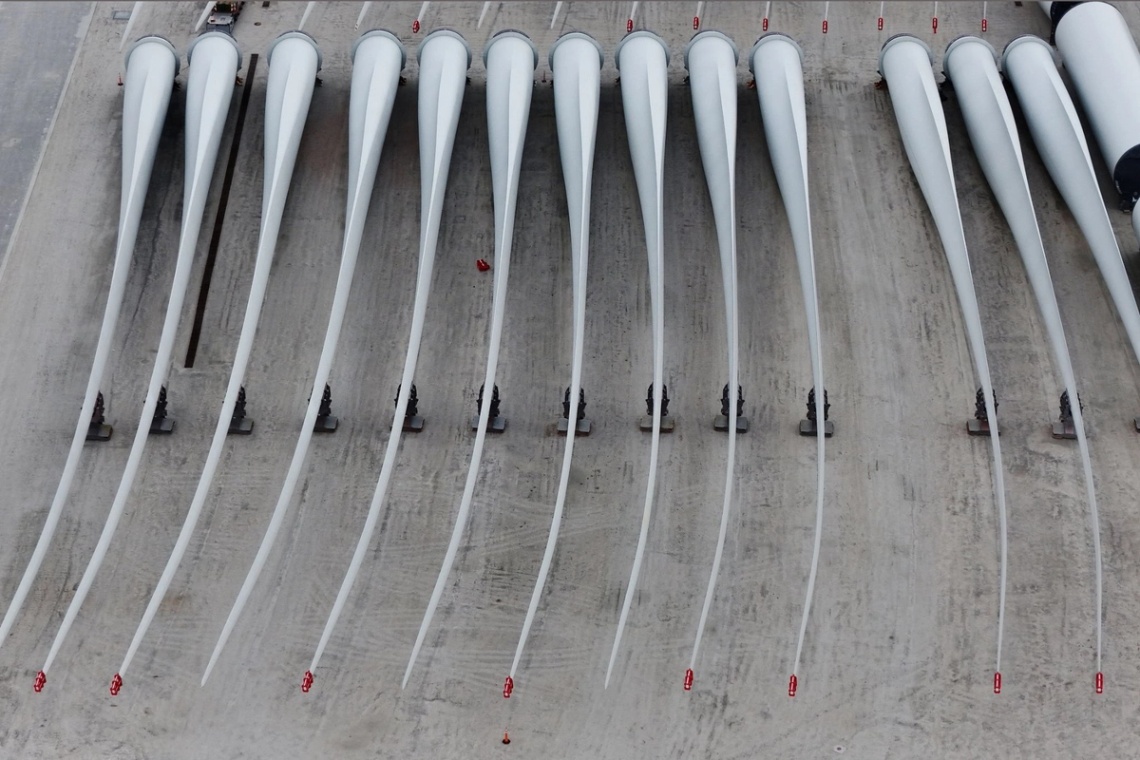 - A clean energy surge kept India’s power-sector carbon emissions flat in the two years to June. For the first time in more than 50 years, there was no growth in coal power over a two-year period, according to analysis by CREA for Carbon Brief.
Fossil Fuels- Texas regulators granted ExxonMobil permission for a $5 billion carbon capture project, after a
|
|
|


