|
Dear all,
Please find below your weekly update from the UK Health Security Agency (UKHSA).
If you have any questions please get in touch by emailing externalaffairs@ukhsa.gov.uk
As always, you can also follow UKHSA on X, on Instagram, on BlueSky, and on LinkedIn for all the latest updates. You can also find the latest news from UKHSA on our news page on GOV.UK.
Best wishes,
UKHSA External Affairs Team
New stories
- MenB vaccine: Freshers urged to get vaccinated with 2 doses before term starts
- UKHSA blog posts: this winter's vaccines explained
- Help us promote the flu vaccination offer - toolkit available
- Updated RSV communications toolkit for older people
- Pharmacy First expands to five more conditions
Ongoing issues
- Salmonella outbreak update
- Latest measles data
Upcoming webinars
- UKHSA & NHS England webinar: communicating vaccines - winter 2026/27
- UKHSA, NHSE and DfE webinar: vaccinations in schools: support for educators
- NHSE webinar: responding to measles outbreaks - what local learning can tell us about improving uptake and reducing health inequalities
- UKHSA webinar: cold weather preparedness
- UKHSA webinar: Preparing for World AMR Awareness Week 2026
UKHSA communications toolkits
- Information on how to access UKHSA communications toolkits
UKHSA data, analytics and surveillance
- Statistics at UKHSA
- UKHSA data dashboard
- Notification of Infectious Diseases report
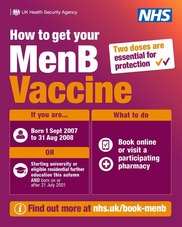
Young adults, particularly university students, remain at increased risk from meningococcal meningitis and septicaemia, with new figures from the UK Health Security Agency (UKHSA) showing that Meningitis B (MenB) was responsible for 97% of invasive meningococcal disease cases in 15 to 24-year-olds (93 of 96 cases) in England during 2025 to 2026.
UKHSA is urging freshers to ensure they are protected with 2 doses ahead of term starting. This is really important because students in their first year of university face a risk of meningococcal disease around 7 times higher than young people of a similar age who do not go to university.
All eligible young people can book their MenB vaccine by booking online or visiting a participating pharmacy.
A reminder that the one-off vaccination programme is being offered to:
- Everyone born between 01/09/2007 and 31/08/2008
- Young people under 25 (born on or after 21/07/2001) who will be starting higher education for the first time, or who will be starting further education for the first time as a residential student, in autumn 2026
- International students under 25 entering their first year of university. They should receive their first dose in their home country where possible to give the best chance
- of protection ahead of the start of the autumn term
A reminder that stakeholders can support communications on the MenB vaccine offer by using our communications toolkit which is available on the Campaign Resource Centre.
|
We have published three blogs to help people understand which vaccines they may be eligible for this winter, and how to book them.
The flu, COVID-19 and RSV vaccines all help protect those most at risk of serious illness. Eligibility varies depending on factors such as age, health conditions and pregnancy, so we encourage people to check whether they or someone they care for could benefit. The RSV vaccine is offered all year round, but RSV infections typically peak during late autumn and the winter months.
Each blog explains who can get vaccinated and the different ways to access each vaccine, whether through your GP, a local pharmacy, or an NHS vaccination service.
Read the blogs to find out more:
|
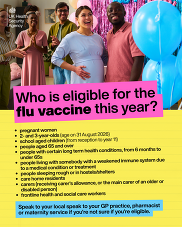
You can help promote the flu vaccination offer to your audience with our winter vaccines communications toolkit for stakeholders – produced jointly with NHS England. This also includes messaging, resources and further information on the RSV & COVID-19 programmes.
A reminder that flu vaccinations have already started for two and three-year olds, children in a clinical risk group, and pregnant women. Other eligible groups will begin receiving their flu vaccinations from 1 October, including people aged 65 and over, adults with some long-term conditions, care home residents, carers, close contacts of people who are immunocompromised, people experiencing homelessness and frontline health and social care workers. Our blog 'Your guide to who’s eligible for the autumn 2026 flu vaccine' runs through what people need to know about who can get vaccinated this year, and what's changed since last autumn.
We are urging stakeholders to encourage their audience to book their vaccine appointment early so they are vaccinated in good time before winter viruses start circulating widely, giving them the best possible protection through the autumn and winter months.
For further information about our national vaccine campaign and communications please contact: externalaffairs@ukhsa.gov.uk (UKHSA) or england.vaccinations-screening-communications@nhs.net (NHS England).
|
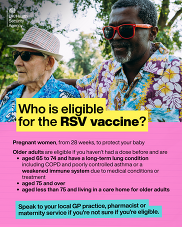
We have recently updated our RSV communications toolkit for older people, which is jointly produced with NHS England.
The toolkit has been updated to include information on adults aged 65 to 74 who have a weakened immune system or have long term lung condition who as of 1 September, are eligible for the RSV vaccine. This new eligible cohort can get their vaccine at their GP practice and in some parts of the country at their local high street pharmacy, to protect themselves from serious illness and hospitalisation.
Those who were already eligible for the vaccine include adults aged 75 years or over and adults living in a care home for older adults (adult residents of any age).
For messaging and resources on the maternal RSV programme, please refer to our vaccines in pregnancy communications toolkit.
|
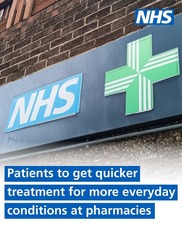
Last week NHS England announced that Pharmacy First will expand to five more conditions from autumn: migraines, acne, scabies, ear infections and rhinitis.
People will be able to get treatment for these conditions direct from participating pharmacies.
Pharmacy First already covers seven common conditions and has delivered 14 million consultations since launching in February 2024.
The service helps to free up GP appointments for patients who need them most, and gives people quicker and more convenient access to safe and high quality healthcare.
|
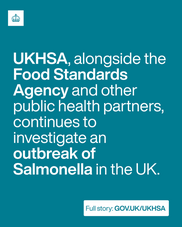
The UK Health Security Agency (UKHSA), alongside the Food Standards Agency (FSA) and other public health partners, continues to investigate three clusters of Salmonella Enteritidis (t5.9411, t5.9765 and t0.24068) in the UK that evidence suggests may be linked to imported eggs.
As of 7 September 2026, there have been:
- a total of 322 confirmed cases and one death linked to the t5.9411 cluster in England, with sample dates ranging from 11 August 2025 to 21 August 2026
- a total of 186 confirmed cases linked to the t0.24068 cluster in England, with no deaths reported, and sample dates ranging from 27 May 2025 to 18 August 2026
- a total of 41 confirmed cases and one death linked to the t5.9765 cluster in England, with sample dates ranging from 27 January 2026 to 11 August 2026
Cases continue to be associated with eating at a range of food outlets, including small cafés, restaurants and takeaway businesses.
The risk to the general public from Salmonella remains low.
Based on FSA guidance, older adults, pregnant women, young children and people with weakened immune systems, can safely eat raw or lightly cooked hen eggs, or foods containing them, if the eggs carry the British Lion mark or are produced under the Laid in Britain assurance scheme. When eating out, the safest approach for vulnerable people is to ensure the eggs they are eating are thoroughly cooked and to avoid dishes containing raw or lightly cooked egg, such as mousses, fresh mayonnaise or hollandaise sauce.
Further information:
|
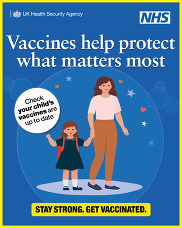
Our latest measles data shows that measles continues to circulate in many parts of the country.
Between 1 January 2026 and 31 August 2026, there have been 983 laboratory confirmed measles cases reported in England. An additional 13 cases were reported since the last publication on 17 August 2026 (Figures 1 and 2). In 2026, measles activity started to increase in February, peaked in May and has declined since then.
Three measles-related deaths have been reported to date in 2026: one was an acute measles death in a child, another was a death in a child due to late effects of measles, and the third was a death in an adult with an underlying immunological problem.
We continue to work with partners to urge parents to check their children are up top date with their MMR or MMRV vaccines to give them the best and safest protection against measles.
Further resources
- We have a measles communications toolkit which brings together a range of resources which partners can use to raise awareness of measles, its signs and symptoms, and the MMR/MMRV vaccination offer. This is available on our Google Drive.
- We also have a measles communications toolkit which brings together a range of resources which partners can use to raise awareness of measles, its signs and symptoms, and the MMR/MMRV vaccination offer. This is available on our Google Drive.
|
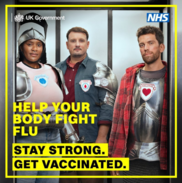
As we enter flu season, the UKHSA Communications Team is organising a webinar as part of the Communicating Vaccines series in collaboration with NHS England (NHSE) which will focus on winter vaccines communications. It will take place on Monday 5 October, 2pm - 3.15pm.
The webinar will look back about how last year’s campaign performed and plans for this season, and NHS colleagues will give an update on operational delivery of the vaccine programmes and how communications can support rollout. We will also have a dedicated section on the mis- and disinformation landscape and how communicators can respond, led by UKHSA digital engagement colleagues. We've allocated time for questions at the end to address any questions you may have.
This webinar is designed for:
- Communications professionals working in the NHS, local government, Integrated Care Boards (ICBs), and the voluntary and community sector
- Health professionals who engage in public-facing vaccine communications as part of their role
- Public health teams involved in local and/or regional vaccine promotion
- Anyone responsible for developing or delivering vaccine uptake messages in healthcare settings
You can register for the webinar via this form. You will receive the joining link closer to the event. The webinar will be recorded, and the recording and slides shared with attendees as soon as we can post-event. If you cannot attend the event but would like to receive the recording, please sign up using the same form so we have your details.
|
Join colleagues for the third and final national online webinar sharing learning from the measles outbreak. The webinar will take place on Wednesday 14th October, 4pm - 5.15pm.
This webinar aims to bring together colleagues from the UKHSA, NHS England and the Department for Education to explore the resurgence of measles and the vital role that educational settings play in protecting children through vaccination.
This webinar will contextualise the current measles situation within the wider childhood immunisation programme, sharing learning from recent outbreaks linked to educational settings and exploring the collaborative approach needed to prevent and respond to them. It will highlight why declining uptake of the routine childhood and adolescent vaccination schedules matters for schools, outline the role schools play alongside School-Aged Immunisation Services in delivering successful vaccination programmes, and signpost attendees to Health Protection guidance and immunisation resources for educational settings. Attendees will leave with practical actions to take away and implement in their own setting.
You can register for the event on the NHS England website.
|
Join NHS England for a webinar exploring how system partners have responded to recent measles outbreaks in Birmingham and Solihull and the London Borough of Enfield.
|