| | US President Donald Trump beefs with Big Oil, Saudi Aramco makes a profit despite the Iran war, whil͏ ͏ ͏ ͏ ͏ ͏ |
| |  | Energy |  |
| |
|
 - More big oil profits
- Steep crude discount
- Private credit eyes energy
- European renewables swap
- BYD booms
 DRC secretly ships uranium to China, and European insurers face a wildfire crisis. |
|
 US President Donald Trump is predictably annoyed at Big Oil. If BP’s blowout earnings and raised dividend today are any indication, he seems unlikely to be placated anytime soon. Oil companies are “making too much money,” Trump complained after ExxonMobil and Chevron posted bumper second-quarter profits, and exhorted them to “cut the retail price.” More frustration is coming Trump’s way: Fuel refining giants Marathon Petroleum and Phillips 66 also report this week, and are expected to follow suit. There’s a familiar pattern at play: Crude oil prices dipped to a multi-week low as Trump held off on further strikes against Iran, and as Iran and Oman appeared to close in on a deal to boost traffic through the Strait of Hormuz. And yet, there’s little impact at the pump: US average gasoline prices remain above $4 per gallon. The bosses of Exxon and Chevron tried to get ahead of this last week, issuing loud warnings that fuel prices always take longer to fall than politicians want. Oil futures jump up and down daily based largely on traders’ vibes. But retail fuel prices are a product of complex physical trading and manufacturing realities. US refineries have already been running full-blast for months to offset the loss of products moving out of Gulf refineries, and won’t be able to keep that up much longer without needing to come offline for maintenance. US gasoline inventories are falling rapidly. China is still restricting fuel exports, and Ukrainian drone strikes continue to savage Russia’s refineries, both of which have contributed to a global diesel crunch. Last week, the spread between crude and gasoline prices hit its highest point since the war started, a sign that there’s far from enough refining capacity to keep up with demand. BP, for its part, is “making sure that we are focused on the things we can do to try to help address the situation,” including adjusting its refinery runs to prioritize the most-needed consumer products, CEO Meg O’Neill told CNBC on Tuesday. Still, the disconnect between headline crude prices and consumers’ actual experience of energy prices will add an extra layer of political urgency to peace negotiations. If disruptions in the Strait of Hormuz continue for another month, JP Morgan analysts predict US gasoline prices will rise back above $4.20 — the point they were at when talks on June’s short-lived memorandum of understanding really gathered steam. “Oil may be a global commodity,” Natasha Kaneva, JPM’s head of commodities research, wrote, “but political tolerance for high energy prices remains overwhelmingly domestic.” |
|
Aramco boosts profits despite war |
| |  | Mohammed Sergie |
| |
 Ahmed Jadallah/File Photo/Reuters Ahmed Jadallah/File Photo/ReutersSaudi Aramco’s second-quarter profit rose 33% from a year earlier, as higher oil prices and strong refining margins offset lower export volumes during the US-Iran war. Decades of investment in pipelines, storage, and Red Sea export terminals helped the company to keep crude flowing, despite disruptions to the Strait of Hormuz, Houthi threats in the Bab el-Mandeb, and attacks on Saudi energy facilities. The performance allowed Aramco to maintain its $21.9 billion base dividend, providing a critical boost to the Saudi government, which receives about 55% of its revenue from oil. Chief Executive Amin Nasser said in an analyst call that Aramco is exploring ways to expand its East-West pipeline and identify other export routes to increase “optionality” against future disruptions. He expects oil demand to rise by about 2 million barrels a day in the second half of the year as countries look to replenish stockpiles that have become depleted during the war. Meanwhile, in the US, leading shale driller Diamondback Energy also reported a profit surge and said it will raise its oil production target for the year. |
|
Iraq offers major oil discounts |
 Iraq’s state oil marketer is offering discounts of up to nearly $30 per barrel to traders willing to load tankers at its port inside the Persian Gulf, Reuters reported. Although Trump suggested on Monday the Strait of Hormuz could be fully reopened “literally tomorrow” as Iran and Oman work out a new system to charge “service fees,” tanker traffic through the waterway remained at just a few ships as the risk of attacks remains high. Iraq’s steep discount is a potentially an enormous windfall for risk-tolerant traders — up to $60 million for a single tanker — but also a revealing indication of how little confidence Baghdad has that the Strait of Hormuz will really reopen soon. |
|
Semafor Exclusive Clean energy turns to private credit |
 Jim Urquhart/File Photo/Reuters Jim Urquhart/File Photo/ReutersEnergy companies with big construction plans are looking for new lines of credit and, despite the recent turmoil in private credit markets, more financial firms are lining up to offer them. Private credit “is kind of a dirty word,” Benjamin Baker, managing partner of the midsized asset manager GDEV, told Semafor, after months of headlines highlighting shaky loans and spooked retail investors. But for the US power sector, which has plans to grow its combined annual capex from about $190 billion today to more than $220 billion by 2030, it still looks like an attractive option. GDEV, which has only ever funded energy ventures through equity, is now opening an arm that will issue lines of credit in the range of $40-75 million, Baker said. That starts today, with a facility for the commercial solar developer Telyon. Despite the Trump administration’s rollback of clean energy tax credits, “there’s an acceleration of actual building,” Baker said. “We’re looking at real, asset-backed collateral that should support this debt, either through its value or through its cash flows, so it’s a very different risk” compared to the software companies that have burned private credit investors. |
|
Oil majors trade renewables assets |
 Benoit Tessier/Reuters Benoit Tessier/ReutersEurope’s oil majors are trading renewable energy assets at a rapid clip this week, revealing their differing strategies for navigating a period of uncertainty in the clean energy transition. Shell agreed to sell its onshore European renewables business to TotalEnergies for an undisclosed sum, continuing CEO Wael Sawan’s multi-year push to offload non-fossil assets and streamline the company’s operations. Total, meanwhile, sold a 50% stake in a different batch of European renewables to private equity firm KKR for more than $2 billion. While its rivals have moved away from renewables, Total has been snapping up early-stage projects, bringing them to completion, and then flipping them to PE or other investors. BP, meanwhile, put its $4 billion US biogas business up for sale, part of new CEO Meg O’Neill’s strategy to pare back the company’s large debt load. |
|
BYD’s profits jump on overseas demand |
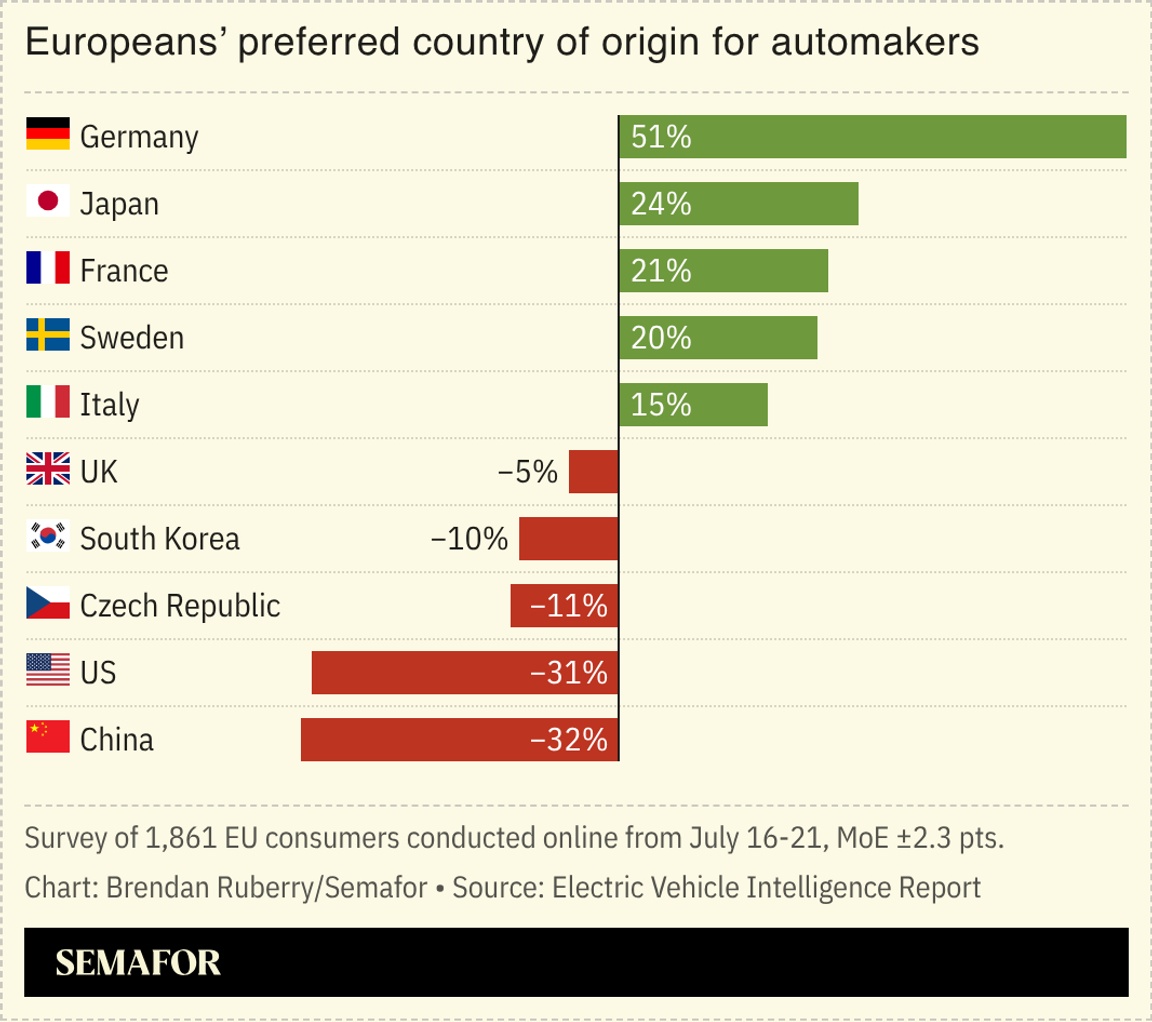 China’s BYD recorded a 22% year-over-year increase in EV sales in July, marking a third straight month of growth, as overseas gains continued to help offset slumping demand at home. The company must sharply lift its second-half sales to meet its annual goal, Bloomberg noted, as a sluggish Chinese economy and intensifying competition depress its domestic sales; last week, BYD unveiled the first electric mini-car not made by a Japanese company to be sold in Japan. Tesla sales have recovered in Europe, spurred by higher fuel prices, but polling suggested Europeans find the Chinese government’s support for BYD less toxic than Tesla’s association with CEO Elon Musk, as the US automaker weighs spinning out or selling its China business before potentially merging with SpaceX, The Wall Street Journal reported. |
|
 The Gulf now reaches far beyond the region, shaping energy markets, supply chains, and the global economy. Semafor Gulf is here to help you make sense of it. Five days a week, editor Mohammed Sergie and our team across Abu Dhabi, Dubai, and Riyadh will connect you with what’s happening on the ground, and how it affects business, energy, and diplomacy — bringing clarity to the most consequential story in the world. |
|
 New EnergyFossil FuelsFinanceTechPolitics & Policy |
|
|


