|
|
|
|
A global biotechnology revival is under way – and Canada has rarely had as many promising, cutting-edge medical companies poised at the edge of success as it does now. But while foreign pharma giants are flush and keen to acquire promising drug developers, Canada’s institutional investors are largely absent from the space. |
|
|
|
|
With big pharmas at the doorstep and indifferent investors at home, can our domestic sector avoid getting hollowed out – and finally produce globally relevant life sciences giants? That’s in focus today. |
|
|
|
|
|
|
|
|
|
|
|
|
|
|
|
|
WestJet: The airline will require several days to fully restore its flight schedule after reaching a deal with the flight attendants’ union. |
|
|
|
|
|
|
|
|
|
|
Oil: Prices fell to a three-week low yesterday after U.S. President Donald Trump held off a fresh attack on Iran in the hope of sealing a deal that could boost oil supplies
from the Gulf. It’s ticking higher today amid uncertainty. |
|
|
|
|
|
|
|
|
|
|
|
|
|
|
|
A clean lab in Burnaby, B.C., where Kardium makes a medical device that treats atrial fibrillation. Jimmy Jeong/The Globe and Mail
|
|
|
|
|
|
|
|
|
|
|
Canadian innovation is booming. Where’s the Canadian money? |
|
|
|
|
Hi, I’m Sean Silcoff, and I write about technology and life sciences for The Globe. |
|
|
|
|
I’ve covered the pharmaceutical business on and off for more than 30 years, dating back to my days as a journalism student at Carleton University. Since joining The Globe 14 years ago, I’ve focused on the challenges and opportunities facing Canada’s homegrown drug and medical device developers. |
|
|
|
|
|
|
|
|
It’s long fascinated me that, despite Canada’s reputation for world-class medical discoveries (insulin, stem cells, how GLP-1 works – to name just three), we’ve never produced a homegrown pharma giant. The life sciences industry is a rounding error of the Canadian economy. Meanwhile, our discoveries have fuelled enormous economic value for other companies in other countries. |
|
|
|
|
But Canada’s health sciences sector is at a hinge moment. It has had one of the strongest 12-month stretches in memory. Listed companies have raised $2.4-billion on public markets in that time – and that excludes the $1.5-billion of stock sold by generic drugmaker Apotex in its June IPO. |
|
|
|
|
|
|
|
|
|
|
We have several companies applying artificial intelligence to the biotech space (including Biossil Inc.,
Variational AI Inc. and Congruence Therapeutics Inc.) and a Toronto company called Satellos Bioscience Inc. looking to deliver a treatment that could reverse the effects of a terrible wasting disease called Duchenne muscular dystrophy, which first shows up in children. |
|
|
|
|
Perhaps the biggest spotlight is on Vancouver-based antibody developer AbCellera Biologics, which became a global biotech star six years ago when it developed a treatment for people infected with the COVID-19 virus. The company has since pivoted from discovering drugs for other partners to developing its own. |
|
|
|
|
This quarter, it is set to deliver key human efficacy results for its lead drug, a treatment for reducing the severity and frequency of hot flashes in women during menopause. If it works, it could be a billion-dollar-a year blockbuster. And AbCellera has several other treatments lined up to take into clinical trials. |
|
|
|
|
AbCellera “may turn out to be Canada’s Genentech,” Cantor Fitzgerald analyst Steve Seedhouse said recently, referring to the legendary U.S. company that kicked off the biotech revolution 50 years ago. |
|
|
|
|
There’s a lot to watch in Canadian life sciences, but a big question is – where are the domestic investors? |
|
|
|
|
There is no shortage of institutional investors keen to capitalize on our sector – but most of them, which the exception of a handful in Quebec, are outside Canada. |
|
|
|
|
One of the biggest Canadian institutions in the space – Canada Pension Plan Investment Board – is overwhelmingly invested everywhere but Canadian life sciences. Why is that? Find out here. |
|
|
|
|
|
|
|
|
|
|
|
|
|
|
|
|
|
|
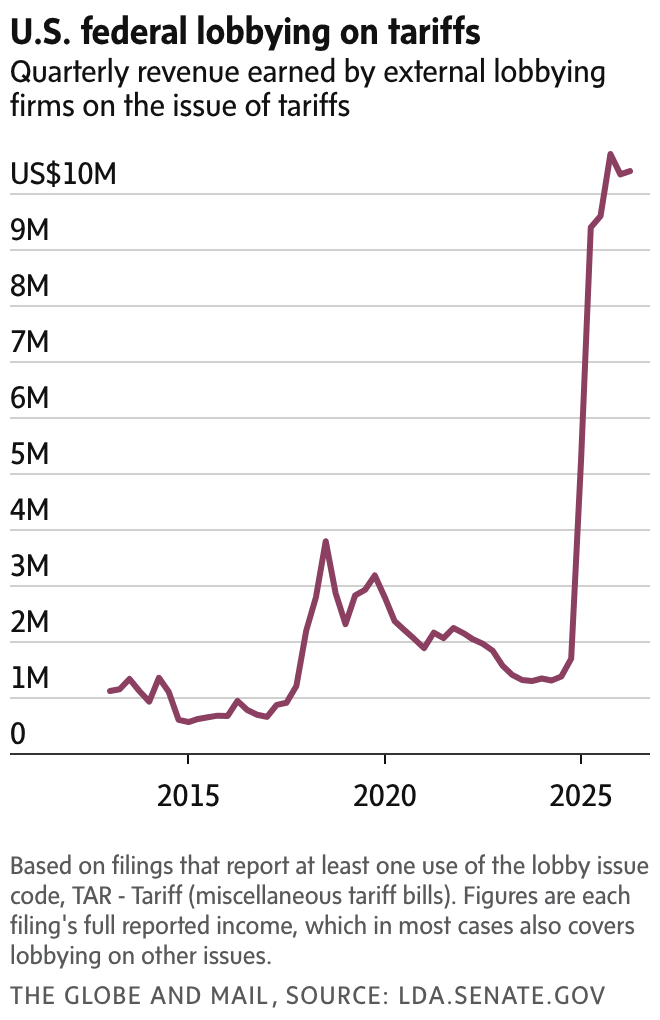
Drain the swamp? In the run-up to U.S. President Donald Trump’s first election victory in 2016, he repeatedly vowed to “drain the swamp” in Washington. With Trump’s second term dominated by aggressive tariff actions, including his newest threat to slap 50-per-cent duties on US$20-billion of Canadian goods, Washington is filled with lobbyists angling to influence trade policy. |
|
|
|
|
|
|
|
|
|
|
|
|
|
|
|
|
|
|