Last week, Unity announced that it is “bringing dedicated Engine support to Netflix Games, making it easier for developers to build and deliver games across Netflix’s multi-platform ecosystem on mobile and TV.” The set-up will help studios to “build once and ship across platforms while giving members a faster path from browse to play.” Unity’s platform makes an open-access model within the Netflix ecosystem technically possible. To date, Netflix has not shared whether it will adopt one.
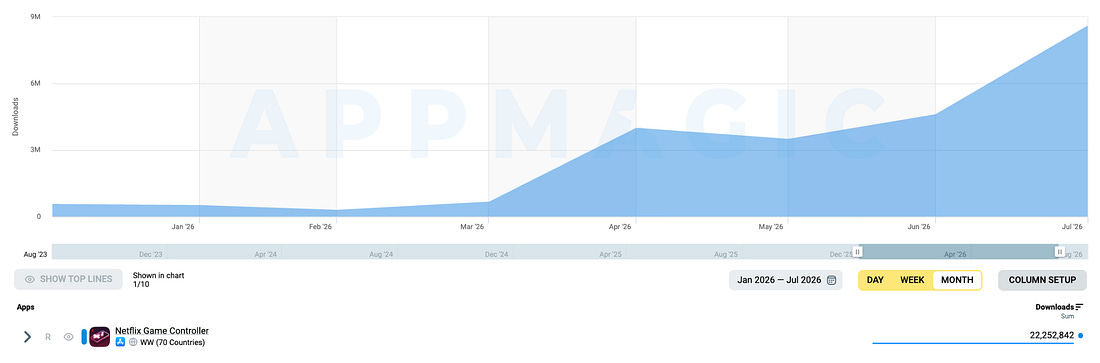
Implicitly, Unity is messaging that Netflix is changing the way it looks at its distribution architecture. The story Netflix has told about its gaming strategy, to date, is a business logic of “Engagement, revenue, profit drives [the] flywheel”. Recently, that story to investors has been both a careful retreat from mobile gaming and careful entry into the TV gaming space. The former suggested “Netflix is retreating from gaming exactly when gaming architecture becomes the model for AI-era media.” The latter has been a quiet success: According to data from AppMagic, a Sensor Tower Company, the Netflix Game Controller app has been downloaded over 22 million times since March 2026.
To date, Netflix has tightly managed developer access to its ecosystem. It began acquiring game studios back in 2021. It launched both first-party games using its own IP—like “Stranger Things”—and third-party games with the sales pitch “no ads, no fees, no in-app purchases”. In recent years, it opened up its ecosystem to popular games like Rockstar Games’ “GTA: San Andreas”—which delivered nearly 60 million downloads between December 2023 and December 2025, according to AppMagic.
The obvious message of Unity’s announcement is that Netflix will be trading its playbook of one-off curated deals for a platform-scale gatekeeper model, much like Xbox or Steam’s certification systems. By comparison, Sony’s Playstation Store has almost 10,000 titles in its digital store, Microsoft’s XBox Store has over 17,000 games in its store and Steam—an online store for PC games—has over 120,000 playable games.
If Netflix is indeed making this trade-off, it is messaging two changes to its business model. First, it is messaging a more dynamic gaming business model—effectively a mix of B2B (access to the Netflix ecosystem) and B2C. Second—and less obviously—it is seeing that consumers value interactive experiences more than the passive viewing experiences of Hollywood movies and TV series.
These are not small changes.