
|



Matic: A new era of visually intelligent cleaning (Sponsored)
 |
Try Matic, backed by their 6 month money back guarantee.
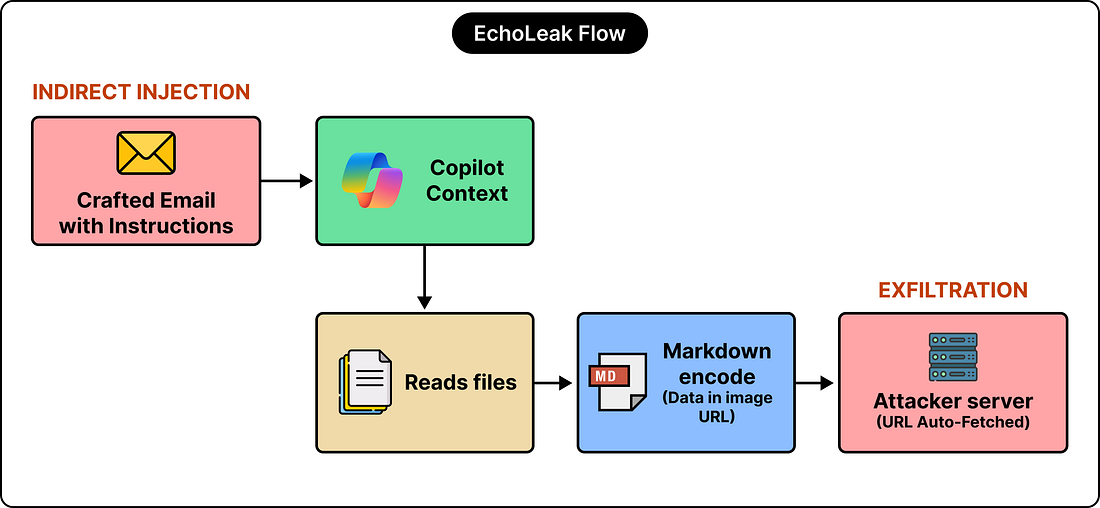
In June 2025, security researchers at Aim Security demonstrated that a single email could cause Microsoft 365 Copilot to retrieve a company’s internal files and transmit them to an external server, with no user interaction.
The email contained ordinary text and exploited no software flaw. Copilot’s output was driven by hidden instructions in the email together with the user’s actual request, and the system applied no distinction between the two. Microsoft closed the specific path within days and reported that customers were unaffected.
But this incident sheds interesting light on how language models process text. The vulnerability was named EchoLeak, assigned CVE-2025-32711, and it serves as a useful study to understand the landscape of LLM security.
 |
For contrast, consider a different case. For roughly $20 in API queries, a team extracted part of a production OpenAI model through its public interface. That sounds like the threat most teams should really fear.
In this article, we try to build a map of the full attack surface that threatens an LLM’s security. With it, a given LLM feature can be located, its exposure points identified, and new threats reasoned about as they appear.
So let’s start with the single most important property.
Disclaimer: This post is based on publicly shared details from various sources. References at the end. Please comment if you notice any inaccuracies.
Trust Boundaries
Almost every LLM vulnerability traces to one property. A language model receives instructions and data as a single sequence of tokens, and that sequence contains no marker separating commands from information.
Traditional software keeps the two apart.
For example, a parameterized database query holds the command in one position and the user’s input in another. This means that the text typed into a name field stays text even if it spells out a SQL statement, because the structure of the query enforces the separation.
However, an LLM context has one position for everything. The system prompt defining the assistant’s role, the user’s message, a document retrieved from a database, and the output returned by a called tool all arrive concatenated in the same sequence. Any portion of that sequence can affect the generated output as if it were an instruction, because the model computes each next token from the entire preceding sequence with no separate treatment for any part of it.
This is where prompt injection comes in, which means the supply of instruction-like text so that the model output conforms to those instructions instead of the operator’s intent. It reaches the model by two routes:
The direct route is a hostile instruction typed into the chat box. This is the version most people picture.
The indirect route places the instruction inside the content that the model retrieves during a legitimate task, such as a web page being summarized, a document being read, or an email in a managed inbox.
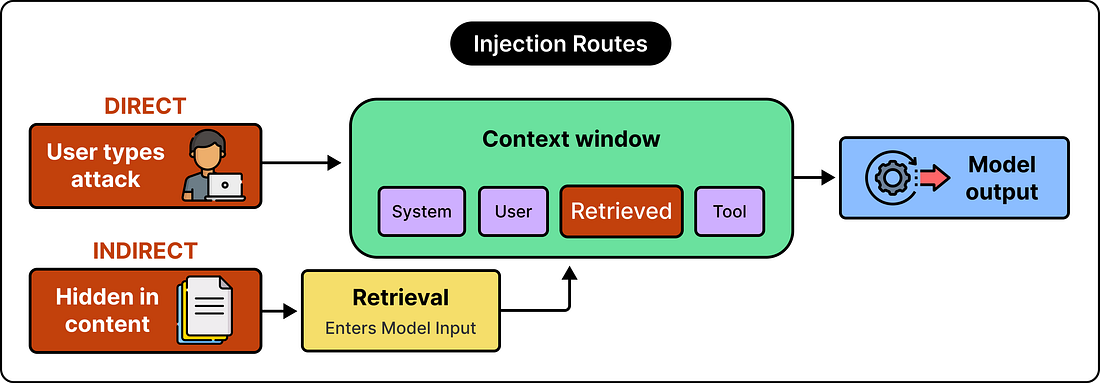 |
EchoLeak was an example of the indirect route. The user requested ordinary work, and the attacker’s instructions arrived in an email the user had not opened. In fact, the payload passed through Microsoft’s dedicated cross-prompt-injection classifier, which indicates that input filtering can be porous when used alone.
The property applies to any system that supplies external text to a model. A feature that processes retrieved search results, uploaded files, tickets, or comments carries indirect injection exposure by construction.
Parameterization solved SQL injection by separating code from data at the database boundary. No equivalent exists for natural language, because instructions and information are both expressed as words, and there is currently no reliable method to mark a span of text as inert and have that marking respected during generation. Filtering reduces the problem to some extent but does not eliminate it.
Since the confusion can occur wherever text enters the model or an action leaves it, the next step is to map those points.
Attack Surface
The OWASP Top 10 for Large Language Model Applications is the industry reference for the most critical LLM risks. Its recent edition presents ten separate items. Placed against the path that data takes through an application, those ten items become positions on a single map.
The pipeline runs in stages.
Input arrives from the user. The system frequently retrieves context to ground its answer, a step usually built on a vector database that stores documents as numerical embeddings and returns the ones most relevant to a query. That pattern is retrieval-augmented generation, or RAG. The model then processes the assembled input. It may call tools or other agents that take actions externally. Output returns to the user. Monitoring surrounds the pipeline, and every component within it originates from a supplier, which forms the supply chain beneath the system.