| | In today’s edition: US opts for diplomacy with Iran, Tehran doesn’t trust Washington’s outreach, and͏ ͏ ͏ ͏ ͏ ͏ |
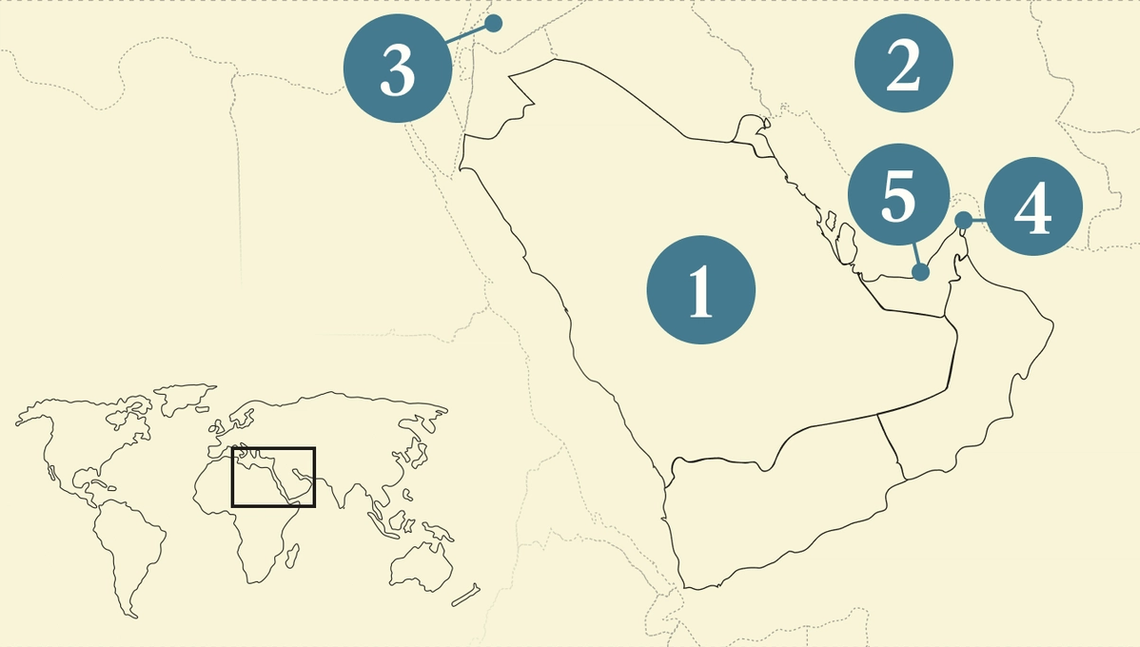
| |  Washington, DC Washington, DC |  Riyadh Riyadh | Khor Fakkan |
 | Gulf |  |
| |
|
 - Trump heeds Saudi call
- Iran doesn’t trust diplomacy
- Qatari bet on Syrian farms
- Jebel Ali > all the new ports
- Abu Dhabi gives up Murban
 Guggenheim gets an open date. |
|
Trump holds back on Iran strikes |
 Evelyn Hockstein/Reuters Evelyn Hockstein/ReutersUS President Donald Trump called off threatened strikes on Iran, after Saudi Crown Prince Mohammed bin Salman urged him to prioritize diplomacy. Trump said the “perimeters of a deal” were in place to reopen the Strait of Hormuz and talks with Iran were due to take place on Monday, although Iran said the only formal discussions it is involved in were with Oman. Qatari mediators presented Tehran with a new plan to restore traffic through the strait, to which Iranian diplomats reacted positively, The Wall Street Journal reported. Five months of oscillation between bombing and negotiation have left Trump with no good options: “He’s looking for a knockout blow when there is none,” one analyst told The New York Times. The renewed diplomatic activity has had a market impact: Oil prices were down 5% in early trading on Monday. |
|
Tehran’s diplomatic pessimism |
 Alkis Konstantinidis/Reuters Alkis Konstantinidis/ReutersOutsiders often argue that hardliners are firmly running the show in Iran these days to explain Tehran’s approach to the Strait of Hormuz and its strikes on neighboring countries — but that overlooks another possible explanation. Investor and analyst Esfandyar Batmanghelidj said his conversations with people in Tehran suggested the regime is increasingly pessimistic about what diplomacy with the US can achieve, both because of President Donald Trump’s erratic nature and the rift within the administration between Secretary of State Marco Rubio and Vice President JD Vance. Iran has also noted Washington’s failure to deliver on even basic confidence-building measures in the June interim peace deal. Iran has a diminished, but still extant, network of regional allies and proxies that continue to support it. Tehran is also increasingly dictating the pace of war. One analyst told the Financial Times that its recent attacks on Egypt and Jordan were designed to show that “while the US and Israel started this war, they are not going to be the decisive party in how it ends.” |
|
Qatari group invests in Syrian agriculture |
 Qatar’s Baladna Food Industries is developing a $3.3 billion project in Syria to produce cotton, wheat, textiles, and other agriculture goods, The National reported. Baladna is an arm of the business empire of Syrian-born business moguls Moutaz and Ramez Al-Khayyat, who have backed power, real estate, and transport projects in their homeland. The investment is the latest in the jockeying among Gulf investors to rebuild Syria, in part motivated by the hope that the country can become a geopolitical buffer keeping Iranian influence out of the Levant. Baladna and Abu Dhabi-based Al Dahra, which is backed by a UAE sovereign wealth fund, have also agreed to jointly develop farming techniques and assets in Syria. |
|
Gulf ports not easily replaced |
 Planet Labs PBS/Handout via Reuters Planet Labs PBS/Handout via ReutersAll of the additional port capacity planned by Gulf states outside the Strait of Hormuz is far less than the volume stranded inside the chokepoint. Between them, the three ports of Jebel Ali in Dubai, Khalifa Port in Abu Dhabi, and Hamad Port in Qatar have the ability to handle 35 million 20-foot equivalent units (TEU). On the other side of the strait, far less new capacity is planned, and most of it was conceived long before the conflict with Iran began, such as Saudi’s expansions in Jeddah and NEOM. New projects include 2.5 million TEUs in Fujairah and up to 10 million at Khorfakkan, both on the UAE’s Gulf of Oman coast.
|
|
Abu Dhabi ditches oil benchmark |
 Brendan McDermid/Reuters Brendan McDermid/ReutersAbu Dhabi has given up on its attempt to create a new crude oil pricing benchmark, after huge price swings during this year’s Iran war made the system unreliable. State oil company ADNOC will abandon its Murban contract, which is priced on the ICE Futures exchange in Abu Dhabi, and instead price its output against the Platts Dubai benchmark. In March, ICE was forced to reassure traders in the volatile Murban market that there was enough crude on hand. That reflected mounting strain on the futures contract, which relied on physical cargoes loaded from the UAE, where Iranian strikes had disrupted exports. Added pressure came from oil majors building large positions that amplified the price swings, Bloomberg reported. |
|
 AI - The new trope that expensive consultants — and everyone else — are churning out AI slop disguised as insight is getting validation. PwC, hardly the only culprit, reportedly published reports with “hallucinations” for its Middle East practice. One telltale sign: The same claim appeared in three footnotes, each citing a different source. — Financial Times
Banking - Emirates NBD bank bought HSBC’s retail banking operation in Egypt, adding 43 branches to the Dubai-based bank’s existing network of 64 outlets in the country. The deals’ value was not disclosed, but HSBC announced a pre-tax gain of around $300 million. — Reuters
Energy - OPEC+ agreed to raise oil production by 188,000 barrels a day in September, marking its sixth consecutive monthly increase. It is a largely symbolic move because of supply disruptions, but the higher quotas will give producers like Saudi Arabia more flexibility to raise output once oil flows normalize.
Utilities - China State Construction Engineering Corp signed a $3.3 billion contract with Kuwait’s public works ministry to build the country’s largest wastewater treatment plant, designed to handle up to 1 million cubic meters a day. — MEED
Sovereign Wealth - Mubadala officials, including Chief Strategy and Risk Officer Ahmed Saeed Al Calily, met business and tech executives in Washington last week. The Abu Dhabi sovereign wealth fund plans to commit more capital to the US, where it has about $170 billion invested — 44% of its portfolio — across AI infrastructure, semiconductors, healthcare, energy, and manufacturing.
|
|
 Courtesy of Guggenheim Courtesy of GuggenheimAbu Dhabi announced plans for a Guggenheim in 2006, when its home of Saadiyat Island was mostly sand and Dubai had not yet finished the Burj Khalifa. The museum building that opens Dec. 11 reaches back further still: Architect Frank Gehry designed the museum as 10 giant wind towers — echoing an ancient technique used by local builders to cool buildings long before air conditioning was invented. Inside will sit a collection built since 2009 of works by the likes of Basquiat, Pollock, and Warhol, in the largest Guggenheim ever constructed. It joins a list of celebrated arts buildings by global ‘starchitects,’ most notably Norman Foster’s Zayed National Museum and Jean Nouvel’s Louvre close by on Saadiyat, as well as Rem Koolhaas’ national library and I.M. Pei’s Museum of Islamic Art in Qatar, along with another Nouvel statement, the National Museum of Qatar. |
|
| |