| | In tonight’s edition: A deep dive into the scourge of YouTube slop.͏ ͏ ͏ ͏ ͏ ͏ |
| |  San Francisco San Francisco |  Washington Washington | New York |
 | Media |  |
| |
|
 - Blue-state slop war
- Asking YouTube
- Cabbie Takes
- Mixed Signals
- Bloomberg selling?
- Internet explorers
- Chat ads
|
|
 If CBS News’ poaching of Ross Douthat from The New York Times is any indication, the paper may need to start locking its journalists into TV-style talent deals. In another era, the departure of a longtime columnist would be a minor headache, not an organizational challenge. But over the last year, Douthat had morphed into a surprise podcast star for the paper, which increasingly relied on him to score hard-to-land interviews with leading figures on the right. Douthat’s show, Interesting Times, racked up millions of video views on YouTube, where it has a larger following than many other Times podcast offerings. (Douthat is expected to be a part of CBS News’ expanded podcast division, though a network source told Semafor nothing is finalized.) Douthat’s show will be the second major podcast shaken up by departures this summer. In June, Kevin Roose announced he was leaving the Times in August to launch his own media company with Hard Fork co-host Casey Newton. Both shows are now hunting for new hosts, with Hard Fork holding screen tests for new candidates, including Times tech journalists Mike Isaac and Kashmir Hill. The Times has accepted a future where many of its journalists spend more time on camera, and recently reorganized its podcast and audio departments into a more 2026-friendly “shows” structure. It’s also sunk considerable resources into video production, with plans for monetization, including potential licensing deals with TV networks or streamers. The paper wants to become “a preferred brand for watching news,” CEO Meredith Kopit Levien told investors in May. But the show format, which requires continuity, leaves the paper more exposed to the whims of its best journalists. And the shows’ success means journalists will have even more opportunities to become stars in their own right, something the Times has historically chafed at. It’s all part of the great flattening of media. As the Times behaves more like a television network, it’ll face the same talent challenges as traditional TV. (And the same opportunities, too; the resumes started rolling in the second Douthat and the Hard Fork hosts announced they were leaving, we’re told.) TV networks seem to be going in the opposite direction. CBS News’ major hires this summer weren’t veterans of rival TV networks; they were digital and print media names. Also today: a deep dive into the scourge of YouTube slop. |
|
Semafor Exclusive AI ‘news’ accounts show a blue-state dystopia |
 Screenshots via Semafor Screenshots via SemaforCalifornia Gov. Gavin Newsom and New York City Mayor Zohran Mamdani are the focus of a wave of AI-generated fake newscasts on YouTube that have collectively racked up millions of views. For this week’s edition, I explored a vast network of computer-generated, error-ridden, occasionally accidentally hilarious viral videos about blue states like California and New York devolving into economic disasters. They’re fooling viewers who don’t know (or don’t care) that they’re watching AI; one clip even made it to the president’s Truth Social account. After Semafor reached out for comment on some of these channels, YouTube removed them, citing violations of the platform’s spam policy. Fears of deepfakes in politics were largely overblown in the past. But as I explore in the piece, these proliferating AI-generated videos could become a major part of the information ecosystem as the midterms and the 2028 presidential election loom. |
|
YouTube reverses course on AI video search |
 Dado Ruvic/Illustration/Reuters Dado Ruvic/Illustration/ReutersYouTube users, perhaps also tired of slop, panned YouTube’s latest attempt to infuse AI into its platform: a search feature that pulled answers to questions from different YouTube videos and aggregated them with AI into slideshows. “People just didn’t like it,” said Emily Moxley, YouTube’s vice president of product management. The company then launched a new AI-powered feature called Ask YouTube, where users can query the site for info on how to, say, fix a garage door, and are taken to the specific part of a creator’s video that has the answer. YouTube’s shift makes clear that the messenger matters as much as the message. Humans are often very bad judges of quality, but they are very good judges of authenticity. — Reed Albergotti |
|
Semafor Exclusive Rahma keeps the meter running |
 Screenshot/YouTube/Kareem Rahma Screenshot/YouTube/Kareem RahmaThe host of Subway Takes is taking his original show to a broader global audience. During an interview on Friday for an upcoming episode of Mixed Signals, Kareem Rahma said he was expanding his hit YouTube show, Keep the Meter Running, to cities outside the US. The show, a 30-minute documentary-style series featuring comedic and heartwarming interviews with the city’s most interesting cab drivers, will become an “always-on” show, with episodes dropping on a monthly, eventized basis. “We’re gonna take the show international,” he told Semafor. Rahma said the show has always felt more personal than the series he’s more famous for, Subway Takes, and that Keep the Meter Running is closer to the type of work he wants to do. He argued that the show, which focuses on connection and storytelling, is partially aimed at addressing the US’ “men problem,” and that “seeing men hanging out, and in positive ways, is helpful to the current state of the world.” “[The show] makes my life interesting and it takes me to places that I’ve never been, and it is inspiring and it feels really good,” he said. |
|
Semafor Exclusive Bloomberg’s post-Mike moves |
 Brad Penner-Imagn Images/Reuters Brad Penner-Imagn Images/ReutersBloomberg LP’s post-founder future is quietly in motion. Executives from the financial media and data giant have held preliminary talks with investment bankers about a potential IPO or other transaction, Semafor scooped this week. Mike Bloomberg also recently transferred some of his personal stock in the company to his philanthropic arm — a move that would minimize taxes if the company pursued either path. The 84-year-old billionaire owns an estimated 88% of Bloomberg LP, according to Forbes, which pegs the company’s annual revenue at $15 billion. The business could be worth $80 billion or more, a big bite for any buyer. But the chance to buy a minority stake in Bloomberg, with its decades of proprietary market data and distribution through its ubiquitous terminals, might tempt everyone from AI labs to exchanges to asset managers. When asked about the moves, spokesman Ty Trippet said: “Mike controls the firm, is the majority shareholder, and has no plans to sell the company.” — Liz Hoffman |
|
Vic Jacobi on ‘Mixed Signals’ |
 From a Kobe Bryant Twitter follow in high school to a decade of courtside access, Fashion Week client work, and a branding studio in downtown Manhattan, Vic Jacobi has built one of the more unusual careers in sports media. On this week’s episode of Mixed Signals, the NBA personality and creative consultant joins Max to discuss how she earned the trust of players who keep famously tight circles, what it means to be the person between an athlete and an agency, and what former NBA star Carmelo Anthony told her about her work. Plus, who has the best “drip” in the league and why the “tunnel fit” era has peaked. |
|
Semafor Exclusive Navigating the news |
 Screenshots: Instagram/@BikiniBottomNews; YouTube/MoistCr1TiKaL Gaming; YouTube/Johnny Harris; YouTube/PowerfulJRE Screenshots: Instagram/@BikiniBottomNews; YouTube/MoistCr1TiKaL Gaming; YouTube/Johnny Harris; YouTube/PowerfulJREYoung people who don’t seek out news are still keeping up with it. They’re just not following traditional sources, according to research shared with Semafor following a new focus group. Navigator Research, a left-leaning research and public polling firm, had increasingly noticed that its focus group participants were not engaging with traditional news media but were still exposed to news through a patchwork of alternative sources online. So it held a focus group last month with 26 voters to look specifically at the types of information these passive news consumers were getting in battleground states, and what they thought about the media that shows up in their feeds. It turns out, “they might not be deeply engaged in [news], but they’re still getting little pieces of information,” Navigator managing director Melissa Toufanian told Semafor. She said many are “following everything from what’s affecting their own neighborhood to trying to figure out how the US is engaging in the world.” The study, which took place over three days in July and focused on a group ages 18 to 44 in battleground states, had several key takeaways: When asked what “the media” meant to them, respondents mentioned cable and broadcast news networks, as well as social media, passive news consumers’ primary news source. They largely failed to distinguish between traditional media and social media content popping up on their feeds, which they said was as biased as legacy news sources. The respondents told surveyors they get their news from YouTube, Nextdoor, and other platforms. Some left-leaning respondents cited “in-depth perspectives about topics” from X and creators like Joe Rogan and Lex Fridman. Others cited YouTube sources like Johnny Harris and Instagram creators like Bikini Bottom News, an account that frames the news through a SpongeBob SquarePants bit about a talking fish (which one respondent, who also reads The New York Times, described as a “neutral” source). One right-leaning independent respondent said they watched YouTubers MoistCr1TiKaL and “Dolan Dark” for general current events. Passive news consumers recoiled at content created by elected officials, and said they wanted to see it in their feeds less. |
|
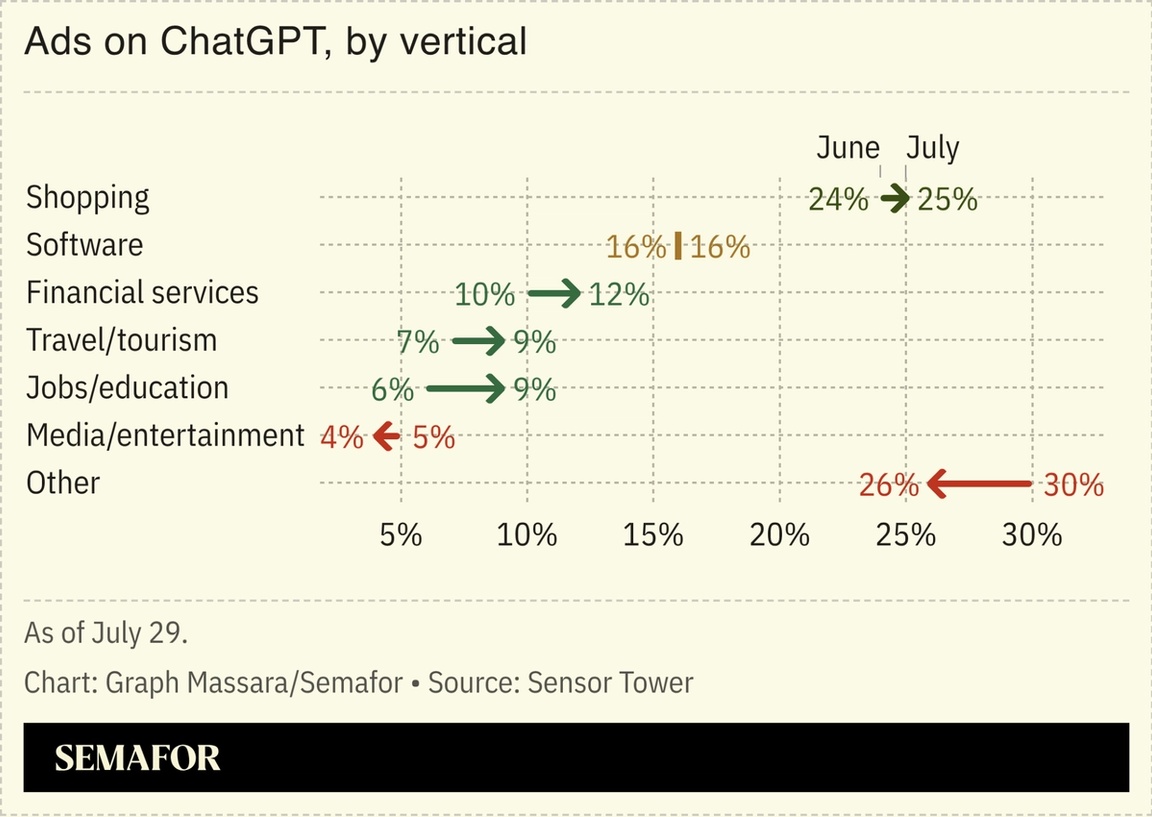 A variety of companies are starting to advertise on OpenAI’s ChatGPT, according to data from Abe Yousef with market intelligence firm Sensor Tower. Financial services is the fastest-growing category, amounting to 12% of ChatGPT’s ads, up from 2% in April. More than a third of all ad spend on ChatGPT in April was for shopping (the sort of thing Anthropic mocked its rival for), but by last month, shopping ads had fallen to about a quarter. The number of unique brands advertising grew from about 300 in April to more than 800 last month. The biggest spenders: travel site Booking, Intuit (of tax software fame), Home Depot, and L.L. Bean (for staying cozy while you query). — Graph Massara |
|
Bloomberg: Netflix wants to pay Hot Ones to decamp from YouTube to its platform, Lucas Shaw reports. Columbia Journalism Review: Amos Barshad detangles the relationship between Sports Illustrated Tickets and the venerable sports magazine that shares its name (but not its revenue). Status: Natalie Korach reports that Adam O’Neal’s departure from The Washington Post was not a |
|
|


