




 |
Detroit, Michigan
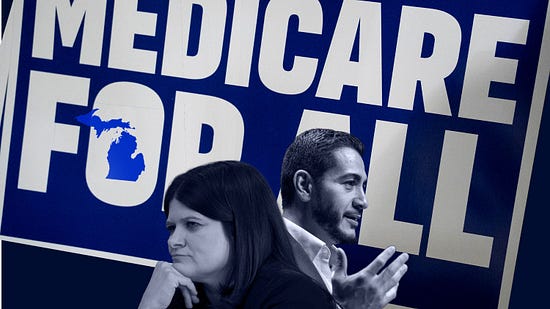
ABDUL EL-SAYED HAS BEEN RUNNING to become Michigan’s Democratic Senate nominee for more than fifteen months. And if there’s been one constant over that period it’s been his promotion of “Medicare for All” as a way to make sure all Michiganders—and all Americans—have access to affordable, quality health care.
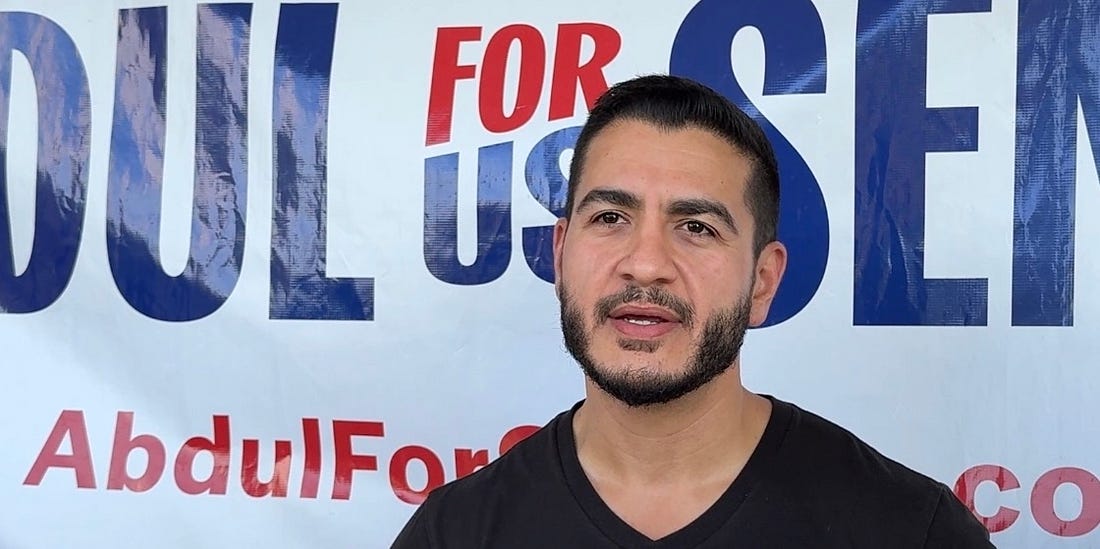
It’s a big focus of his stump speech, something he usually raises right at the beginning. It’s all over his campaign signage. And it’s the only specific policy promise in his three-part campaign slogan, which he and supporters invoke constantly:
Money out of politics. Money in your pockets. Medicare for All.
Medicare for All—a proposed version of universal health care that would have the government cover everybody directly, mostly doing away with private health insurance—has been part of the policy conversation among Democrats since the 1940s, when Harry Truman proposed a national health plan that included a prototypical version of the idea.
In the last few decades, partly as a nod to real-world political constraints, Democrats have leaned more toward hybrid plans with both private and public insurance as the surest path to universal coverage. That approach gave us the Affordable Care Act in 2010, which alongside Medicare and Medicaid—and with some financial reinforcements put in place during the Biden administration—reduced the uninsured rate to a record low.¹ It’s as close as America has ever come to a place where health care is a right, not a privilege.
But even then, millions of Americans didn’t have insurance or couldn’t cover their out-of-pocket costs. And that was before Donald Trump and the Republicans started hacking away at the existing programs, exposing even more people to crushing medical bills. Partly in reaction to those realities—and partly thanks to high-profile advocacy by the likes of Senator Bernie Sanders, the Vermont democratic socialist—over the last decade or so the idea of a full reset through Medicare for All has gotten increasing attention from the Democratic faithful.
On Tuesday, those sorts of voters in Michigan will get a chance to weigh in on this debate when they decide between El-Sayed, who is a former public health director in Detroit and Wayne County, and Haley Stevens, who is a four-term House Democrat. Stevens is from the wing of the party that prefers to work within and around existing arrangements, whether that means trying to repair the damage from Trump or creating a new, optional public insurance program for people who want an alternative to private coverage.
For voters here who care about health care, weighing the two candidates means considering the different policy paths they recommend, including the merits of Medicare for All itself. But it also means pondering something that hasn’t gotten as much attention: exactly what kind of senator El-Sayed and Stevens would each likely turn out to be, and what history teaches us about how their distinct styles would play out in the current political landscape.
Original reporting.
Sharp analysis.
Honest commentary.
Stick with us through the midterms and beyond—sign up for a Bulwark+ membership and get your first two weeks free.
IT WOULD BE DIFFICULT to overstate how central health care is to El-Sayed’s identity.
The political origin story he tells involves his journey through medical school when, while working in a New York City hospital, he saw the difference between the lavish attention to wealthy patients on the top floor and the shabby treatment that the destitute got down in the emergency room. One of his staple campaign lines is that the life expectancy in the country of his parents, Egypt, is roughly the same as it is in parts of Detroit.
He says it convinced him to focus on public health rather than the practice of medicine—which, in turn, drew him to Medicare for All. “In public health, we’re always in this position where we’re underfunded and underinvested-in,” El-Sayed told me during a phone interview Saturday, while driving between campaign stops. “That’s because our current health care system sucks so much money into the care part of things rather than the prevention part of things.”
 |
A few years ago, El-Sayed collaborated with a physician-researcher on Medicare for All: A Citizen’s Guide, a book that briefly explains how America’s health care system evolved, then sketches out the broad outlines of a Medicare for All system, including benefits and financing.²
The pitch El-Sayed makes in his speeches and appearances doesn’t get into the policy weeds; it is more like a general pitch for the idea of universal coverage, which is something that takes a variety of forms abroad. Many countries’ systems include significant roles for private insurance, and some have considerable out-of-pocket spending. At the same time, even the hybrid systems of countries like France or the Netherlands have more in common with the single-payer systems of Canada, Taiwan, and Sweden than they do with the American patchwork.
One way to think about Medicare for All—and to evaluate El-Sayed’s support for it—is to imagine, as a thought experiment, what it would be like to transplant one of those systems here. You’d have to account for all kinds of cultural differences, including among medical practitioners, that can have profound effects on the economics of health care. You’d also have to account for the transition, which may be the hardest part of the equation because health care represents one-sixth of the economy and even modest changes would entail massive disruption.
Spend any time with the numbers and you’ll discover Medicare for All, like all health care systems, including America’s status quo, would require making difficult tradeoffs. Throw in the political obstacles to any kind of substantial health care reform—a list that includes the power of monied interests, the skewed representation