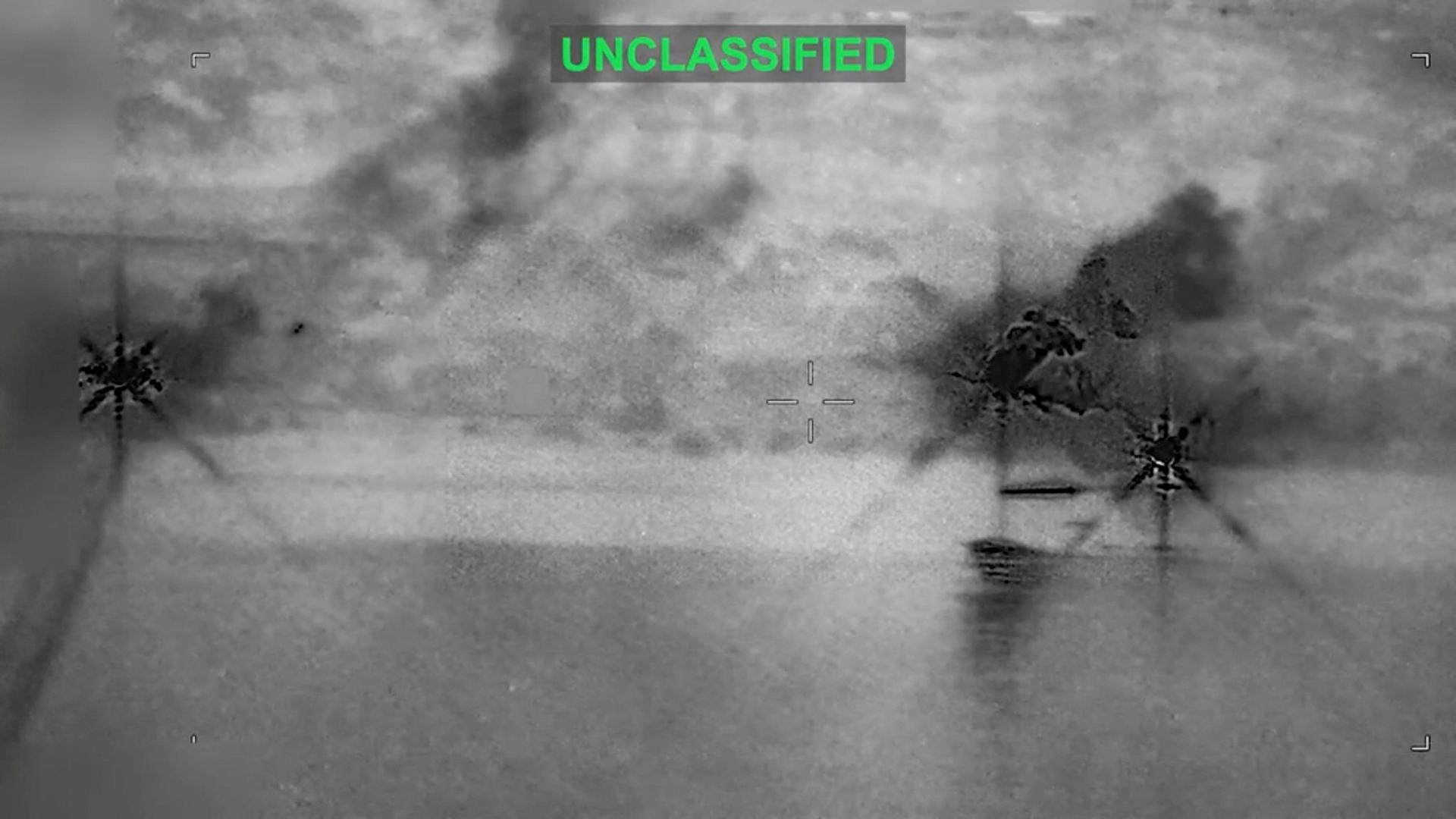
Smoke rises at an unknown location following what US Central Command says is a new wave of strikes against Iran. US Central Command/Handout via REUTER |
-
A NATO summit that began with Trump ordering a cutoff in trade with one member, Spain, and rebuking others was widely hailed as a success after he re-committed to the alliance. But European leaders are bracing for more turbulence ahead. Here is a look at his options to halt trade with Spain and the possible implications.
- President Vladimir Putin is rejecting calls to negotiate peace with Kyiv, three sources close to the Kremlin told Reuters, with Ukraine's recent drone strikes on Russia's oil refineries and ports strengthening his resolve to keep fighting for now.
-
The US will grant Ukraine a license to manufacture Patriot missile interceptors, a huge boost for Kyiv, which has long sought permission to produce the defensive weapons.
-
Democratic Senate candidate Graham Platner of Maine promised to formally withdraw from the race, after a string of controversies including an accusation of sexual assault plunged one of the most competitive races in the 2026 midterm elections into turmoil.
-
China and Taiwan were bracing for possibly the most destructive tropical storm in years as Typhoon Bavi churned southeast of Taiwan, with winds near 124 mph, and as parts of China were still reeling from Typhoon Maysak.
-
Bonnie Tyler, the gravelly-voiced singer of dramatic rock ballads like "Total Eclipse of the Heart" and "Holding Out for a Hero" has died at 75.
|
|
|
|
Staff works on Id. Buzz production line at Volkswagen Commercial Vehicles in Hanover, Germany. REUTERS/Fabian Bimmer/File Photo |
- Volkswagen's proposal to cut up to 100,000 jobs and close four German factories faces a major test as the groups that control Europe's largest carmaker meet to discuss the plans, while workers protest against the overhaul.
-
A ban on EU funding for Chinese-made inverters — a critical clean energy component — could slow or even halt the rollout of solar and wind projects in poorer European countries that rely on public money, companies and investors warned.
-
Russia hopes by mid-July to have a commercial logistics hub up and running in one of two berths at the naval base it leases in the Syrian port of Tartous, while keeping a military presence at the other, Syrian officials told Reuters.
-
Australia and India reached a deal to export Australian uranium to India for use in the nuclear energy industry, while agreeing to deepen cooperation in renewables, critical minerals and green hydrogen.
-
Comcast, the empire led by Brian Roberts, will split into a cable and a media company. On this week’s Viewsroom podcast, Breakingviews columnists play out the deals that could follow, and why any buyer could just inherit the same doom loop.
|
|
|
|
Modern farming depends on cheap fertilizer. The war with Iran has made fertilizer more expensive, with ships trapped, fertilizer plants shut down, farmers panicking and world food production thrown into peril
The war cut off 17% of the world’s natural gas supply and more than 30% of world nitrogen fertilizer supply. Almost half of the world’s exported sulfur, a critical component for another type of fertilizer, was trapped in the Middle East Gulf. The disruption to the Strait of Hormuz means it will be months or years before some natural gas and fertilizer production returns to a pre-war normal. |
|
|
|
A quasar emits exceptional amounts of energy, as seen in this illustration. NASA, ESA, Joseph Olmsted (STScI)/Handout via REUTERS |
A quasar — among the universe's most luminous and energetic objects — is a supermassive black hole caught in the act of guzzling matter at the heart of a galaxy.
Scientists have now found quasars dating to so early in cosmic history that they are baffled as to how they al |
|
|
|
|