|
|
|
|
|
|
|
|
|
The home of the week is an industrial but welcoming family home in Toronto's Roncesvalles neighbourhood. Tenzin Chosang/Tenzin Chosang/ Tenzi Films
|
|
|
|
|
This week: Why more Ontario homes are selling at a loss or under duress, and the World Cup Airbnb boon that hasn’t come. Plus, a first-of-its-kind development might have a harder time finding renters, and one property worth a look. |
|
|
|
|
|
|
|
|
|
|
Ahead of the World Cup, many short-term rentals are surprisingly vacant |
|
|
|
|
|
|
|
|
|
|
|
|
|
The FIFA frenzy was supposed to be a boon for tourism in Toronto and Vancouver, but many Airbnb hosts are finding the opposite. Jennifer Gauthier/Reuters
|
|
|
|
|
Thinking of escaping the World Cup chaos and making a pretty penny by renting out your place on Airbnb or VRBO? Think again. The tournament was supposed to be a boon for short-term rental owners in Toronto and Vancouver, but as Emma Bolzner reports, many Airbnb hosts are finding their properties shockingly vacant.
“When I started looking into whether there has been an influx in short-term rentals and hotel bookings, I was surprised to learn the promised rush hadn’t come,” Emma told me. “Instead, many short-term rental hosts have not had any bookings at all.” |
|
|
|
|
Shelby Lim had hoped to get up to $1,500 a night for her unit near the stadium in Vancouver, but the lack of bookings – even with prices lowered to $500 – is leaving her perplexed. “I have bookings all the way up to the day before FIFA starts. Then, I start being booked solid again in July,” she said. She’s not alone, with other hosts suspecting the market is flooded and hotel groups blaming FIFA, in part, for booking and then cancelling thousands of hotel rooms ahead of the tournament. |
|
|
|
|
It’s a sharp contrast compared to the finale of Taylor Swift’s Eras Tour in Vancouver, which sent hotel prices skyrocketing and sold rooms out months in advance of the singer’s three shows in December, 2024. Are Swifties more dedicated than soccer fans? “No comment,” Emma laughed. But short-term rental hosts and hotels caught in an unexpected slump are certainly hoping they can shake it off before kick-off. |
|
|
|
|
|
|
|
|
|
|
More Ontario homes sold at a loss in 2025 |
|
|
|
|
|
|
|
|
|
Homeowners in the province are increasingly selling at a loss or under duress, according to new data. Fred Lum/the Globe and Mail
|
|
|
|
|
If you’re a homeowner selling in Ontario, you’re more likely to be doing it at a loss – or under duress. The share of homes sold in power of sale has grown exponentially since 2022,
from 578 to 2,979 in 2025, according to new data from Teranet Inc., the private company that manages all registration of property titles in the province. That 415-per-cent increase is a major sign of turmoil in the market, one which Teranet manager Karan Malhotra attributes to pandemic-related unemployment and interest rate hikes to combat inflation. |
|
|
|
|
And as Shane Dingman reports, many of those who sold their homes of their own volition haven’t seen their fortunes improve, either. More are selling at a loss, and it greatly depends on when you bought your home. Those who purchased at the peak of prices in 2022 are the worst off, with 36.6 per cent of sales coming below the original purchase price in 2025, five times as many as for homes bought just two years earlier in 2020. |
|
|
|
|
Though Malhotra hasn’t crunched the numbers for this year yet, he expects the stress on homeowners to grow as more mortgages come up for renewal at higher rates this year. “The factors are not dying down; I think it’s more doubling up now. It will get more expensive to survive from a household and funds management perspective in 2026,” he said. Read Shane’s full story here. |
|
|
|
|
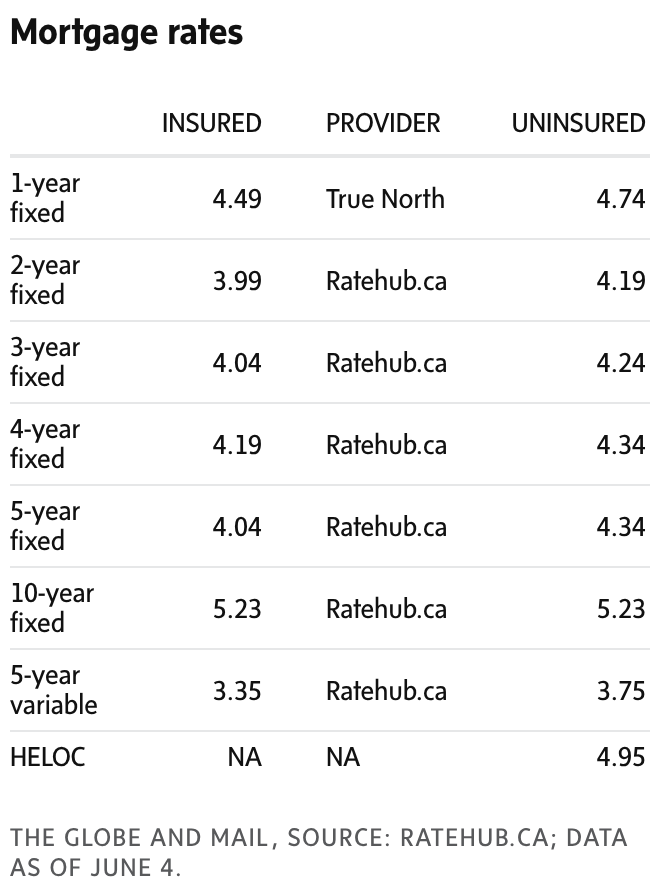
This week’s lowest fixed and variable mortgage rates in Canada |
|
|
|
|
|
|
|
|
|
|
|
|
|
|
|
|
|
|
A landmark Vancouver development is opening, but will renters want to live in it? |
|
|
|
|
|
|
|
|
|
The first phase of the Squamish Nation's Senákw project will add roughly 1,400 rental units, but whether they can fill them is another question. Alison Boulier/The Globe and Mail
|
|
|
|
|
For the last few years, I’ve been watching three massive towers appear at the mouth of Vancouver’s False Creek on my morning commute and during walks around the seawall. Senákw, owned by the Squamish Nation
and built on a parcel of reserve land, has been touted as a key to economic prosperity for the Nation that will create much-needed housing and help bring rents further down. But now that the first phase of roughly 1,400 units is almost complete, whether people will want to live there is another story. |
|
|
|
|
Salmaan Farooqui has followed the project, which drew some blowback for its size and scale in the heart of Kitsilano, from afar for years, and got the chance to visit in March. “When I arrived in Vancouver to report on this, I immediately noticed that the buildings really do stand out, with their bright orange trigons and the sheer height of the towers,” he told me. “The developers believe they have something special with the location and the amenities offered in the building,” Salmaan said. |
|
|
|
|
However, the new units may not be exactly what some renters are looking for. They’re mostly relatively small bachelors and one-bedrooms, units that have seen some of the largest drops in prices and demand in recent years. And Senákw’s starting rents ($2,275 for a one-bedroom and $3,505 for a two-bed) are close to or slight above the city’s average market prices. Beyond whether the injection of supply will indeed lower rents, Salmaan thinks “the bigger question is whether Senákw will be able to fill all these units right away.” You can read the full story here,
and for now, I’ll keep looking up at the towers to see how many lights come on. |
|
|
|
|
|
|
|
|
|
|
Analog is back – and it’s by design |
|
|