
|


 |
Beyond the Demo: What Real AI Agents Actually Do at Work
I am always on the lookout for new AI agents and applications that operate outside the coding world. By agent, I mean a system that can take a goal, use tools, keep context, and work through several steps rather than simply answer a prompt. Looking through my notes from the recent AI Agent Conference, I put together a few standout examples drawn from conversations with the people who built them and friends at the conference. What stands out is not that these systems are magical. It is that they are showing up in ordinary business workflows where speed, judgment, and access to the right data matter.
When Marketplaces Start Doing the Work
Upwork’s Uma Recruiter starts from a familiar problem: hiring is not just search. A client may write an incomplete job post, miss important constraints, or fail to separate required skills from nice-to-have ones. Uma Recruiter turns that messy input into a structured hiring task, then searches the talent marketplace and evaluates candidates across signals like past work, portfolio depth, availability, prior client relationships, and Job Success Score. It then invites promising candidates and ranks incoming proposals. Upwork is treating a job post less like a one-time query and more like the start of a multi-step recruiting process. Early results suggest this is not just a demo: Upwork says Uma Recruiter can produce shortlists within six hours, initial testing showed a 30 percent increase in hires using the shortlist, time to hire fell 11 percent, and jobs filled within seven days rose 10 percent between November 2025 and March 2026.
DoorDash’s merchant tools are less like a single recruiter-style agent and more like a bundle of AI-enabled workflows placed directly into merchant operations. The core idea is to remove setup and growth tasks that independent restaurants often lack the time or staff to handle. Its AI-powered onboarding pulls information from a merchant’s existing web presence, including photos, hours, and menu items, so a merchant can review and edit rather than start from scratch. DoorDash says this helps merchants launch more than 35 percent faster. The suite also includes AI photo tools that retouch or replate food images while preserving the underlying dish, AI-generated branded websites for direct ordering, and AI-assisted marketing campaigns for email content and scheduling. Millions of photos have been enhanced, AI-powered websites are seeing nearly 10 percent average order conversion, and merchants report meaningfully reduced effort across onboarding and marketing.
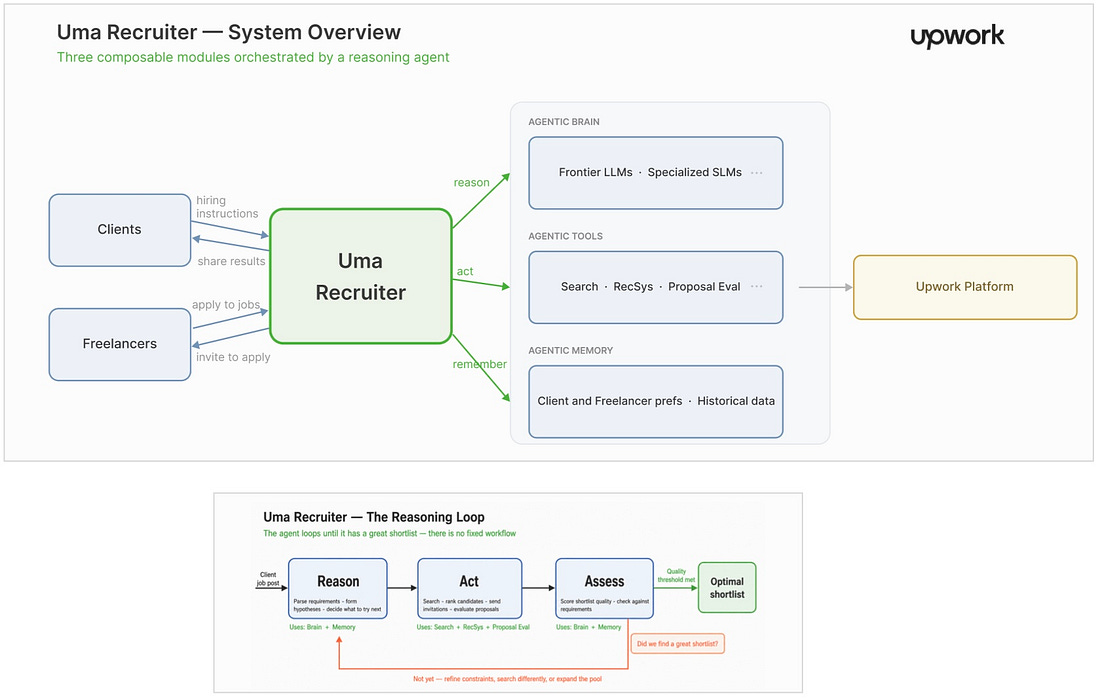 |
The common thread is that both companies are using AI to make their platforms easier to use, not to replace the marketplace itself. Uma Recruiter is more explicitly agentic: it has a reasoning core, specialized tools, memory, and an iterative plan-act-assess loop that runs until it has a strong shortlist. DoorDash is more embedded and task-specific, appearing as product features that reduce merchant friction at known points in the lifecycle. For builders, the distinction matters. Upwork is automating a judgment-heavy workflow where the system must reason across candidates and outcomes. DoorDash is automating setup, content, and marketing jobs where usability, guardrails, and tight integration into the merchant portal may matter more than a visibly autonomous agent.
Two Paths to the Enterprise Agent
Meta’s AI Second Brain addresses a problem most knowledge workers recognize immediately: the context needed to do your job is scattered across documents, meetings, tasks, code reviews, and internal discussions. Rather than starting each session cold, the system gives an AI agent a persistent workspace organized around the PARA method, a lightweight structure for Projects, Areas, Resources, and Archives that tells the agent what you are actively working on, what to load on demand, and where to route new information like meeting notes. The agent connects to internal tools through authenticated MCP servers, which give it scoped, permissioned access to internal systems, and command-line interfaces. The adoption numbers are striking: more than 63,000 installs in roughly three months, around 10,000 daily active users, and thousands of user-created skills written in plain markdown. That kind of internal traction usually means the tool solved a real problem.
EY’s agentic AI effort targets a very different kind of knowledge work: audit and assurance. The firm is embedding a multi-agent framework directly into EY Canvas, its global assurance platform built on Microsoft Azure, Microsoft Foundry, and Microsoft Fabric. The system is designed to help audit teams orchestrate complex tasks, surface updated accounting and audit guidance, sharpen risk assessments, and reduce administrative overhead, while keeping human judgment explicitly in the loop. The scale is institutional rather than viral: 130,000 assurance professionals, 160,000 audit engagements, more than 150 countries, and a roadmap to support end-to-end audit activity by 2028.
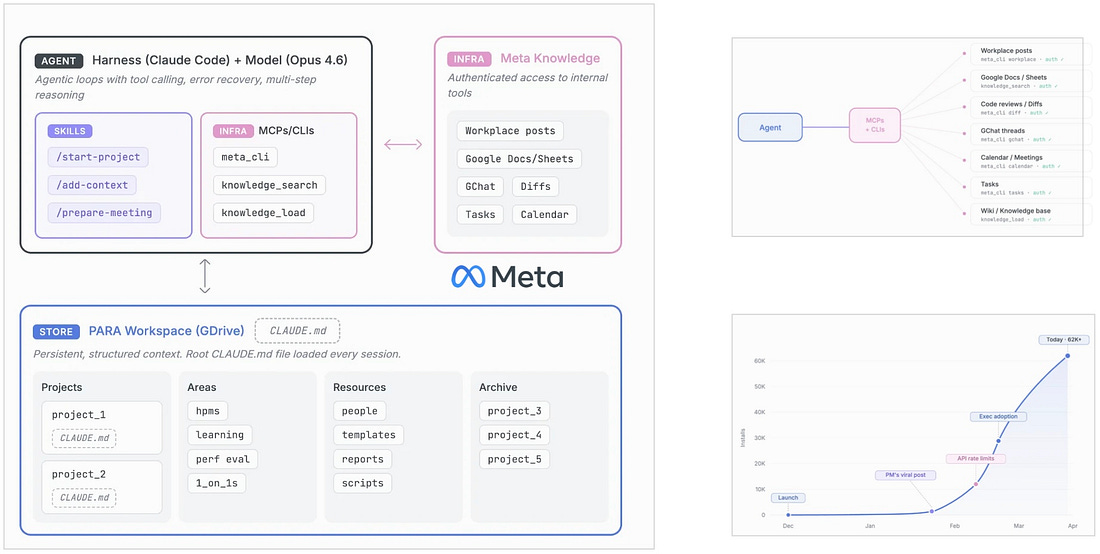 |
The shared lesson is that internal agents need far more than a capable model underneath them. They need access control, structured context, workflow integration, and a clear boundary between AI assistance and human decision-making. Where the two cases diverge is in philosophy. Meta’s system grew from the bottom up: users write their own skills, teams extend workflows, and adoption spread because the entry cost was low and the system was composable. EY’s deployment is top-down by design, embedded inside a regulated professional platform where governance, quality controls, and training matter as much as productivity gains. Some agents spread because people can adapt them. Others earn trust precisely because they cannot be adapted freely.