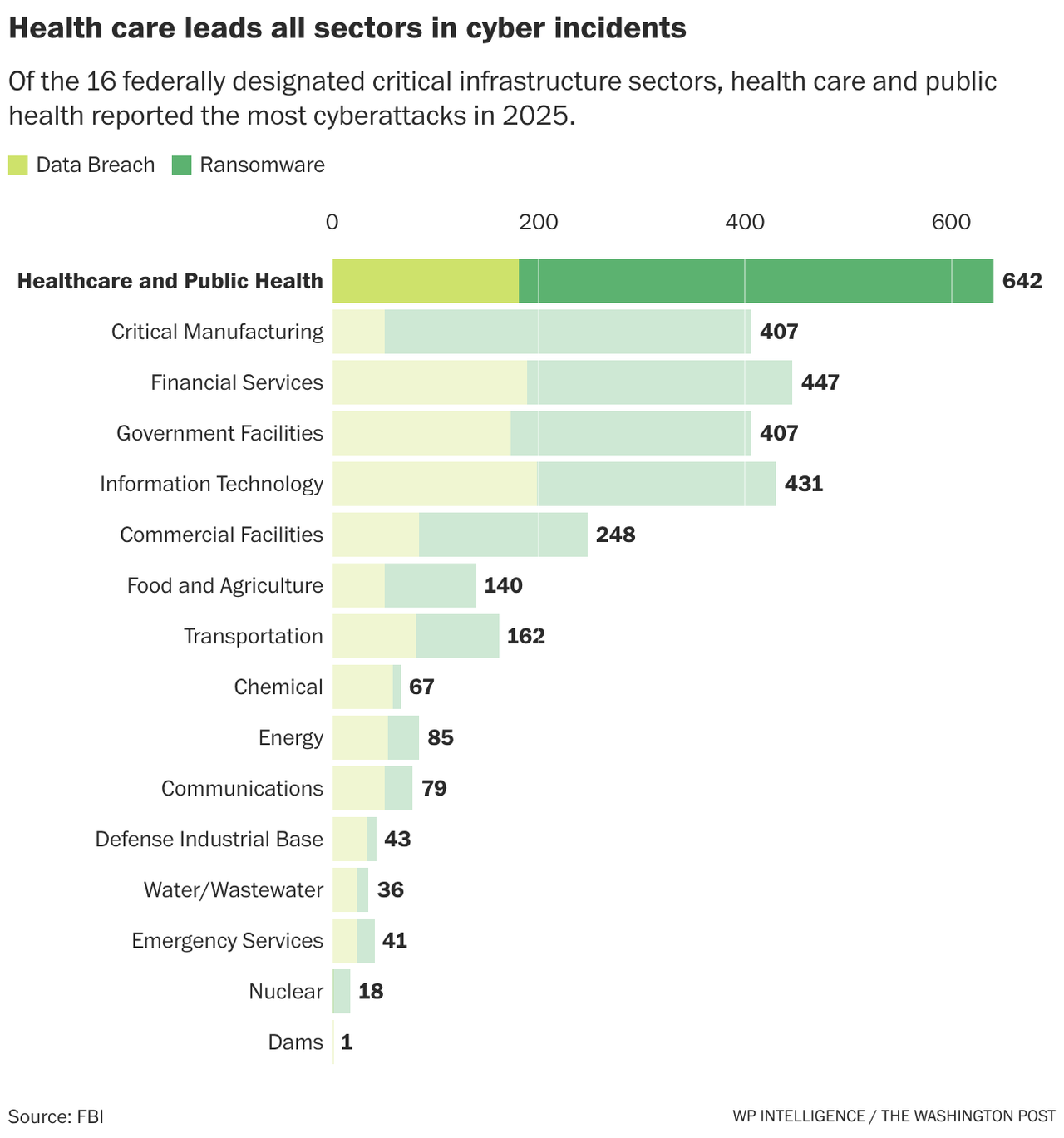
| |  | The Lead Brief | The health care industry, which represents almost one-fifth of the U.S. economy, is more vulnerable than ever to cyberattacks as technology advances. That’s the focus of the latest report from Rebecca Adams, lead health care analyst at WP Intelligence. Much of the concern is driven by artificial intelligence models that can rapidly uncover and exploit software vulnerabilities, ferreting out flaws that humans did not notice for years or even decades. While Nancy Phillips, the chief information security officer for Ensemble Health Partners, told Rebecca that the health care industry is excited about the expanding capabilities of AI, there is also “a lot of fear of what it means to defend an organization.” Hospitals around the country spent about $30 billion on cybersecurity technology and services last year, significantly more than the financial services sector, according to data compiled by the American Hospital Association. In April, AI giant Anthropic announced that its Mythos model’s powers in finding and exploiting software gaps were so advanced that the company deemed it too dangerous to make it available to the public — although parts of the model were inadvertently exposed before the company even noticed. One of the company’s primary rivals, OpenAI, followed soon after with similar capabilities. Phillips said she’d heard talk late last year about these kinds of advanced AI technologies — and while she normally has a policy of not texting executives over the holidays, she sent them a message about what she’d been hearing: “This is what’s keeping me up at night,” Phillips recalls writing around Thanksgiving. The new models’ abilities to rapidly exploit any vulnerabilities that hospitals may have is “really accelerating the attack cycle time frame, so the threats are increasing at an alarming rate,” Scott Gee, the American Hospital Association’s deputy national adviser for cybersecurity and risk, told Rebecca. → Anthropic has rolled out a limited-access initiative, Project Glasswing, which allows more than 50 companies — including CrowdStrike, Microsoft, Palo Alto Networks, Nvidia and others — to use Mythos. Health care organizations can partner with those companies. Despite that effort, the advent of advanced models such as Mythos has health industry cyber leaders alarmed about the vulnerability of the U.S. health care system — and the risks it poses to patients. They are calling for a more proactive and coordinated federal government response. “When Mythos dropped last month, the Treasury secretary and the Federal Reserve chair got all the bank CEOs on a call to coordinate what the response would be,” said Dan Jones, senior vice president of federal affairs for the Alliance of Community Health Plans, an industry group that represents smaller insurance plans. “There’s no equivalent in the health care space. Banks are well financed,” Jones said. “It’s a much bigger threat on the health care side.” Project Glasswing allowed a major bank to preview Mythos, but did not permit hospital or health industry officials to do so. Andrew Nixon, a spokesperson for the Department of Health and Human Services, said the agency “works with health care organizations and federal partners to strengthen cyber preparedness across the sector as threats continue to evolve.” “The department remains engaged with our partners to protect patient data and critical systems,” Nixon added. Read the full report: “New AI models raise alarms among health care leaders.” | 
_tstmp_1756933376-1920-1080.png)