
|
 |
Abortion Politics Are About to Bite Trump Again
A new fault line is emerging in the president’s coalition.
|



| ||||||||||||


The Met Gala was last night—and if you’re hoping for commentary on that, we’re afraid you’ve come to the wrong place.
Sam and Bill (Andrew is ailing) are going on Substack and YouTube at 10 a.m. EDT for Morning Shots Live. Happy Tuesday.
 |
Trump’s Lose-Lose Abortion Dilemma
by Andrew Egger
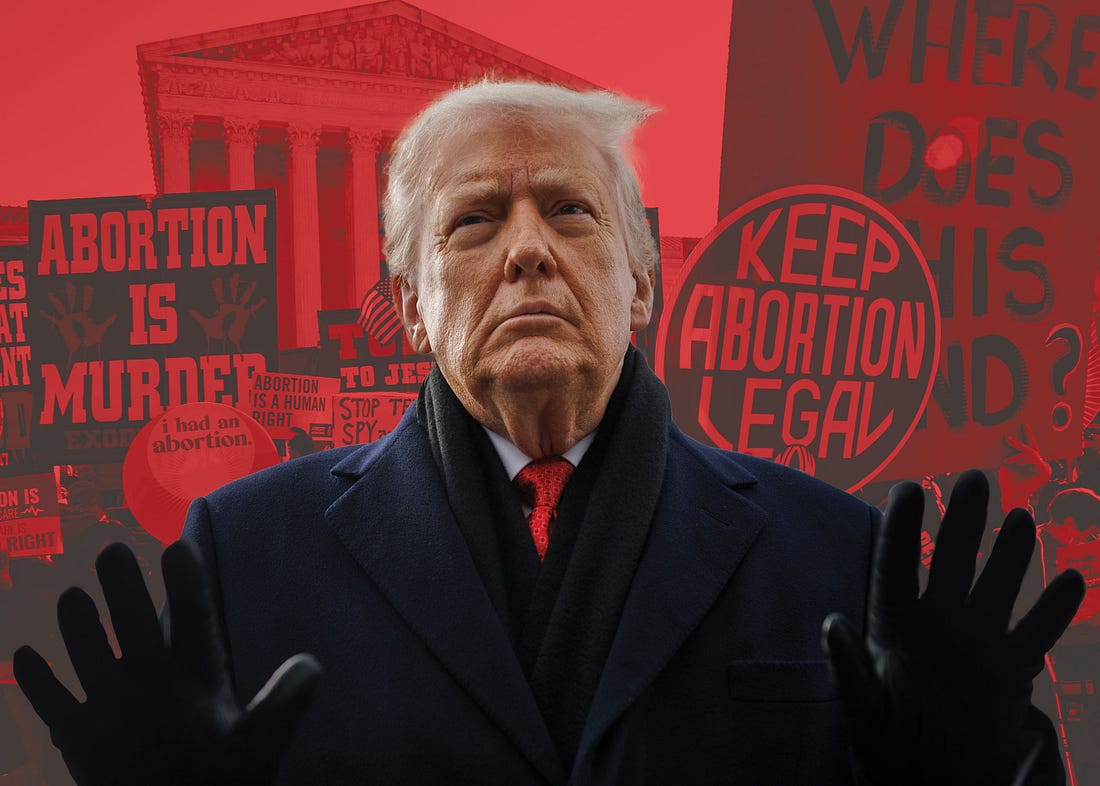
One of the million strange things about our political moment is how abortion politics has all but dropped out of it. Donald Trump, who has never cared personally about abortion bans, functionally cut the pro-life movement loose during his 2024 campaign and has more or less ignored the issue since his re-election, while Democrats have had their hands full opposing the things Trump is doing right now. It’s a far cry from four years ago, when the end of Roe v. Wade caused a backlash so ferocious that Democrats made it a tentpole of their messaging in both 2022 and 2024.
But abortion politics may be coming back. Red states with active abortion bans have been suing to end the chief federal policy blunting their anti-abortion efforts: a substantial Biden-era expansion of clinics’ ability to mail abortion drugs to patients without a physical visit. This Food and Drug Administration policy has meant that even living in a total-ban state is hardly a barrier to access: Women seeking abortions can simply request drugs from an out-of-state clinic and receive them discreetly by mail.
Last week, a federal court upended that uneasy status quo. In a case brought by the state of Louisiana, a New Orleans-based appeals court ruled unanimously that the FDA’s authorization of the telehealth prescription and nationwide mailing of mifepristone—one of two drugs typically taken in tandem to induce abortion—violated the state’s right to regulate the practice within its borders.
Yesterday, the Supreme Court placed that decision on a short-term hold to give the parties time to appeal. Mifepristone’s two manufacturers, Danco and GenBioPro, are arguing that the Fifth Circuit’s decision is a recipe for “immediate chaos” since it “renders inoperable an agency action that has already been in effect for years.” But the current conservative Court, which already issued the most significant anti-abortion decision in history in Dobbs v. Jackson Women’s Health, may prove sympathetic to Louisiana’s argument that the current FDA posture amounts to complicity in facilitating large numbers of abortions that are illegal under state law.
Reproductive-rights groups see this as a nightmare scenario. Ironically, so does President Trump. His administration has been doing everything it can to kick the can down the road while keeping the mifepristone status quo frozen quietly in place. Last September, amid a barrage of pestering from Republican state attorneys general, Health and Human Services Secretary Robert F. Kennedy Jr. said that the FDA would conduct a “review” of mifepristone’s authorization. But they seem to be in no hurry to complete it—and meanwhile, the Trump administration has consistently asked courts to delay weighing in on the subject until that review is completed.
Trump’s political bind here is obvious. He sees abortion policy as political deadweight, a loser of an issue with an electorate that he’s in no position to press at the moment. But it also happens still to be the central issue for the social conservatives who still constitute a non-trivial portion of his base. Any action he or his government might take on the matter would infuriate some group of voters that he can ill afford to infuriate. But his attempts to slow-walk the process are no longer working, either.
Meanwhile, antiabortion groups like Susan B. Anthony Pro-Life America—which Trump essentially bludgeoned into silence during his 2024 campaign—are getting tired of waiting quietly in the hope the president will throw them a bone. “Trump is the problem. The president is the problem,” SBA President Marjorie Dannenfelser told the Wall Street Journal this week. The status quo, whereby abortion policy is decided at the state level beneath an umbrella federal policy that permits unlimited abortion pills by mail, is no longer acceptable to Dannenfelser and her allies. If Trump’s stance on abortion becomes the broader Republican stance, she said last week, “then the movement as we know it is finished.”
If the Supreme Court throws out the mifepristone-by-mail status quo, it will dramatically sharpen the salience of abortion as a political issue—one that currently favors Democrats. But if they decline to throw it out, the pressure from pro-lifers on Trump and Kennedy to simply change the rules in question will become astronomical.
In 2016 and again in 2024, Trump unified the GOP’s various factions and interest groups more or less through sheer force—he made himself the only game in town. But as his presidency founders and electoral catastrophe looms, Trump is making it far easier for various types of conservative to start planning for how to survive in what comes next—in other words, to start taking a good, hard look at what comes after the Trump Era for the first time in years. Pro-life groups won’t be the last rats off this sinking ship.