
|
 |


Another day, another absolutely brutal poll for President Donald Trump. The latest WaPo-ABC News-Ipsos survey finds Trump’s approval rating at 37 percent, with catastrophically low approval across a host of issues: 23 percent approval on cost of living, 27 percent on inflation, 33 percent on the conflict in Iran, 34 percent on the economy, and 40 percent on immigration. Crazy how many are so ungrateful to be living in the HOTTEST COUNTRY ON EARTH right in the middle of its GOLDEN AGE.
Sam and Will Sommer will be going live this morning at 10 a.m. EDT for MAGA Monday—tune in on Substack or YouTube. Happy Monday.
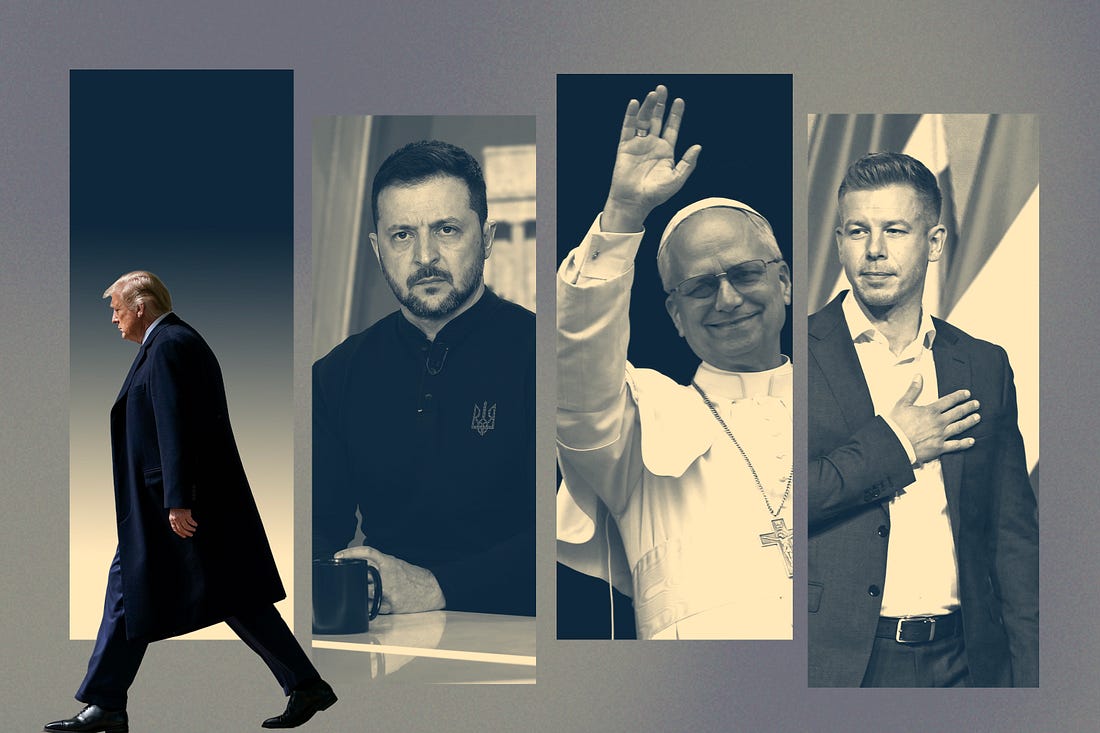 |
Volodymyr, Péter, and Leo
by William Kristol
On June 4, 1940, in the wake of the evacuation of the British Expeditionary Force from Dunkirk, Prime Minister Winston Churchill spoke in the House of Commons. The conclusion of the speech is justly famous:
We shall go on to the end, we shall fight in France, we shall fight on the seas and oceans, we shall fight with growing confidence and growing strength in the air, we shall defend our Island, whatever the cost may be, we shall fight on the beaches, we shall fight on the landing grounds, we shall fight in the fields and in the streets, we shall fight in the hills; we shall never surrender, and even if, which I do not for a moment believe, this Island or a large part of it were subjugated and starving, then our Empire beyond the seas, armed and guarded by the British Fleet, would carry on the struggle, until, in God’s good time, the New World, with all its power and might, steps forth to the rescue and the liberation of the old.
In fact, eighteen long months later—“in God’s good time”—the New World did step forth to the rescue and liberation of the old. And for eight decades after that, the United States took on the responsibility of leading the Free World.
No longer. The current American president doesn’t care much about the world. His administration’s slogan is “America First.” And his administration doesn’t care much about freedom. As White House Deputy Chief of Staff Stephen Miller explained, “we live in a world, in the real world . . . that is governed by strength, that is governed by force, that is governed by power. These are the iron laws of the world.” And if we simply live in a world governed by iron laws of force and power, all this talk of freedom and the Free World is bunk.
So under the Trump administration, we’re no longer the leader of the Free World. Indeed we’re barely on the side of the Free World.
And yet, despite Miller’s fatalism and determinism, history is full of surprises. Trump’s success here in the United States surely counts as an unfortunate surprise. But in this past decade, the Old World has also generated surprises—hopeful surprises. The Old World has produced leaders who have stepped forth to defend freedom, and who may, in God’s good time, inspire us once again to do the same.
Seven years ago, in April 2019, an entertainer who’d never held elective office, Volodymyr Zelensky, was elected president of Ukraine. What his nation has done in defending its national freedom against the brutal assault of a much larger and dictatorial neighbor has surely been the twenty-first century’s finest hour.
And so, as David French recently put it, “for the first time in my adult life, the moral and strategic heart of the defense of liberal democracy doesn’t beat in Washington. . . . It’s in Kyiv, where a courageous leader and a courageous people have picked up the torch America has dropped.”
A year ago, on May 8, 2025, Cardinal Robert Francis Prevost was elected pope. Pope Leo XIV, the first American pope, is of course not from the Old World. But the institution he heads is certainly an Old World one. And so we have the paradox that it has fallen to the head of an ancient, pre-liberal institution to remind the president of the United States of the dignity and responsibilities of human freedom. And for all President Trump’s belittling of him, People Leo XIV has turned out to be a formidable enough figure that Trump is sending his secretary of state to Rome this week to pay his respects. This is not quite Henry IV journeying to Canossa—but it’s not nothing.
Then last month, Péter Magyar trounced Viktor Orbán in the illiberals’ favorite haunt, Hungary. As David Baer observed last week in The Bulwark, Magyar
did this by invoking the spirit of Hungary’s 1848 liberal revolution. Highlighting the contrast between the ideals of 1848 and the reality of Orbán’s Hungary, Magyar turned the election into a referendum on illiberalism. . . . Presented with a clear, stark choice between reactionary conservatism and national liberalism, Hungarians chose liberalism.
As David and I discussed yesterday, Magyar has a formidable task ahead. But he seems to understand the challenge of re-creating liberal institutions and a free society, and is moving aggressively to meet it.
So: Three surprising and impressive leaders in the fight for freedom. Can they succeed on their own turf? Could they also inspire a resurgence of the cause of liberty here in the United States? Could the Old World come to the rescue of the New?
Why not? If the principles of the Declaration of Independence are universal, why shouldn’t the impetus for their renewal c