| | In today’s edition: Prowar conservative commentators like Marc Thiessen are having a moment. ͏ ͏ ͏ ͏ ͏ ͏ |
| |  Atlanta Atlanta | Washington | New York |
 | Media |  |
| |
|
 - The hawks’ perch
- Mixed Signals
- Carr vs. ABC
- Air America 2.0?
- Media omnivores
|
|
 Last week, Semafor’s Ben Smith scooped that our first terminally online vice president had deleted X from his phone for Lent. JD Vance isn’t the only ambitious national politician curbing his social media use to improve his political standing. In an interview on The Bulwark’s podcast, Sen. Jon Ossoff, D-Ga., said social media is a helpful tool, but he keeps it off his phone. “I see the importance, the power, of reaching and organizing people using this technology, but I’m not going to pretend to be extremely online hour-by-hour when that’s actually not how I live my life,” he told Tim Miller. That two of the youngest potential candidates for presidency may be embracing a more Bricked relationship with social media shouldn’t be a surprise. If they run, Vance and Ossoff will be part of the first generation of candidates that grew up with the internet; they can speak its language and understand its rhythms without necessarily needing to soak in it all the time. The 2024 election taught politicians and executives that much of America is living in an online world untouched by mainstream sources. In tonight’s newsletter, we write about how Democratic donors are planning to drop tens of millions on new media initiatives to reach these people in their feeds. But while some political figures are diving headfirst into the bizarre corners of the internet to try and speak to Americans where they are — and as the Oval Office’s current occupant reposts memes on the social media site he owns — maybe the next president will be a digital native who understands when it’s time to log off. Also today: Prowar conservative commentators like Marc Thiessen are having a moment. |
|
Fox News’ war hawks are back |
 Screenshots/Fox News and Fox Business/YouTube; Yves Herman/Reuters Screenshots/Fox News and Fox Business/YouTube; Yves Herman/ReutersThiessen, the Bush speechwriter-turned-Washington Post and Fox News commentator, may deserve credit for one of the surprises of President Donald Trump’s second term: Trump’s continued, if measured, support for Ukraine in the face of hostility inside his party and his administration. “He is doing more to help Ukraine than Biden ever did,” Thiessen declared in a piece ranking Trump’s best 2025 decisions. Post opinion editor Adam O’Neal has told journalists that Thiessen’s calls with Trump regarding Ukraine were influential in persuading Trump to continue to take the country’s side in the conflict in the face of some Republicans pushing for a quick settlement with Russia, people familiar with the Post’s internal conversations said. It’s an assessment Thiessen has told Post colleagues he agrees with. In public, Thiessen has teased that his well-placed sources led him to believe that Trump has never been more determined to see the US’ military campaign against Iran through to completion. Thiessen’s rise reflects a broader shift in Trump’s orbit away from media figures like Joe Rogan and Tucker Carlson, who celebrated Trump’s efforts to withdraw American forces from conflicts around the world, and toward advisers linked to the wars that defined the Bush years. Trump has infuriated some anti-interventionist allies by increasingly boosting prowar figures like Fox News radio host Mark Levin. Meanwhile, within the Post, one insider said, some staff groan that Thiessen’s columns are being written for one reader in particular. |
|
Johnny Harris on ‘Mixed Signals’ |
 He went from selling his own plasma to running a YouTube channel with over 7 million subscribers. Johnny Harris, YouTube creator and Newpress co-founder, joins this week’s Mixed Signals to talk about how he built a sustainable business around difficult topics without chasing the outrage that drives so much attention online, and why millions of people are obsessed with longform video explainers. |
|
Conservatives skeptical of latest FCC push |
 Paul Morigi/Getty Images for Semafor Paul Morigi/Getty Images for SemaforThe FCC has opted to review several local ABC stations’ broadcast licenses years ahead of schedule, Semafor first reported last week, as Chairman Brendan Carr ramps up his investigation of ABC parent company Disney’s corporate diversity efforts. Carr has insisted the commission’s move was a long time coming, and there “was no call for agency action from the outside.” But the timing of the news — right after Trump called for late night host Jimmy Kimmel to be fired over a joke at Trump’s expense — is sparking accusations of nanny-state censorship from even some in Carr’s own party. “I do not believe the FCC should operate as the speech police,” Sen. Ted Cruz, R-Texas, told Punchbowl. “I would hope that if my friend Brendan Carr is looking at something on ABC, it has more to do than with a few tasteless jokes,” Kentucky Rep. James Comer, a Trump ally, told NewsNation. “The government should stay completely out of this controversy,” conservative commentator Glenn Beck said on his show. Carr’s renewed pressure on the network is also an early test of new Disney CEO Josh D’Amaro, who has so far declined to take Kimmel off the air or take other drastic steps. One TV executive offered advice to him, by way of Status’ Brian Lowry: “Stay calm,” and wait it out. |
|
Progressive megadonors’ big media bet |
 Sean Gardner/Reuters Sean Gardner/ReutersThe Democracy Alliance, the progressive movement’s largest donor network, plans to invest “tens of millions” of dollars in new media sources, its president told Semafor’s David Weigel. The party’s losses in 2024 convinced some Democracy Alliance members that its work can’t be truly effective if most of the content voters encounter organically, like the superficially apolitical postings of MAHA influencers, is still steering them rightward. The network’s new fund would boost organizations that have been making content that breaks through to young people, like the Emmy-winning More Perfect Union, to counter the right’s online presence. Progressive digital media figures like Tara McGowan, who in 2019 founded the left-leaning Courier Newsroom, celebrated the change in strategy. “It was hard to get folks in the pro-democracy movement, on the left, to actually understand how the media ecosystem has changed,” she told David. Progressive donors have in recent years been wary of investing in explicitly left-leaning media; some, McGowan said, still associate it with Air America, the Bush-era radio experiment that produced talent like Rachel Maddow but otherwise fizzled. But progressives have grown increasingly leery of legacy outlets they see as kowtowing to Trump, like CBS and The Washington Post, and “they feel a desperation that wasn’t there when they stood up Air America,” David writes. |
|
American teens’ diversified news diet |
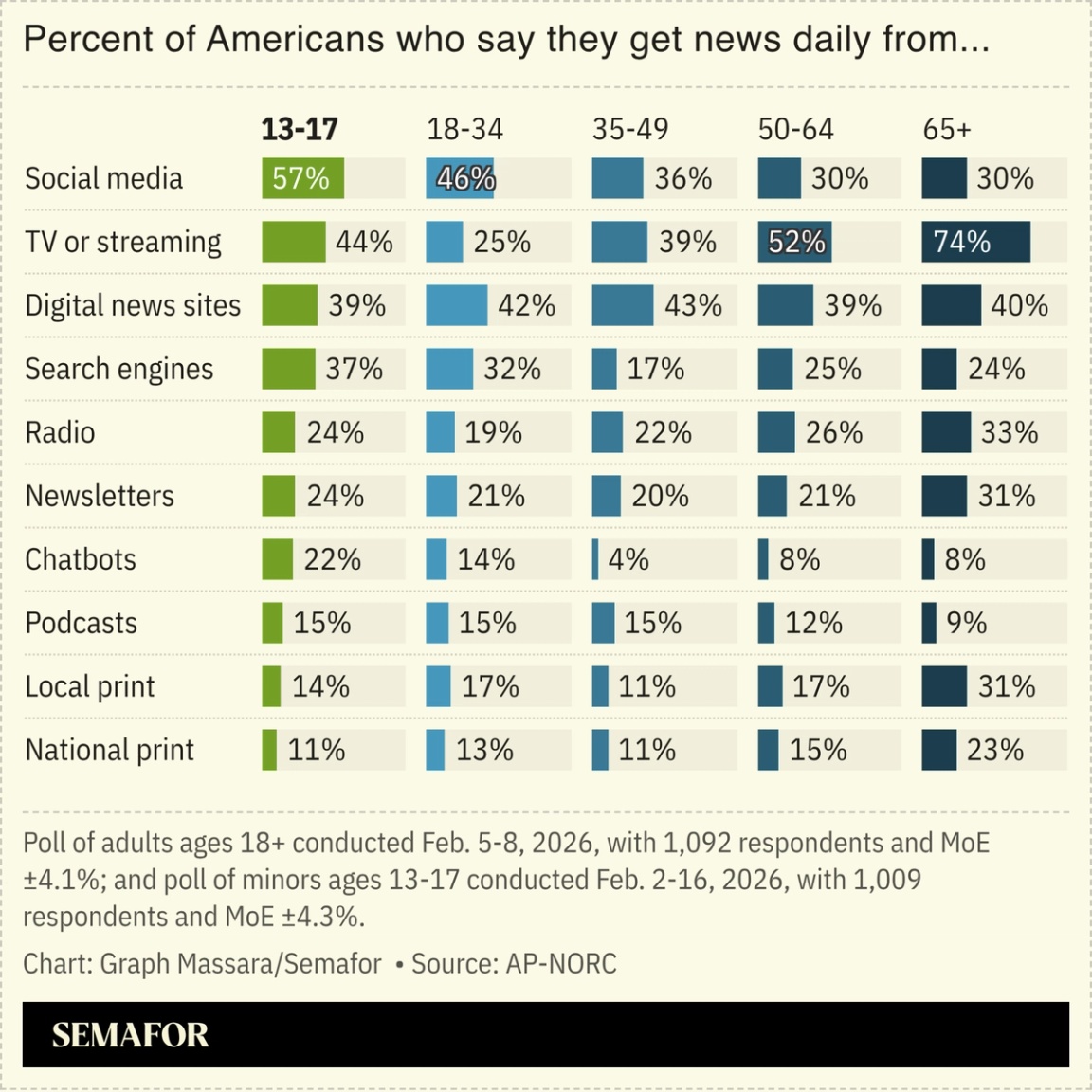 American teens today are getting their news from… everywhere. A new AP-NORC survey of Americans ages 13 and up, out last week, shows that the youngest media consumers are omnivores; 13-to-17-year-olds said social media (57%) was their top source of daily news, and TV, their parents’ favorite source, was their No. 2. But sizable portions also said they get news each day from search engines (37%), email (24%), radio (24%), and chatbots (22%), a more even spread than older cohorts. And 57% of teens said they “sometimes” or “often” get information on national news from influencers or independent creators (compared to 44% average across age groups). Another finding from the survey suggests the reason why: Teens distrust all news sources roughly equally, except for AI, which they trust even less. — Graph Massara |
|
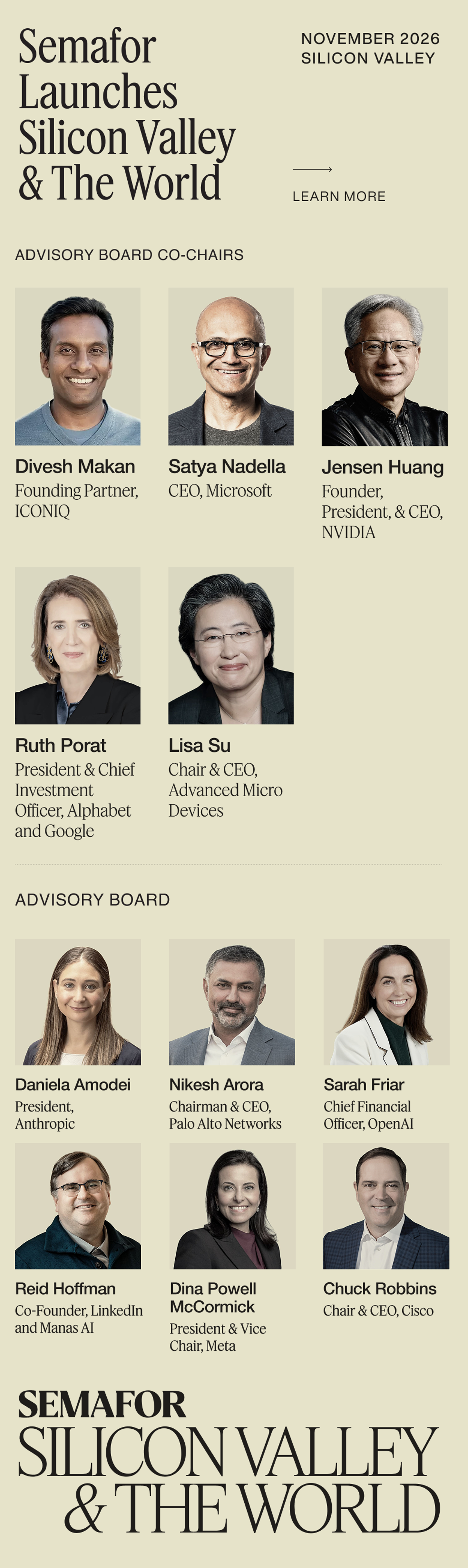 Semafor’s Silicon Valley & The World will bridge the widening gap between the leaders building artificial intelligence and other breakthrough technologies and the leaders responsible for shaping the strategies, policies, and institutions around them. Co-Chaired by Divesh Makan, Satya Nadella, Jensen Huang, Ruth Porat, and Lisa Su, this new initiative will bring together top technology CEOs, senior government officials, and global financial leaders in Silicon Valley in November. Building on the success of the 2026 annual convening of Semafor World Economy, Semafor’s Silicon Valley & The World will be the definitive forum to connect builders of transformative technologies with the global institutional leaders shaping their consequences. Through Semafor’s signature live journalism, the initiative will examine the forces now sitting at the center of global leadership: artificial intelligence, national competitiveness, energy demand, capital formation, security, labor markets, and the shifting relationship between technological power and public authority. |
|
WSJ: Amazon is in talks to produce a reboot of The Apprentice, with Donald Trump Jr. as host, Jessica Toonkel and Dana Mattioli scoop. Bloomberg: An explosion in AI-generated “podslop” has human podcasters wondering how to break through, Ashley Carman writes. Breaker: Will Lewis’ post-Post gig is consulting for Greek media company Antenna, Lachlan Cartwright reports. Status: The Washington Hilton sent a “hefty bill” to the White House Correspondents’ Association for last month’s scuttled dinner, and hasn’t offered to help shoulder any do-over costs, Oliver Darcy writes. |
|
 - Anna Wintour’s view of The Devil Wears Prada seems to be softening just in time for the release of its sequel — and next week’s Met Gala. Wintour has been famously cagey about the 2006 film, in which Meryl Streep plays an icy fashion editor inspired by Wintour. But in the leadup to the film’s premier, the longtime Vogue editor sat for an interview about the film with her successor and Streep; Vogue’s podcast has done three different episodes on the new film over the last few days. All of this is funneling more attention towards the movie, which is performing well at the box office.
- In a meeting with staff this week, Business Insider CEO Barbara Peng said that the company is seeing some positive signs in its focus on user engagement. Peng said so far this year, the company is meeting its revenue goals for advertising, subscriptions, commerce, and events, though it is slightly behind its targets for its syndication and partnerships. Peng also said it has been pleased so far with its audience targets, slightly exceeding its goals for return visitors.
- Versant made a sale.
|
|
|


