By Jorge Liboreiro
Brussels is known as the city of leaks. Any document, particularly those highly anticipated, runs the high risk of being circulated against the will of its authors before its official presentation. Journalists are notorious virtuosos in the field. But so are policy experts, lobbyists and advocates, all of whom have their own channels to secure privileged access to information.
However, no leak, and no leaker, is ever the same, as this week has proven.
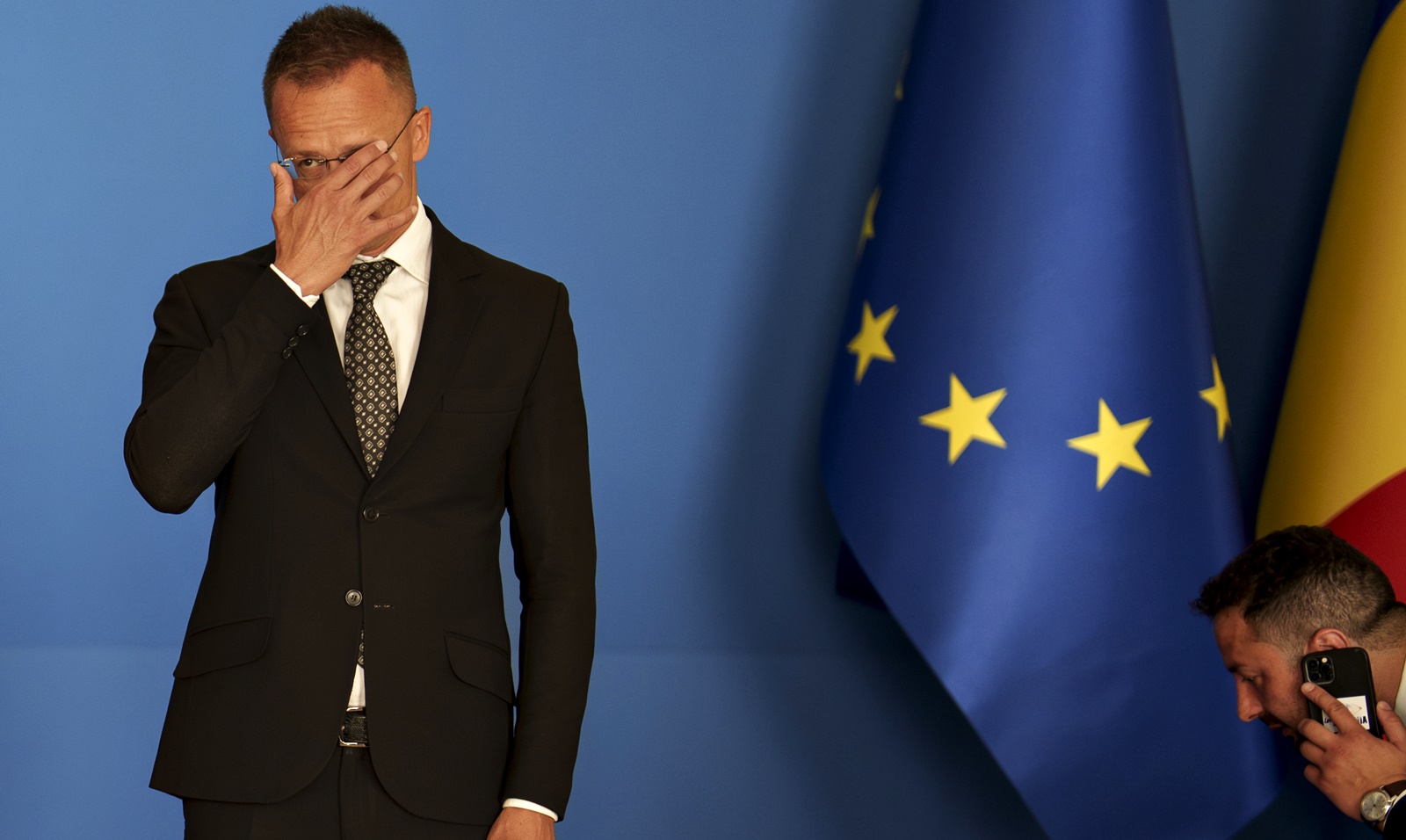
In a headline-making admission, Hungary’s Foreign Minister Péter Szijjártó openly said he speaks with his Russian counterpart, Sergey Lavrov, “before and after” meetings of the EU Council. He also does this with his partners in the US, Turkey, Israel and Serbia. “What I say may sound harsh, but diplomacy is about talking to the leaders of other countries,” he said during a campaign event.
It wasn’t an unprompted confession. A few days later, the Washington Post had published a bombshell story about a purported Russian plan to stage an assassination attempt on Hungarian Prime Minister Viktor Orbán to help win the pivotal election in April, where the incumbent trails by double digits.
But the story caught the attention of Brussels because of one paragraph in the middle that indicated Szijjártó makes “regular phone calls” during breaks at EU meetings to provide Lavrov with “live reports on what’s been discussed” and possible solutions, citing European security officials.
At first, Szijjártó went on the offensive, calling the article “fake news”. Shortly after, he changed his tune with the “before and after” nuance. The clarification did nothing to soothe the scandal. The German Foreign Office said the allegations were “very, very serious”, while the European Commission said member states were bound by “the legal duty of sincere cooperation”.
Polish Prime Minister Donald Tusk, whose relationship with Orbán is, to say the least, fraught, didn’t mince words, calling it a “disgrace”.
“We’ve had our suspicions about that for a long time. That’s one reason why I take the floor only when strictly necessary and say just as much as necessary,” he said.
Other leaders, however, were conspicuously silent. Tensions with Orbán are already sky-high over his veto on the €90 billion loan for Ukraine. There’s a reluctance to escalate amid a brutal campaign.
In Brussels, diplomats quipped: “Colour me shocked” after the revelation, almost as if they were expecting it. After all, as the Washington Post story pointed out, Szijjártó has made 16 official visits to Moscow since the start of the full-scale invasion of Ukraine. Telephone calls are just another element of the controversial re-engagement, they said.
Still, there is a difference between travelling to Moscow to conduct bilateral relations and calling your Russian counterpart “before and after” key EU meetings. Szijjártó’s on-the-record admission raises important security questions. Did Hungary coordinate its position with Russia in advance? Did Hungary disclose any information that was deemed sensitive, or even confidential? Did Hungary warn Russia of any course of action that the bloc was about to take, such as sanctions? Did Russia use those insights to prepare its response?
It’s almost certain we’ll never know for sure.
But the uncertainty itself raises yet another important question that touches the very core of our decision-making. Can the EU properly function if member states don’t trust each other?
For decades, the EU operated under the unspoken assumption that its member states would always, and without exception, uphold its integrity, fundamental values and common interests. The assumption was so strong that the Treaty of Lisbon, signed in 2007 and still in force, didn’t include a provision to expel a country outright, regardless of the lengths that said country might go.
The farthest the treaty dared go is Article 7, which allows depriving a member state that commits a serious legal breach of its voting rights. From the moment of its inception, the provision was conceived as a last resort. Reading through it, you can see why: moving to the last stage of punishment requires the unanimity of all member states except the one under scrutiny.
It’s a formidable standard to meet: 26 capitals would have to agree to suspend the voting rights of their peer, rendering it voiceless and therefore powerless. It’s a last resort that many are unwilling to trigger out of fear of facing the same fate sometime in the future. (Never underestimate how much countries like to vote.) This explains why Hungary has been subject to Article 7 since 2018 on a strictly putative basis, without any repercussions.
Meanwhile, the principle of sincere cooperation, which has been repeatedly invoked in the past few days, lacks an immediate enforcement mechanism. The most Brussels can do is launch legal action and wait for the court to rule in two years. What’s left are makeshift solutions.
“The others can also meet without Hungary,” José Manuel Barroso, the former president of the European Commission, told Euronews.
“Beyond the legal measures, I think it can be more effective politically to show a country that behaves like that, not respecting the basic principles of decency, that the other countries can move on politically as well.”
|