But the exact boundaries can be hard to pinpoint — even for reporters.
Nonprofit, investigative journalism on a mission to hold the powerful to account. Donate

ProPublica
ProPublica

Dispatches

March 21, 2026 · View in browser

In this week’s Dispatches: Prosecutors are charging border crossers for trespassing on land recently designated as “national defense areas.” Data reporter Agnel Philip explains what happened when he tried to find the boundaries of these new military zones.


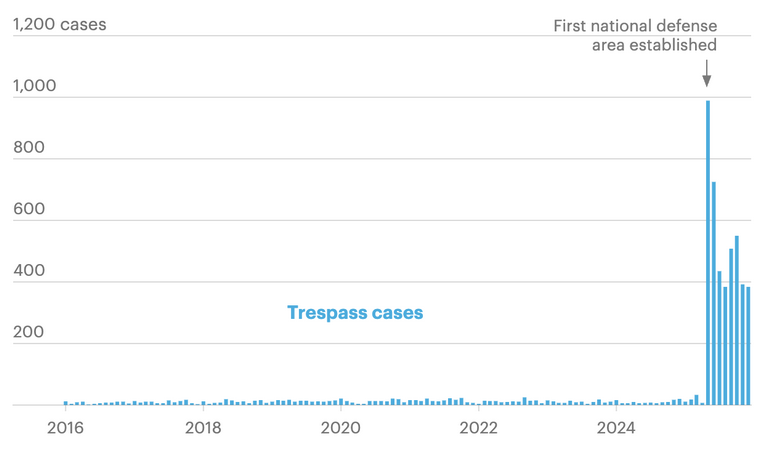
Our reporting started, like much of our work, in a spreadsheet. As I parsed through federal court data, I noticed something odd: Within months of President Donald Trump’s inauguration in January 2025, prosecutors began filing obscure charges related to trespassing on military property — so many, in fact, that more cases were filed in 2025 than in the prior decade.

Agnel Philip, ProPublica data reporter

A bar chart showing trespass cases from 2016 through 2025. Cases remain very low until mid-2025, when they suddenly spike to nearly 1,000. A label that says “First national defense area established” points to the highest point of the spike.

Note: Counts are of unique cases in which charges were filed under 50:797 (“Penalty for violation of security regulations and orders”) and 18:1382 (“Entering military, naval, or Coast Guard property”). Source: Federal Justice Center’s Integrated Database


Nearly all of these charges originated from cases along the U.S. southern border, where last spring, the White House designated large swaths of land as national defense areas. Putting them under military authority allowed troops to play an unprecedented role in apprehending undocumented immigrants; federal soldiers are generally barred from enforcing the law on domestic soil. If you were caught in one of these zones, the government could also now prosecute you for breaking federal laws, including one enacted in 1909 to keep spies away from arsenals.


In an investigation we published this week, my co-reporters Perla Trevizo, Abe Streep, Pratheek Rebala and I dug into what experts say is a major flaw afflicting these prosecutions that threatens to ensnare people for crimes they did not commit: Migrants didn’t know the land they were crossing now belonged to the armed forces. And many judges have ruled that you can’t be guilty of trespassing on military land if you had no idea you were on it.


Since April of last year, we found, at least 4,700 immigrants already charged with entering the country illegally faced these military trespass charges; at least one had to wait in jail for more than a month to stand trial. Most of the charges didn’t stick. In fact, we found that in 60% of the resolved cases, the trespass charges were dropped or dismissed. Yet prosecutors kept filing them.


As we visited courtrooms in West Texas and New Mexico and pored through case records, it became clear how hard it would be to prove that someone knowingly trespassed on military land. Some couldn’t read. At least one person didn’t speak English or Spanish. The small signs are spaced far apart and easy to miss, and many migrants were arrested far away from them.


A Justice Department spokesperson said the prosecutions have deterred unauthorized border crossings and cartel activity. And prosecutors have argued in court that illegally crossing is enough to prove criminal intent for the military trespassing charges. Senior officials in the U.S. attorney’s offices handling trespass cases declined repeated interview requests.


In November, Perla, Abe and I set out to report throughout southern New Mexico and West Texas to see for ourselves what information we could gather about where the zones were and how they were marked.


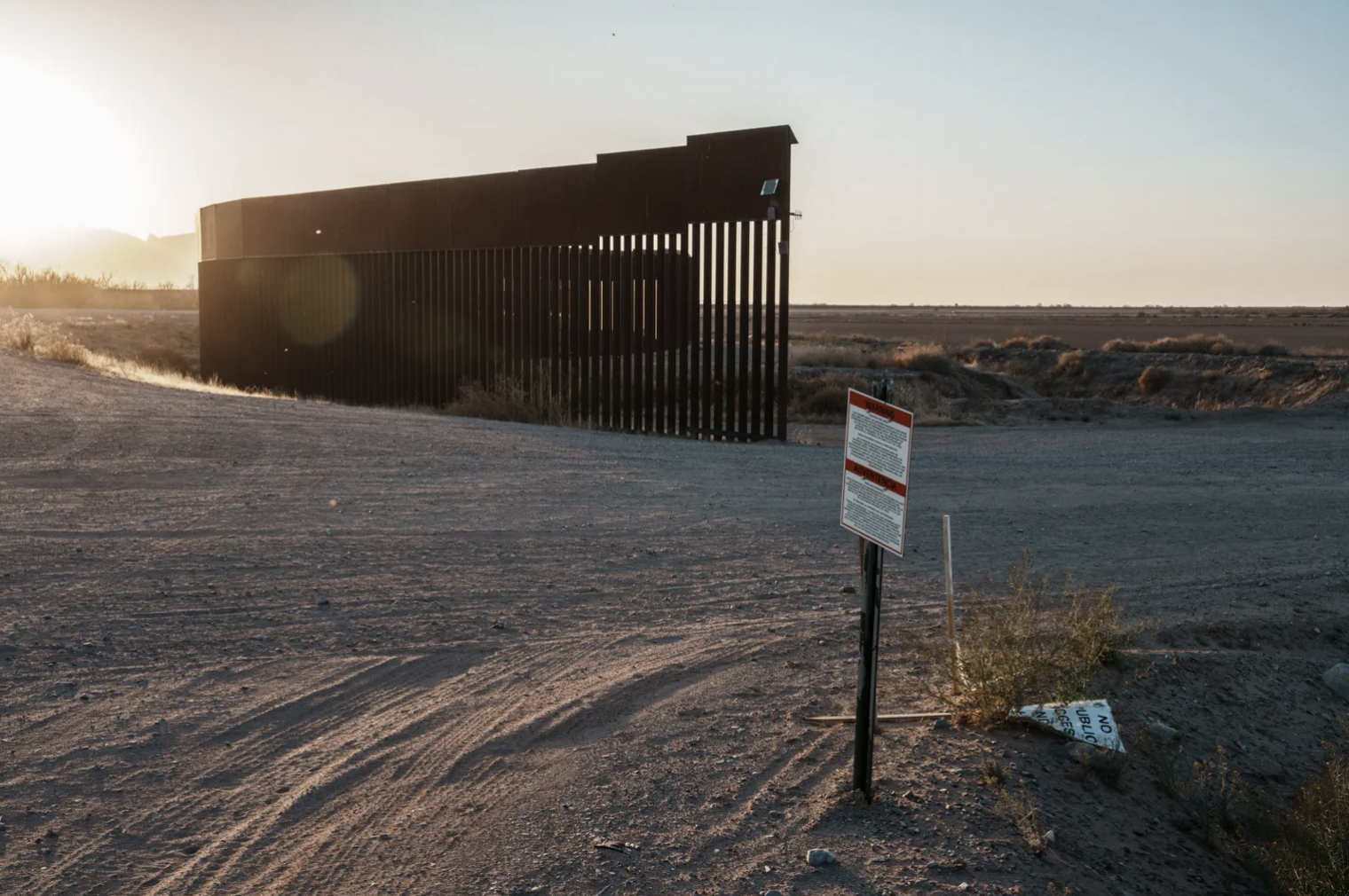
Abe and I arranged a ride-along with Doña Ana County Sheriff Kim Stewart, whose New Mexico agency shares jurisdiction with Border Patrol and the military in one of the zones.  A sergeant from her office drove us along a dirt road that parallels the border as she pointed out 12-by-18-inch red and white signs opposite the fence. She told us her office hadn’t received specific information about where the military zone boundaries were; all they had were the signs. Even in broad daylight, it was difficult to read the words on them unless we got within a few feet.


Read the full investigation

The Trump Administration’s “Disturbing” New Legal Strategy to Prosecute Border Crossers Is Taxing Courts and Testing the Law   


On another outing in New Mexico — this time with the photographer Paul Ratje — I went to a spot in Sunland Park where Ratje said he’d previously taken photos of the border fence. The 2-acre dirt lot sat less than a mile from residential neighborhoods and a popular Italian restaurant. From the lot, we could see more red and white signs along the nearby border road.


While we were taking pictures, a pickup truck with a Border Patrol livery approached us. I was surprised to see that inside, instead of Border Patrol agents, there were two Army soldiers. The soldier in the passenger seat pointed to the signage along the border road and told us not to go past there. The border road was part of the defense area, he told us, though the lot we were standing in wasn’t.


The next day, Perla and I returned to the same location. This time, a Border Patrol agent drove up. The lot was part of the defense area, he told us. When I pointed out that I had been given conflicting information the previous day, the agent said he was told by the military that people couldn’t be in this area. We left. (An Army spokesperson said that the base responsible for the defense area in New Mexico published a map in December; the lot was not included in it.)


Detained migrants have said they didn’t see the posted signs and had no way of knowing they had crossed military land. (Paul Ratje for ProPublica and The Texas Tribune)


My interactions with Border Patrol and the military had so far only added to our confusion about these areas. Later that day, Perla and I drove south to a stretch of border fence along the Rio Grande near Tornillo, Texas. We saw a Border Patrol van near a gate in the fence. We thought we’d try to ask where the defense area was. Before we could do that, another Border Patrol van pulled up to us. Soldiers, including one with a rifle strapped across his shoulder, emerged from both vehicles. Another soldier told us he was “not at liberty to discuss” the national defense area’s exact location. 


The response bewildered us. We asked him how we were supposed to know whether we were trespassing. He shrugged. (Spokespeople for U.S. Customs and Border Protection and the Department of Defense did not directly answer questions about these interactions.)


As we got back into our rental SUV, Perla and I wondered: If we, as reporters who investigate things for a living, couldn’t get a straight answer on where these military zones were, how did the government expect people crossing the border to do better? 


In the four months between our reporting trip and the publication of our investigation this week, the government continued to file military trespassing charges in more than 1,300 cases. And it’s established new military zones, too, in Arizona, California and Texas.


More From Our Newsroom


The Number of Families Being Held at Dilley Detention Center Has Plummeted

DOGE Goes Nuclear: How Trump Invited Silicon Valley Into America’s Nuclear Power Regulator

As Trump Demands Voter Data, This Fiercely Independent Red State Says No

She Was in Labor at a Florida Hospital. Then She Was in Zoom Court for Refusing a C-Section.

How Robert F. Kennedy Jr.’s Vaccine Agenda Risks a Resurgence of Deadly Childhood Plagues


Find us on Facebook Find us on Facebook Threads Find us on Instagram Find us on Instagram Instagram Watch us on TikTok Watch us on TikTok TikTok Find us on X Find us on X (Twitter) Find us on Mastodon Find us on Mastodon Mastodon

Was this email forwarded to you from a friend? Subscribe.


This email was sent to npy7hz0ktx@niepodam.pl.

 
Preferences Unsubscribe
 

ProPublica

155 Ave of the Americas, 13th Floor

New York, NY 10013