Hi! If you want to put a positive spin on your latest workplace flop, the English-to-LinkedIn AI translator can help — you didn’t "accidentally delete the presentation,” you “learned a powerful lesson in the importance of cloud-based version control #GrowthMindset.” Today we’re exploring:
|
- Dollywood: Can a Labubu spin-off create the same buzz that the Barbie movie did?
- Unzucky: The metaverse may be another name in the Big Tech graveyard.
|
✍️Don’t hold back… We’re answerable to you, our readers — so we want to know what matters to you. Join thousands of readers shaping our future newsletters by taking our three-minute audience survey. |
The Labubu movie is just the latest toy story hitting the big screen |
Just when you thought last summer’s collectible craze was over, and Google searches for “labubu” had finally cooled off, someone decided to feed the gremlin-like dolls after midnight... with a concept for a new live-action and CGI feature film.
On Thursday, Sony Pictures and Chinese toy giant Pop Mart — maker of Labubu dolls, the global sensation that raked in a mind-boggling $670 million in sales for the first half of 2025 — announced that a Labubu movie is in “early development,” with the BBC reporting that “Paddington” director Paul King will helm the project.
|
Whether you love or hate the toothy-grinned tchotchkes, it was maybe only a matter of time before Hollywood cashed in on the Labubu frenzy.
Today, the destiny of beloved childhood toys (or adulthood obsessions) seems mostly to be to hit the big screen. Among the first were the “Transformers” franchise movies, based on Hasbro’s popular robot-car convertibles, which have roared since their 2007 debut. |
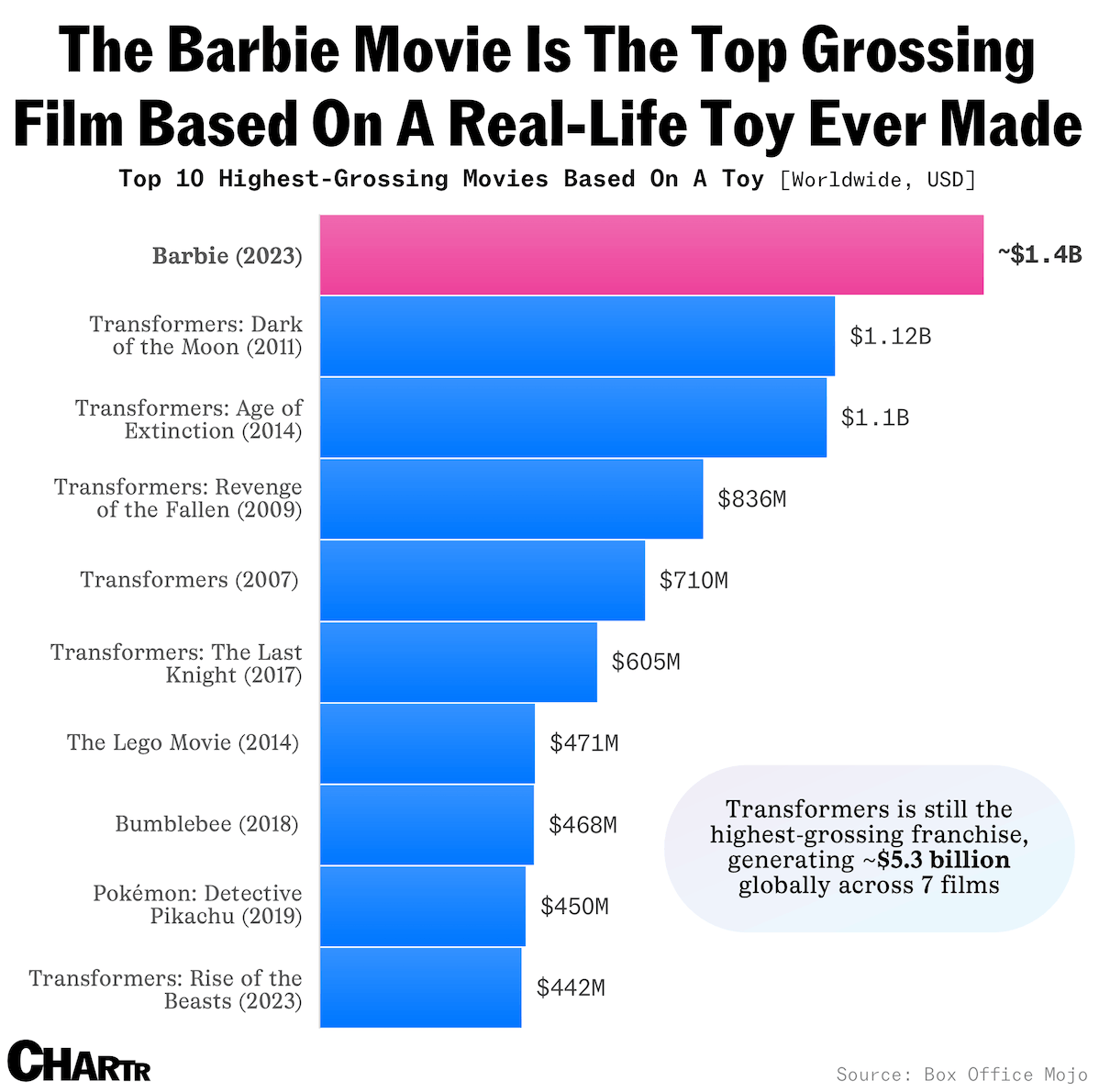
“Transformers” changed Hollywood’s relationship with the toy industry for good, having grossed ~$5.3 billion across just 7 films. Not long after, Lego, the world’s biggest toymaker, developed a string of its own blockbusters.
But the “Barbie” movie brought IP-adapted media to a new level in 2023, having taken ~$1.4 billion around the world — making it the highest-grossing movie based on a real-life toy ever, as well as the 18th best selling movie of all time, per Box Office Mojo figures.
However, as Barbiemania helped drive the movie towards fantastic box-office numbers, how much did Mattel, the maker of the decades-old dolls, actually benefit from the pink wave? |
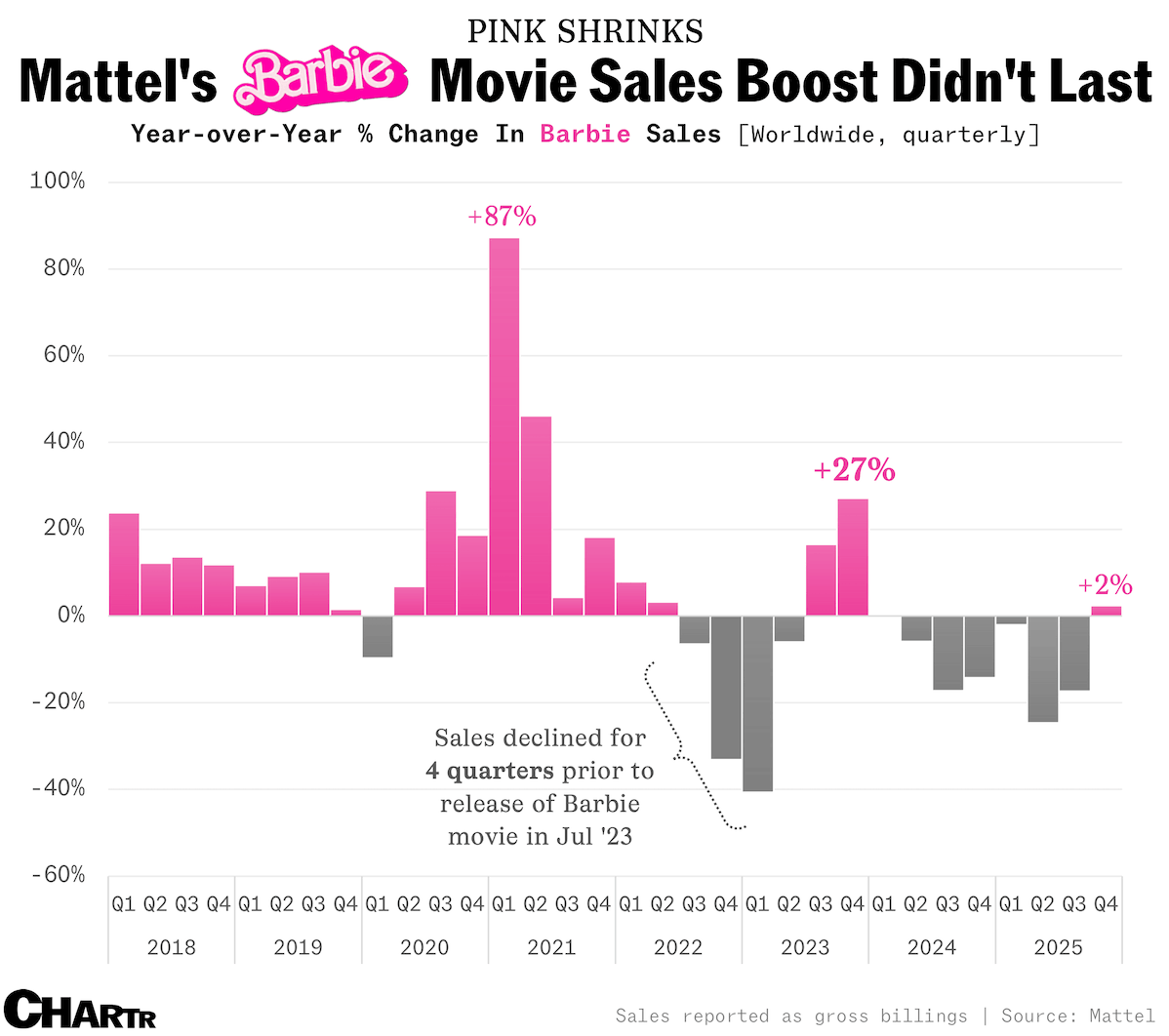
Immediately after the film’s release, sales of the Barbie brand reversed at Mattel — seeing four consecutive quarters of year-over-year sales declines turn positive, and notching record revenues of $605 million in Q3 2023. Mattel’s Barbie sales also jumped 27% YoY in the following quarter.
While still smaller than Barbie’s pandemic-era sales boost, the film helped to shift more dolls than the company had seen in years... though Mattel’s stock price didn’t grow in line with the surge in interest, and Barbie sales slumped across much of 2024-25. |
What can Pop Mart take away from this for its upcoming movie? Well, Mattel shares are continuing to sink as sales fail to deliver; Hasbro’s market cap rise during peak “Transformers” was short-lived; Lego is, of course, Lego. So, while toy movie hits are no guarantee of lasting business success, a new animated kids movie with Chinese origins could at least become box office catnip.
|
|
|
Energy at the Center of Geopolitics |
Geopolitics continues to play a crucial role in global oil and liquefied natural gas (LNG) prices.
Recent conflict and the risk of broader escalation in a region critical to energy flows highlight how quickly supply concerns can resurface. This balance between supply and demand ultimately determines the fundamental direction of prices over the longer term.
At the same time, the global economy faces the reality of rapidly expanding AI influence and the massive amounts of energy, and critical minerals, required to power it. In a world of rising structural demand and constrained supply, VanEck believes the outperformance of the oil and gas sectors will likely continue. The VanEck Oil Services ETF targets the companies behind global oil and gas production: drillers, equipment providers, and service leaders, and offers concentrated exposure to the operational backbone of the energy industry. |
|
|
The metaverse’s slow, drawn-out demise is getting painful |
On Tuesday, in a stark and much-needed reminder not only of the metaverse’s existence, but also of its prolonged disassembly, Meta announced that it would be pulling Horizon Worlds, its metaverse social network, from VR headsets.
By Wednesday, the company’s plans had changed, with Meta’s CTO announcing on Instagram, “We have decided, just today in fact, that we will keep Horizon Worlds working in VR for existing games” — a U-turn that a Meta representative then confirmed to TechCrunch.
This latest debacle (and a catalog of others before it) makes you think that switching off the metaverse might no longer be a question of “if,” rather than “when?” Both questions can, naturally, be answered with a third: “Will anyone actually care?” |
Vaulting ambition, which o’erleaps itself… |
None of this, it should be noted, was for lack of trying — or spending. In 2021, after rebranding the entire company around his bet that we’d rush to his new and exciting virtual universe, CEO Mark Zuckerberg said, “Over time, I hope that we are seen as a metaverse company.” To his credit, Zuckerberg put his money where his mouth was: from Q4 2020 to the end of 2025, Meta racked up losses of ~$80 billion across its Reality Labs division, which houses the metaverse as well as other VR and AR products.
Though that cash burn might make the metaverse one of the costliest wrong turns in recent tech history, it’s hardly the only project to have been hailed as the future, only to quickly fade and become a punchline, or a forgotten ember burning on the dumpster fire of technology missteps. |
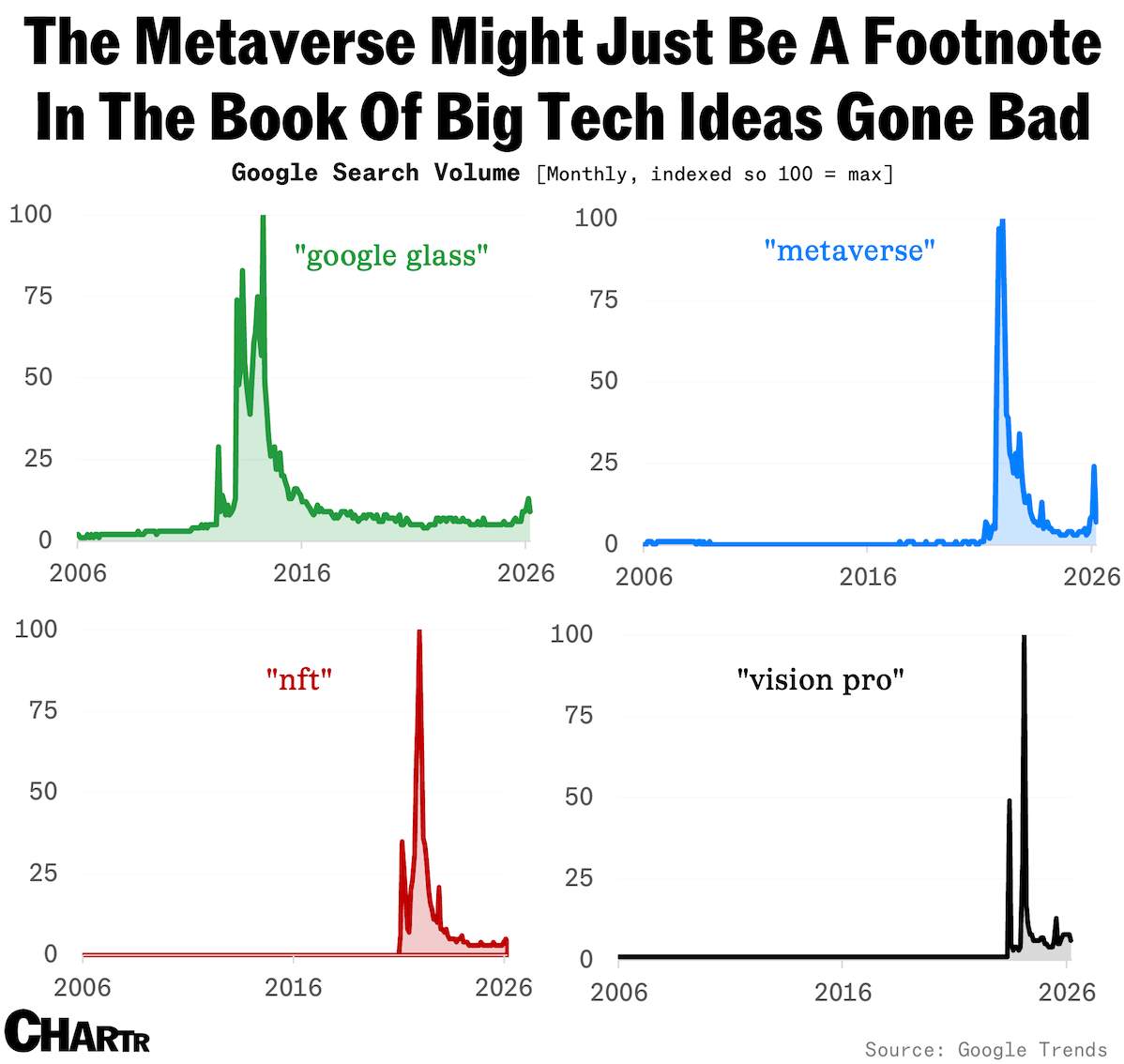
Buzzy products from the biggest names in Big Tech, like Apple’s Vision Pro or Alphabet’s Google Glass, have seen similarly short-lived hype cycles and have come to be widely regarded as failures. Meanwhile, NFTs, one of the most talked about (and ridiculed) tech concepts of the 21st century, have nearly vanished, with a report suggesting that 96% of NFT collections were “dead” by 2024.
Even though the decline must be tough for Zuck and co. to take, our thoughts through this latest tech wind-down are mostly with the user who shelled out $450,000 to become Snoop Dogg’s neighbor in the metaverse five years ago (yes, really). |
-
Futures dipped and oil prices rose to briefly top $110 per barrel this morning, on further strikes and a report that President Trump is mulling a takeover of an Iranian island that processes crude exports.
-
Uber is investing $1.25 billion in Rivian to deploy 50,000 robotaxis by 2031, expanding its 20+ partnerships with autonomous vehicle firms including Waymo and Baidu.
-
Top dogs: Dachshunds broke America’s 5 most popular dog breeds for the first time in over 20 years, while registrations for French bulldogs (who sit at the top) fell, per new data.
-
Shares of Super Micro plunged 28% after its co-founder was charged with allegedly smuggling $2.5 billion worth of AI servers into China.
-
K-pop boy band BTS will perform their first show in over three years on Saturday, streamed live on Netflix, ahead of an 82-date global tour.
|
|
|
In a world of rising structural demand and constrained supply, the outperformance of the oil and gas sectors will likely continue. The VanEck Oil Services ETF offers concentrated exposure to the backbone of the energy industry. Learn more. |
|
|
-
Eggspensive: John Rush collected more than 11,000 receipts of his egg purchases to track prices over the past 25 years.
-
Visualizing how the global network of secret societies has expanded over time.
|
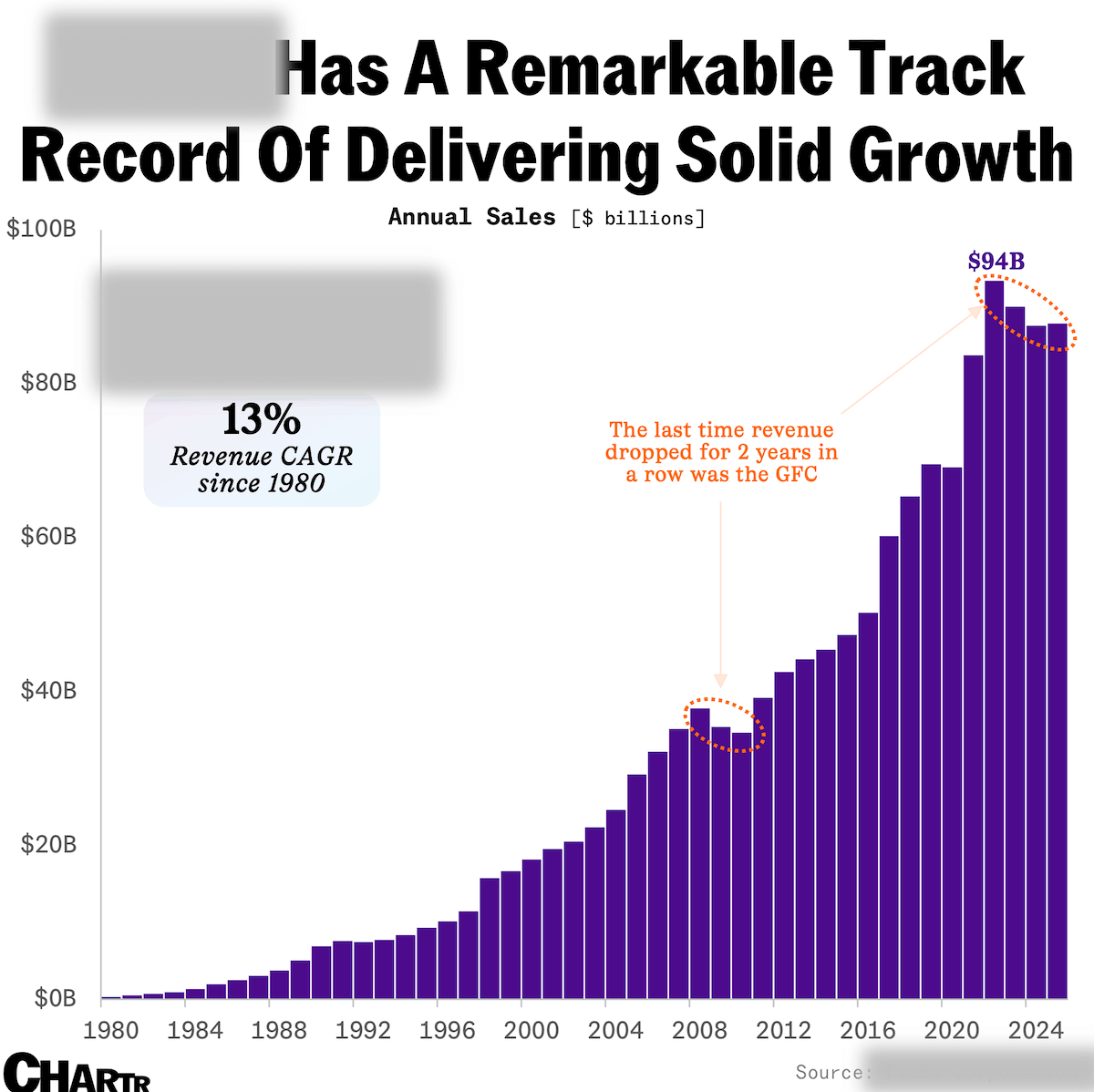
Off the charts: Which company saw its stock rise sharply this morning after delivering a tidy earnings package for investors? [Answer below]. |
Not a subscriber? Sign up for free below. |
VanEck Advertising Disclosures:
An investment in the VanEck Oil Services ETF (OIH) may be subject to risks which include, but are not limited to, risks related to investments in oil services companies, depositary receipts, special risk considerations of investing in European Issuers, foreign securities, small- and medium-capitalization companies, equity securities, m |
|
|
|