|
At CT, we strive not only to cover dense doctrinal topics or explore new aspects of biblical theology but also to do that through a gospel-centered lens. We also want to present these topics in a way that fosters delight in Christ, something theologian Andrew Wilson finds in Christopher Ash’s 2024 commentaries on the Psalms. Wilson also reviews How to Teach Kids Theology, reminding us that how and what our kids think about God truly matters. |
|
Senior Features Editor, Christianity Today |
Three Theology Books to Read This Month |
|
A. W. Tozer once said, "What comes into our minds when we think about God is the most important thing about us." If that is even close to being true, then children need to be taught theology as much as anybody does. This book aims to equip people to do that: to "provide leaders with the principles and practices needed to teach biblical passages and stories to kids with theological conviction and competency." |
|
The result is commendable in several ways. The writers don't suggest dumbing down the content; the writers treat children as people who need to know the deep things of God, not just life advice or instructions on good behavior. The writers use questions and (mis)understandings of real, specific children as springboards for talking about particular doctrines. There is a good balance between the conceptual and the practical. The authors highlight the importance of God’s big story in our communication of theology and do not shy away from difficult ideas or passages. |
|
They also distinguish between central, debatable, and peripheral doctrines and reflect on how to differentiate between them and teach children accordingly. The children’s author in me appreciated these emphases and would love to see them accepted more widely. |
|
At times I found myself puzzled. There is a whole chapter on the difference between "simplifying" the truth (which the authors see as a problem) and "distilling" it (which is their solution), involving distinctions which I found oversubtle and ironically a bit complicated. I am not sure why the authors insist that the primary point of the Good Samaritan is not that we should love our enemies, which seems to me to be Jesus’s punch line in Luke 10:37, but that "our enemy loved us." I thought the book would include more examples of how we can use visual illustrations, objects, life stories, and humor in our communication, and more reflection on the way Jesus himself used these tools. Nevertheless, there is plenty of wisdom to learn here. |
|
Christopher Ash has written a masterpiece: a four-volume commentary on the Psalter that is devotional, scholarly, searching, and delightful. Some commentaries aim at academics, some at pastors, and some at ordinary believers. Many of the best combine elements of all three. But Ash has done something remarkable by writing in a way that is well-versed in the scholarly literature and history of interpretation—much of which he discusses directly in the ground-clearing first volume—yet filled with devotional warmth, theological insight, pastoral application, and evident delight in Jesus Christ. My wife and I have been using it for our daily readings over the last year, sharing (and occasionally squabbling over custody of) each volume. |
|
The secret sauce is the books’ Christ-centered approach to interpretation. For Ash, it is not just that the Psalms reveal Christ in a general, typological way. Nor is it that some Psalms are messianic (22, 31, 45, and so forth) and some are not. The key to the Psalter is that Christ is the primary speaker, singer, and prayer of every Psalm, including the laments, imprecations, confessions, and songs of praise. He prays Psalm 51 as the representative head of the church, confessing our sins as they are laid upon him and asking for mercy. He sings Psalm 95 as our corporate worship leader, summoning God’s people across time to join him in celebration and obedience. He prays Psalm 119 as a fellow meditator on the beauty, wisdom, and sufficiency of God’s Word. So when we read the Psalms, we read them not only as our words or those of the original author but also as those of Jesus. The result is a doxological tour de force. |
|
Martin Luther, The Freedom of a Christian (Fortress, 2008) |
|
At the end of his life, Martin Luther said all his books could be burned except for two: The Bondage of the Will and The Small Catechism. I think he was wrong about that. For me, his most powerful and compelling work is The Freedom of a Christian, which was written in the maelstrom of 1520 as the Reformation was exploding across Germany, and which set out several of his key ideas in pamphlet form. |
|
It opens with the magnificent paradox at the heart of Luther’s theology (and, he would argue, Paul’s): "A Christian is a perfectly free lord of all, subject to none. A Christian is a perfectly dutiful servant of all, subject to all." The doctrine of justification by faith means Christians are the freest of kings and priests forever, with no human power over us and no need of any work to save us. That argument occupies the first half of the pamphlet. But that same gospel also makes us servants of all humanity, as Luther shows in the second half: "If we recognize the great and precious things which are given us, as Paul says, our hearts will be filled by the Holy Spirit with the love which makes us free, joyful, almighty workers and conquerors over all tribulations, servants of our neighbors, and yet lords of all." |
|
The Freedom of a Christian is a short, punchy, and readable statement of many of Luther’s most influential teachings, including the relationship between faith and works, the priesthood of all believers, the marriage analogy for union with Christ, and the oft-quoted idea that although God does not need our works, our neighbor does. If you haven’t read it yet, do yourself a favor. |
|
|
|
|
No good editor will let you start an article with a dictionary definition, which is perhaps the surest sign that a writer has no idea where to begin. But for…
|
|
|
|
|
Roughly 80 years ago, Christian novelist Jan Karon, creator of the beloved 15-volume Mitford Years series, stood in front of a mirror and told herself she would be a writer.…
|
|
|
|
|
|
|
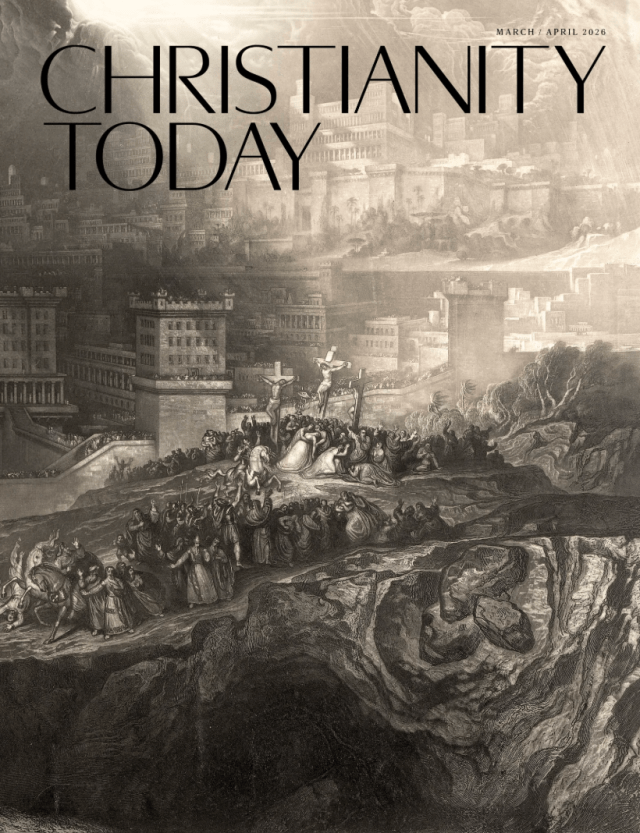
In this issue of Christianity Today and in this season of the Christian year, we explore the bookends of life: birth and death. You’ll read Karen Swallow Prior’s essay on childlessness and Kara Bettis Carvalho’s overview of reproductive technologies. Haleluya Hadero reports on artificially intelligent griefbots, and Kristy Etheridge discusses physician-assisted suicide. There is much work to be done to promote life. We talk with Fleming Rutledge about the Crucifixion, knowing that while suffering lasts for a season, Jesus has triumphed over death through his death. This Lenten and Easter season, may these words be a companion as you consider how you might bring life in the spaces you inhabit. |
|
more from christianity today |
|
CHRISTIANITY TODAY WEEKLY: CTWeekly delivers the best content from ChristianityToday.com to your inbox each week. |
|
CT PASTORS: Each weekly CT Pastors issue equips you with the best wisdom and practical tools for church ministry. |
|
Each issue contains up-to-date, insightful information about today’s culture, plus analysis of books important to the evangelical thinker. |
|
Delivered free via email to subscribers weekly. Sign up for this newsletter. |
|
You are currently subscribed as npxlpxnaph@nie.podam.pl. Sign up to more newsletters like this. Manage your email preferences or unsubscribe. |
|
|
|
Christianity Today is a 501(c)(3) nonprofit organization.
"Christianity Today" and "CT" are the registered trademarks of Christianity Today International. |
| | | |