What matters in U.S. and global markets today

Get full access to Reuters.com for just $1/week. Subscribe now.


Morning Bid U.S.

Morning Bid U.S.

A Reuters Open Interest newsletter

What matters in U.S. and global markets today


By Mike Dolan, Editor-at-Large for Finance and Markets

The energy shock has kicked up a notch, with Brent crude rising above $115 a barrel this morning. Prices started shooting up on Wednesday after Israel targeted Iran’s South Pars natural gas field - the largest in the world - sparking retaliatory attacks by Tehran on gas facilities throughout the region, including against Qatar's Ras Laffan energy complex.

Meanwhile, markets read Wednesday's Federal Reserve's policy decision as hawkish even as it kept rates on hold. Chair Jerome Powell acknowledged the war had injected considerable uncertainty as the Fed lifted its full-year inflation forecast, with futures markets now no longer priced for a rate cut in 2026. Powell's sentiment is likely to be echoed in the communications of the other central banks meeting today.

I’ll get into that and more below.

But first, check out my latest column on what global investors should do amid the Iran conflict - and the factors potentially beyond their control.

And listen to today's episode of the Morning Bid podcast, where I discuss how the latest energy ructions in the Middle East are testing central banks. Subscribe to hear Reuters journalists discuss the biggest news in markets and finance seven days a week.


Data refreshes every time you open this email. For more U.S. market news, click here. Please send any feedback to morningbid@thomsonreuters.com.


Today's Market Minute

  • Oil prices jumped on Thursday, with benchmark Brent rising to its highest in more than a week to more than $115 a barrel, after Iran ‌attacked energy facilities across the Middle East following Israel's strike on its South Pars gas field.
  • The Federal Reserve held interest rates steady on Wednesday and projected higher inflation and a single reduction in borrowing costs this year, a path that Federal Reserve Chair Jerome Powell said was subject to unusually high uncertainty.
  • The Bank of Japan kept interest rates steady on Thursday but warned of the impact rising oil costs from the Middle East conflict could have on ‌underlying inflation.
  • The Iran war’s impact on Gulf aluminium production and exports is accelerating disruption across an already fragmented physical supply chain, writes ROI Metals Columnist Andy Home.
  • The Iran conflict has shattered the fragile coexistence among Gulf energy producers that long underpinned regional stability. Oil and gas markets will now carry a higher Middle East risk premium for years - if not decades, argues ROI Energy Columnist Ron Bousso.
 

Gas field grief

Energy prices surged on the latest escalation in the Gulf. Not only has crude jumped, but European gas prices also soared by around 25%. WTI continues to trade at a wide discount to Brent, partly due to the releases from U.S. strategic reserves, with the U.S. benchmark now around $97 a barrel.

Stocks tumbled around the world on Wednesday as traders digested the latest oil price spike and hawkish signals from central banks. All major U.S. indexes closed down more than 1% after the Federal Reserve held rates steady and projected only a single rate cut for the year.

The Bank of Canada and Bank of Japan also stayed put, with both signalling willingness to raise rates if higher energy prices led to elevated inflation. For the U.S., the energy shock comes as inflation already looks to be running hotter, with producer prices rising by the most in seven months in February - 3.4% - well above consensus forecasts.

The dollar firmed on the Fed’s hawkish signals while the yen wilted, approaching its weakest level in two years. Meantime, gold fell on the stronger dollar, touching its lowest level since February 6.

The mood in equities was dour early on Thursday too, with Asian stocks falling on soaring oil prices. Japan’s Nikkei shed more than 3% and South Korean's KOSPI fell by 2.8%, while European stocks were also down. Wall Street futures were up slightly ahead of the bell, however. 

Further interest rate decisions will come later today from the European Central Bank and Bank of England, which find themselves in the same watch-and-wait boat on the Iran war’s economic impacts. As Fed Chair Jerome Powell put it on Wednesday, nobody really knows “how big this will be and how long it lasts”.

That’s especially true as the parameters of the conflict remain up in the air, with the Trump administration reportedly weighing deploying ground troops to the Middle East, according to a Reuters exclusive.

Away from geopolitics, the AI boom kept humming as Micron Technology posted a sharp second-quarter revenue jump on strong demand for AI memory chips and forecast third-quarter revenue above expectations. Still, its shares dropped 5% after hours as it flagged a $5 billion capex increase for 2026 - spending that investors remain uneasy about.

With that, onto today's column.


Don't panic, don't capitulate: investors try to see beyond Iran war

The scale and duration of this month's energy and inflation shock are still guesswork. But global investors are clearly reluctant to throw in the towel on stocks and bonds, despite the Iran war and a dour first quarter for returns.

Two basic factors explain the relative resilience of financial assets during a turbulent March.

The first is simply that history suggests these conflicts and related oil supply disruptions are often temporary. If you think this one will be too, you keep close ‌tabs on the themes that were booming beforehand - an artificial-intelligence frenzy and brisk earnings and GDP growth.

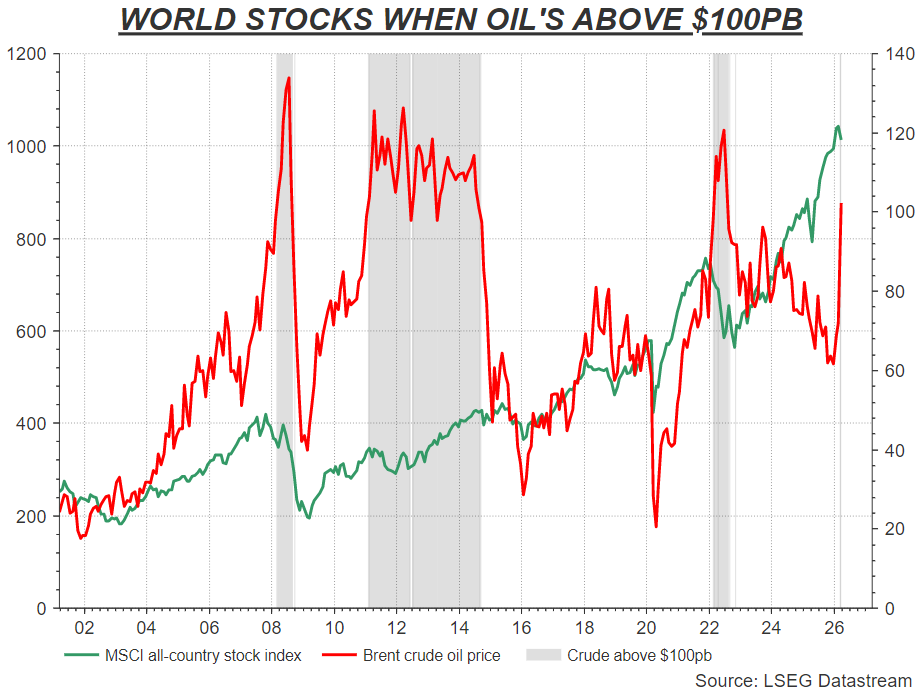
A second is that world stock markets have endured long periods of crude prices above $100 a barrel before without collapsing - unless there were related sharp rises in interest rates, as in 2022, or a bigger financial crisis in the background, as in 2008.


Graphics are produced by Reuters.

Read the full column