Lumina Foundation is working to increase the share of adults in the U.S. labor force with college degrees or other credentials of value leading to economic prosperity.
California is aiming to increase the number of residents with bachelor’s degrees to strengthen the regional workforce and economy. However, a new report from California Competes finds that among the population without a degree, student parents raising young children face some of the most significant barriers to enrolling in and completing college.
One of those barriers is the cost of childcare. For Bay Area parents, that number averages about $49,800 per year for families with young children. This represents more than half (57 percent) of the median household income for parents without degrees, compared to 21 percent for their degree-holding peers.
As the president of a small college in the Rust Belt, Jill Murray feels the crush of enrollment pressures. Her institution, Lackawanna College, has a plan to ease them: It’s starting the pipeline earlier by tapping into Pennsylvania’s 502 school districts.
Lackawanna’s dual-enrollment system is a recruitment tool. It offers college-level courses at $100 per credit—an 80-percent discount—to about 3,000 high school students, giving them some sense of what majors and career tracks they might pursue at the college.
A new report from Excelencia in Education makes one thing clear: Latino talent is vital to the nation's workforce—particularly in science, technology, engineering, arts, and mathematics (STEAM), where innovation and creativity converge to drive economic growth.
The research includes concrete recommendations for both institutions and employers to help more Latinos thrive. Institutions are urged to integrate arts into STEM and STEAM curricula, assess Latino participation at each stage of the pipeline, expand post-graduation mentorship and job placement, and track how alumni apply their education in the workforce. Meanwhile, employers are encouraged to move beyond passive recruitment and leverage existing partnerships with top-producing institutions.
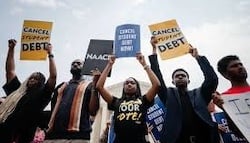
Over the past year, millions of borrowers have run into difficulties trying to navigate a complicated and confusing student loan system under the Trump administration. Experts say recent policy shifts have left nearly 45 million borrowers, disproportionately women, in financial and emotional distress.
Older borrowers especially face significant challenges in the student loan landscape, as the interest on their debt has accumulated over many years, often spanning decades. Meanwhile, Black women, who rely more on student loans than other demographics, are grappling with student debt at the same time they have been pushed out of the public service sector due to waves of government cuts.
The last time Jay Bhattacharya testified before Congress, in early February, the biomedical research community watched optimistically as the National Institutes of Health director downplayed the impact of last fall’s government shutdown on the pace of grant funding. Coming on the heels of lawmakers passing an appropriations bill that pushed back on the most drastic changes to the agency proposed by the Trump administration, scientists were hopeful that 2026 would treat them better than 2025.
But as the director returns to Capitol Hill to appear before the House Committee on Appropriations, that outlook has darkened.
Across Florida universities, some sociology professors are quietly choosing not to alter their courses in response to new state guidelines restricting how topics like race, gender, and sexuality can be discussed.
The professors say they are continuing to teach their classes as designed, rather than rewriting syllabi or removing foundational material as the new demands require. They're doing so because they view the preservation of their curricula not as an act of defiance, but as a professional responsibility to provide students with a full and rigorous education.