|
 |
Hey, guys—happy Friday. Over on the Bulwark homepage I’ve got review of two awards-season contenders: Sentimental Value, a movie about family and filmmaking, starring Stellan Skarsgård and Elle Fanning; and Sirāt, a story about how love may be the one thing that makes sense when the world goes insane. Check it out here.
Meanwhile, in today’s newsletter, I review the new ‘Knives Out’ installment—dropping on Netflix today—and end with a look at how this franchise can help us understand what the purchase of Warner Bros. by Netflix could mean for the movies.
All our work at The Bulwark—all my movie reviews and interviews and commentary, plus all our political and cultural coverage—is made possible by our Bulwark+ members. If you’re not a member yet, sign up today and get your first 30 days free. If you do sign up today, say hi in the comments—we’d love to hear from you.
–Sonny
‘Knives Out’ and Time for Forgiveness
Plus: How the ‘Knives Out’ franchise explains Netflix’s WB play.
|

| |||||||||||||||


 |
RIAN JOHNSON’S FIRST TWO Knives Out films are almost impossibly rooted in their own moments.
Benoit Blanc’s (Daniel Craig) initial outing is as 2019 a movie as exists, just a mishmash of clod-like conservatives and woo-woo progressive hypocrites and snide references to Hamilton, the ultimate symbol of Obama-era liberalism. The hero was a kindhearted immigrant whose mother was at risk of deportation; the villains, the epitome of white privilege. It was like a celluloid manifestation of “allyship.” But the overbearing ideological markers didn’t overwhelm the film because Johnson had crafted a clockwork-tight script, a deft combination of “whodunit” and “howcatchem” that kept audiences who thought they had it figured out guessing until the closing moments.
In 2022, Benoit Blanc returned in Glass Onion: A Knives Out Mystery. And like its predecessor, it too is a time capsule upon rewatch three years later: Shot in the midst of COVID and focused on a tech mogul and his moronic hangers-on (including, naturally, a manosphere podcaster and a sweatpants entrepreneur canceled for dropping ethnic slurs), the mystery at the heart of the picture was sloppier and the resolution less satisfying because it boiled down to Blanc yelling “You’re dumb” at the Elon Musk stand-in played by Edward Norton. This may have been emotionally satisfying for some, but intellectually it was fairly stultifying.
And now, three years later, Johnson and Craig are back with Wake Up Dead Man: A Knives Out Mystery. Suffused with Catholic ideas about guilt and penance, Wake Up Dead Man is an interesting counterpoint to the first two films. Yes, yes: the ideological signifiers are all still there. The worst characters are the most likely to code as rightwing doofuses; the kindest characters more likely to code as progressive. But for the first time in the series, Johnson offers up something like forgiveness—absolution, if you will—to those willing to ask for it.
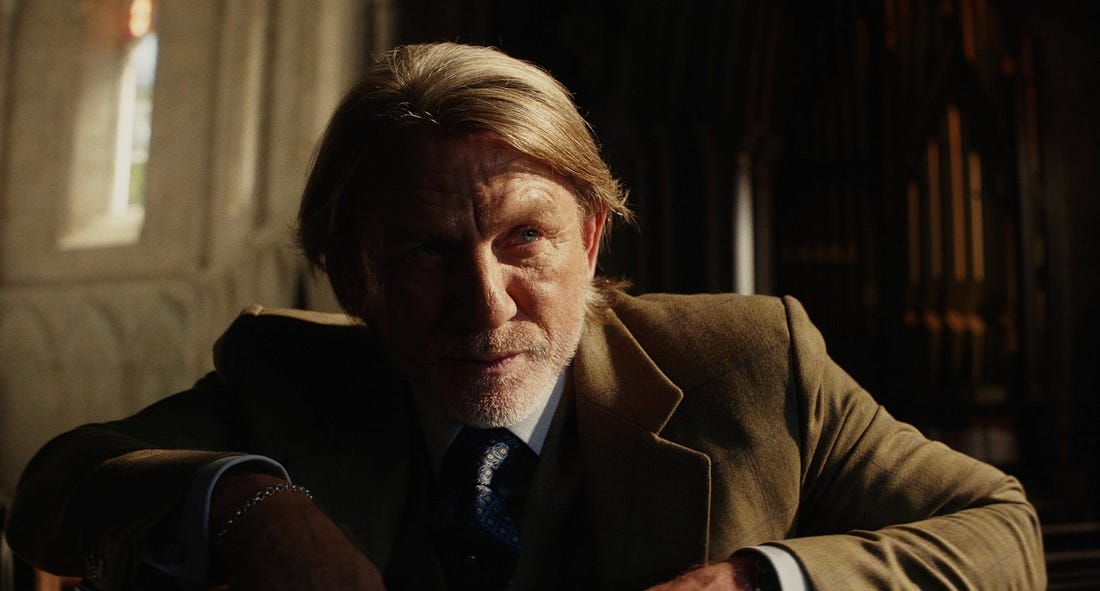
The film opens with a long flashback, Rev. Jud Duplenticy (Josh O’Connor) writing a letter to Blanc explaining precisely how he has come to be the primary suspect in the murder of Monsignor Jefferson Wicks (Josh Brolin). Very long story short: O’Connor’s an outsider to this parish and Wicks is much beloved—at least, by his core group of worshipers, which is shrinking by the day. Duplenticy has been sent to Wicks to help him rekindle faith in the broader community, but his open arms are no match for Wicks’s punchiness. And there are so many secrets being hidden by everyone involved that, naturally, everyone’s a suspect.
I shan’t go into the mystery at the heart of the film or discuss the way it is unraveled, save to say that it is a.) tighter than the previous entry in the series and b.) set up to pay off with one of Blanc’s patented stemwinder explainers. But Blanc withholds his showy checkmate at the last moment, understanding, even as an atheist, that absolution can only come from confession and contrition. You can reveal the guilty but you cannot redeem them; that’s a choice they have to make for themselves.
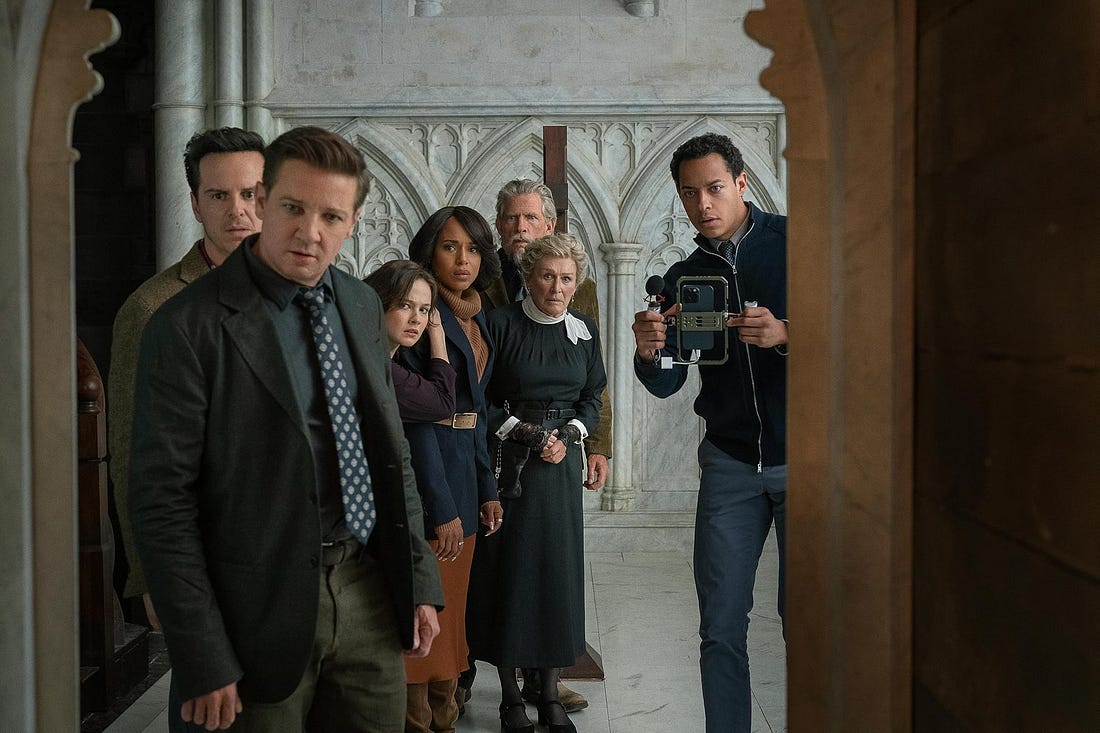 |
Like the previous Knives Out films, this picture is a cavalcade of stars, with Oscar nominees like Glenn Close, Jeremy Renner, Jeffrey Wright, and Thomas Haden Church joining A-Listers like Mila Kunis and Kerry Washington along with relatively fresh faces like Andrew Scott and Cailee Spaeny. It’s just fun watching such top-of-the-line talent chew on Johnson’s occasionally hammy dialogue.
It’s also a remarkably good-looking movie. Cinematographer Steve Yedlin, who has worked with Johnson since his remarkable 2005 debut feature, Brick, has really outdone himself with this movie, playing with light and shadow, sunbeams through stained-glass windows, strobe lighting during a chaotic fight sequence, and more. There’s one moment where a character is backlit by a giant blood moon, and it’s framed and shot in such a way that despite knowing this has to be some sort of special-effects trickery, your mind can’t quite process what’s been done, what’s been monkeyed with. So you just accept the gothic grandeur of it. I didn’t love how Glass Onion looked—too much CGI architecture—but this movie calls to mind the initial outing’s effort to shoot the grand old house that serves as the primary set with a sort of intricate, elevated seediness, along with a return to some of the fun camera-play that Johnson has shed a little over the years.
Elevated seediness: that is the heart of these, or really any, murder mysteries, from Edgar to Agatha to Gillian. They are, all of them, tawdry affairs, murders resulting from greed, or lust, or maybe a little of both. But Johnson, for the first time, seems to have some sympathy for his devil, some empathy for their missteps. And that lends Wake Up Dead Man a tragic air that has been previously lacking in the series.