|
 |
Hey Bulwark fam, we’ve made it official: I’m the new national immigration correspondent for The Bulwark, joining the staff full-time. I couldn’t be more thrilled.
And I’ve got an ask for you and our incredible community: I’d like readers of Huddled Masses to send me any news article (or video or social-media post or TikTok) from your town or city or state describing a time when citizens stood up for immigrants and against Trump and the enforcement agents invading their communities. Fighting back doesn’t have to be physical or mean protesting loudly; sometimes fighting back can be quieter but just as brave. Whether it was your local church, or a community member or group, if you were moved by the way someone stood up and said ‘No, this is wrong!’ send it my way. These stories can be from anytime this year. You can email them to me or leave them in the comments below.
Thanks as always—and read below for an intriguing trend: The backlash to Trump’s crackdown is also inspiring a new generation of candidates to run for office, and they’re more Latino, more immigrant, and willing to fight back.
–Adrian
Trump Immigration Cruelty Fuels Surge in New Candidates
These political newcomers are appalled by the sights and stories of the deportation regime.
|

| |||||||||||||||


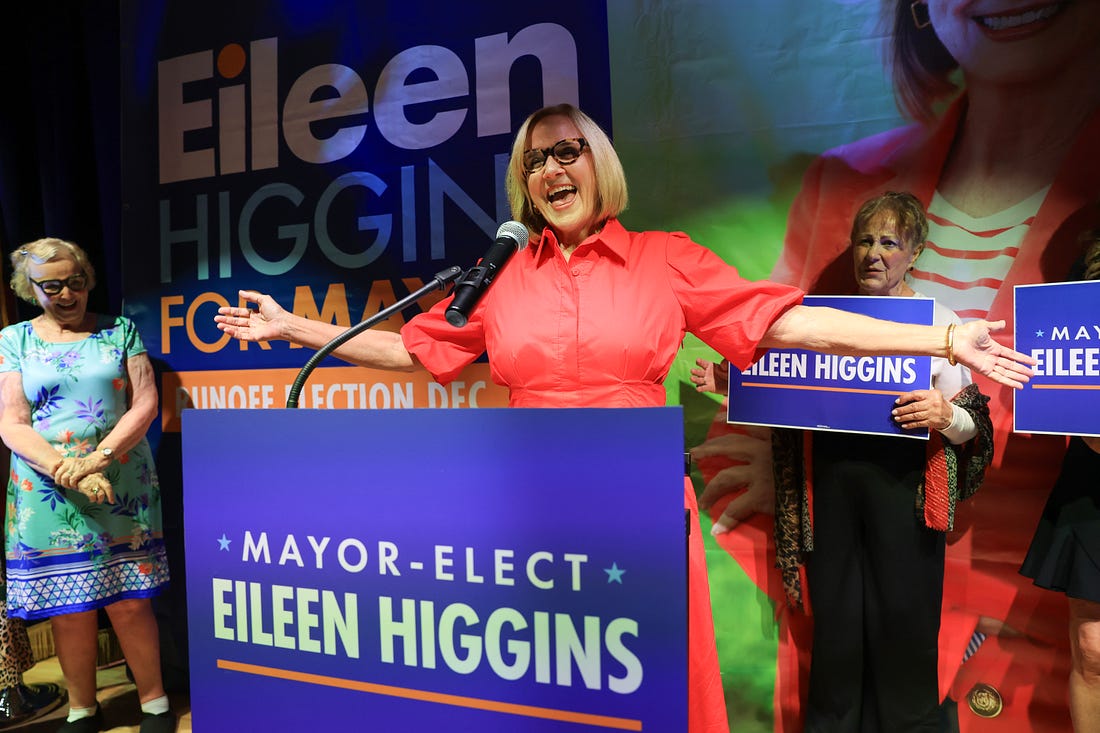 |
WHEN EILEEN HIGGINS BEAT Republican businessman Emilio Gonzalez by nearly 20 points in Miami’s mayoral race on Tuesday, she became the first Democrat to win the office in the heavily Hispanic city in almost three decades.
It strengthened the impression that the fortunes of Democrats rise every day Donald Trump is president. It also showed how the president’s immigration policies are upending the nation’s politics, not just by turning voters against him but by compelling candidates to run for office.
In interviews after her win, Higgins made clear the central role that voter anger over immigration played in motivating her candidacy. She said it had personally affected her race, calling it a politics of “trickle-down hatred” that has created a “new environment” of ambient fear in Miami.
“I’m at community meetings—it’s so sad—and you’ll talk to someone. They’ll whisper to you, my brother, my uncle. Sometimes they’ll tell you they were taken to Alligator Alcatraz. Sometimes they’ll tell you they don’t know where they were taken. They’ve just been disappeared,” Higgins told NPR. “And so unfortunately, this national anti-immigrant fervor is affecting us here in Miami. And I do think it influenced the way people voted this time.”
The Trump administration’s campaign to drive undocumented immigrants out of the country and away from public life has created a hunger for candidates willing to fight him on the issue. It’s also compelled immigrants and Latino candidates to step into the political arena as we barrel toward 2026.
In Texas, Bobby Pulido, a famous Tejano music star, has made immigration central to his congressional race as he works to upset GOP gerrymandering efforts in the Lone Star State. Also in Texas, Julio Salinas, a candidate for the state House, has made his experience as the son of migrant farmworkers a core part of his campaign.
In Illinois, there are a handful of candidates who have been spurred to run not just by the nationwide immigration crackdown but specifically by the way Chicago has been singled out. Jessica Vasquez—running to be elected Cook County Commissioner in the 8th district, a position she has held by appointment since May—is the daughter of Colombian immigrants and the first Colombian American to hold public office in the state of Illinois. She’s also a former immigration advocate, having worked at the well-respected Illinois Coalition for Immigrant and Refugee Rights, and her campaign platform includes fighting to maintain Cook County’s sanctuary status.
Staff Sgt. Demi Palecek, a Latina National Guard member running for a seat in the Illinois House, is the daughter of a Mexican immigrant. She is centering immigrant and refugee rights in her platform, and made headlines in October for saying she would disobey orders to deploy to Chicago as part of immigration enforcement.
Anabel Mendoza, 28, running in a crowded field for the 7th Congressional District seat in Illinois, is another former immigration advocate who has been moved to run by Trump’s mass deportation program and what she’s hearing from her community. She told me she found inspiration to run in her work to protect DACA recipients, as well as in her experiences as the granddaughter of a man who immigrated to the United States in the 1970s.
“I fear for [my family members’] safety, that they will be racially profiled and detained in the streets of Chicago,” Mendoza told me. “You can be a U.S. citizen and have that fear.”
Immigration politics can be cyclical. A backlash to the family-separation policies and Muslim ban efforts in Trump’s first term propelled a lot of Dem activism in the 2018 midterms. A revulsion to an allegedly porous Southern border during Joe Biden’s presidency helped make Trump’s own comeback possible.
What stands out about our current period is both how much further Trump is going than he did during his first time in office—ProPublica recently reported that more than 170 U.S. citizens have been detained by immigration enforcement agents—and how his administration’s actions are motivating not just activism but proactive decisions to seek office.
Amanda Litman is the cofounder and president of Run for Something, an organization that helps recruit progressive candidates; they have seen 75,000 people sign up to run for office in the last year. Litman manages an online community chat where she sees prospective candidates talking about immigration regularly.
“We see it in the pipeline of folks signing up to run, quite a few are naming immigration as one of their top issues,” she told The Bulwark.
While she said housing and affordability are the top issues—“it has always been housing when you’re running locally”—she added that candidates are responding to voters who believe what the Trump administration is doing to immigrants is “egregious and morally offensive.”
“There is an undercurrent of ‘I want to see fight,’ and part of the reason is ‘I want to see a Democratic party that fights.’ . . . Voters believe [Democrats are] not doing enough on immigration detainees, on chaos and kidnapping,” she said.