| | In today’s edition: Qatar forms an AI platform, Mubadala is building AI tools, and a pitch to refram͏ ͏ ͏ ͏ ͏ ͏ |
| |  | Gulf |  |
| |
|
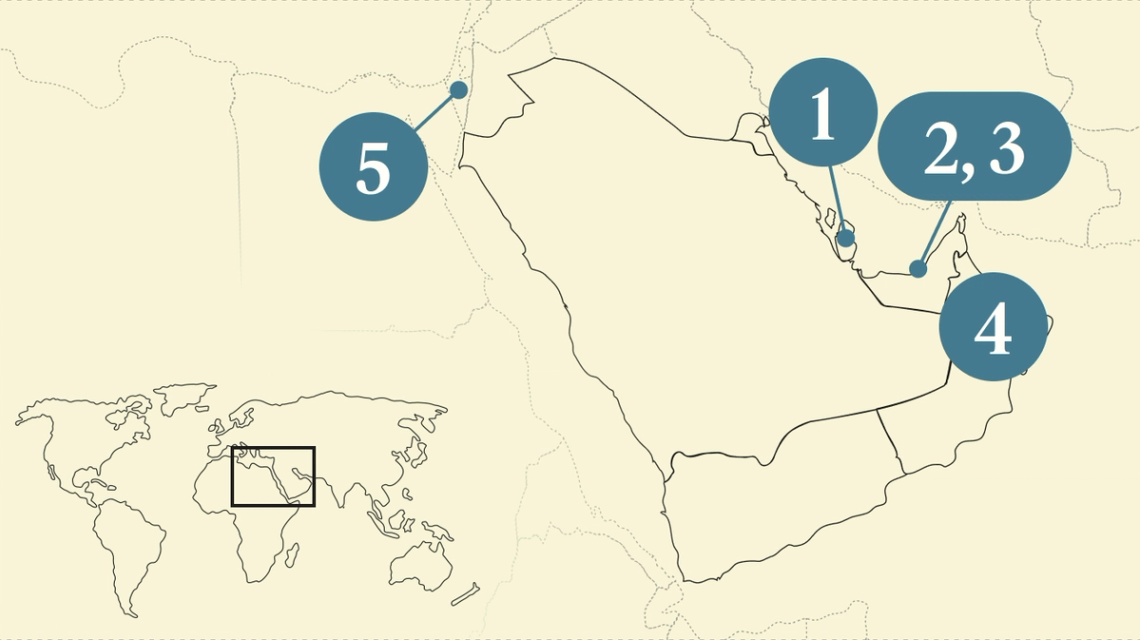 - QIA forms AI unit
- Mubadala eyes AI sales
- Private equity for all
- New city in Oman
- Abraham Accords rebrand
 This week in Gulf history… Aramco hit the market. |
|
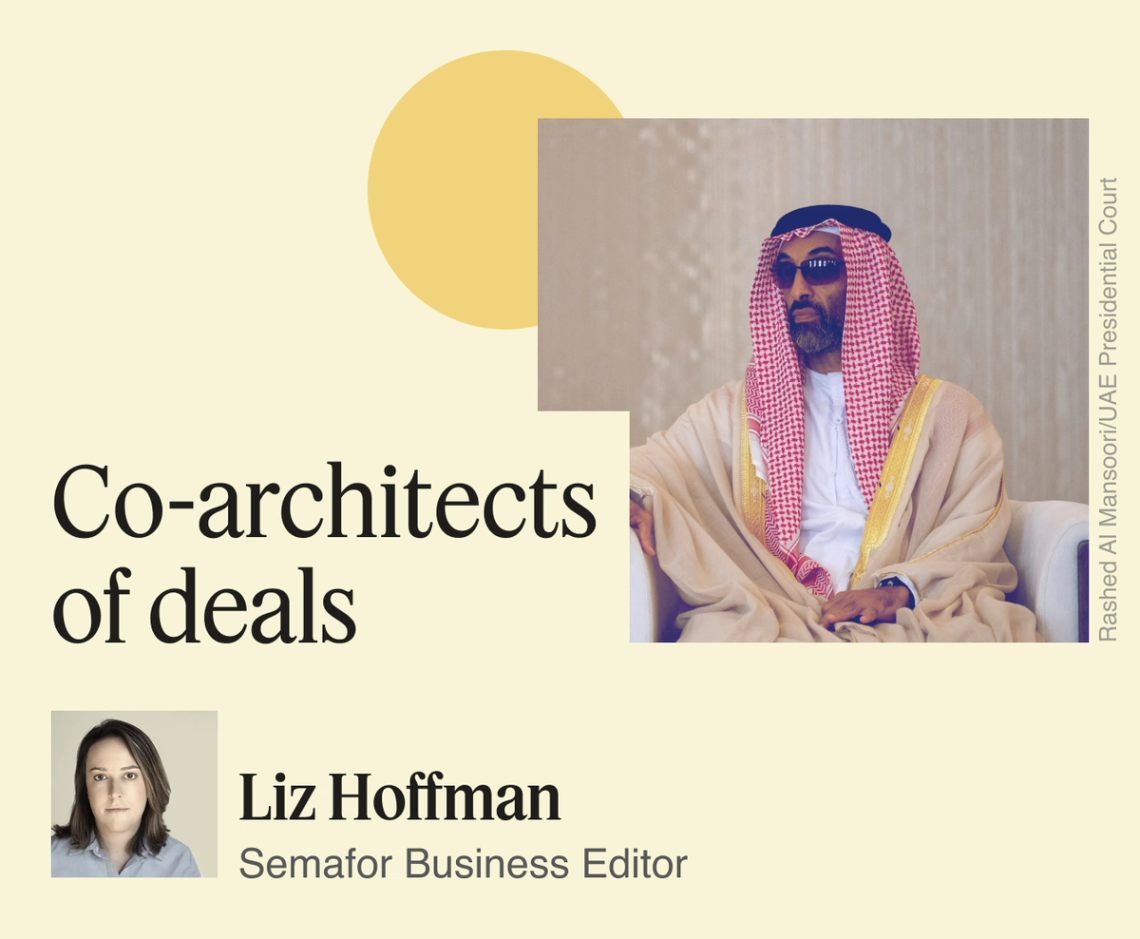 This week brought a perfect encapsulation of the unsettled and century-defining dance for global capital dominance. Abu Dhabi is hosting global billionaires and investors at a glistening seaside conference because it needs their money. Eight thousand miles away, billionaire investor David Ellison is counting on money from Abu Dhabi and its neighbors to press a hostile takeover of a Hollywood icon. Twenty years ago, Western asset managers coming to Abu Dhabi would end meetings with Gulf sovereign wealth funds by saying, “this is how much we expect from you,” Khaled Al-Marri, CEO of real assets at Mubadala, the largest of Abu Dhabi’s many sovereign wealth funds, told me on stage at Abu Dhabi Finance Week. Now, he said, “we are co-architects of deals together.” That shift reflects the reality that the UAE and, to an even greater degree, Saudi Arabia are no longer the bottomless pits of cash they once were. Low oil prices have squeezed government budgets across the region. Borrowing is plugging the gaps for countries with deficits. And decades of trying to buy relevance on the global stage, with financial profits as a secondary goal, often ended with neither. Today’s Gulf countries still have cash — not to splash around, but to invest in projects that bring tangible benefits back home, where cranes are everywhere and ambitions are high. It’s unclear where, exactly, a plan by a new UAE sovereign fund to help bankroll Paramount’s $108 billion pursuit of Warner Bros. Discovery fits into this strategy. (An expansion, perhaps, of the Warner Bros. World theme park on Yas Island?) But if the new power balance holds, the self-branded “capital of capital” will get something for its money. |
|
 Marko Djurica/Reuters Marko Djurica/ReutersQatar has joined Saudi Arabia and the UAE in backing a homegrown AI champion. Qai is now the name to know from Qatar Investment Authority, joining PIF’s HUMAIN and Abu Dhabi’s G42 in the Gulf’s race to build up computing power (G42’s data center firm has even expanded into the kingdom). Qai’s first public deal is a $20 billion joint venture with Brookfield Asset Management to invest in, develop, and manage AI infrastructure in the country and abroad. Qai’s mandate is to build the platforms and systems needed to speed up AI adoption across Qatar, according to its chief executive. The new unit is the most significant swing yet from the $550 billion Qatari sovereign wealth fund in an otherwise busy year on the technology front: QIA has backed OpenAI rival Anthropic and teamed up with alternative asset manager Blue Owl to invest $3 billion in data centers. — Kelsey Warner |
|
Mubadala hungry for power |
 A view of construction progress at the Stargate UAE data center in Abu Dhabi. Courtesy Emirates News Agency-WAM. A view of construction progress at the Stargate UAE data center in Abu Dhabi. Courtesy Emirates News Agency-WAM.“We needed it yesterday.” This is how urgently Mubadala Investment Co. is looking to leverage high-performance computing power in the UAE, as the Abu Dhabi sovereign wealth fund increasingly relies on AI to screen deals, make investment decisions, monitor assets, and, ultimately, sell its own tech products. The $330 billion firm has already sold a white-labeled AI corporate governance monitor, developed with local AI firm Inception, to three other companies, Mubadala’s Head of AI Enablement Aidan Millar told Semafor’s Mohammed Sergie onstage at Abu Dhabi Finance Week. But local computing capacity — a necessity for compliance reasons — is a bottleneck, according to the executive. Mubadala expects to be one of the first users of Stargate UAE, a massive data center under construction with US partners in the Abu Dhabi desert, when it opens in 2026, Millar said. |
|
Private equity outstrips public markets |
 Courtesy of Abu Dhabi Finance Week Courtesy of Abu Dhabi Finance WeekReturns from private equity investments will continue to beat public markets, even as a flood of new capital comes in from retail investors, Carlyle’s top executives told Semafor’s Liz Hoffman in Abu Dhabi. Mom-and-pop investors in the US will be able to get access to private equity funds “in the next year or two,” Carlyle Chairman David Rubenstein said at Abu Dhabi Finance Week. While that may push down returns from private markets, they will still be as much as 400 basis points higher than returns from public markets, he said. Regulators are moving to open up private equity funds, traditionally only accessible to sophisticated investors with hundreds of thousands of dollars to deploy, to a wider investor base. “For the last 50 years, every time a new set of investors came along — public pension funds, sovereign wealth funds, global pension funds, private family offices, high-net worth individuals — people said it’s too much capital, and the rates of return will come down, and almost every time they’ve been wrong,” Rubenstein said. Opening up alternative asset funds to retail investors will unlock a significant new pool of capital at a time when government budgets are overstretched and demand for investment in infrastructure is growing, Carlyle Chief Executive Harvey Schwartz said at the same event. — Matthew Martin |
|
 The price tag of a new real estate project in Muscat planned by London-listed Saudi real estate developer Dar Global. The company is targeting tech entrepreneurs, art collectors, and other affluent types for the Muscat Marine, Art & Digital District — whose name Dar suggests should be shortened to MAD. It will include luxury residential units and hotels, along with shops, business parks, a marina, and cultural venues. The project, being developed in partnership with Art District Real Estate Development, will cover 1.5 million square meters and is expected to take more than 12 years to complete. It joins a growing list of large real estate projects in and around the fast-growing Omani capital, including Al Khuwair Downtown, the hilltop Thuraya City and another Dar project, AIDA, which will include a Trump International hotel. |
|
View: How to revive the Abraham Accords |
  Yoan Valat/Reuters Yoan Valat/ReutersExpanding the Abraham Accords faces significant hurdles, chief among them Saudi Arabia’s insistence on — and Israel’s refusal of — progress toward a Palestinian state. Reframing the agreements away from the religious to the political could also be helpful, Faisal J. Abbas, the Editor-in-Chief of Arab News, writes in a Semafor column. “Renaming the agreements would be symbolic, but also strategic,” Abbas wrote. “It would give the initiative a fresh identity, unburdened by religious overtones, and anchored instead in political realism and transactional diplomacy — something US President Donald Trump understands better than most. Indeed, the ‘Trump Treaties’ has a good ring.” |
|
 Deals- Abu Dhabi sovereign wealth fund Mubadala is planning to double its Asia exposure to nearly a quarter of its total portfolio over the next decade as part of a diversification strategy…
- …the fund is also in talks to rescue Brazilian fintech Will Holding Financeira through an injection of new capital. The deal would involve support from the Brazilian deposit guarantee fund FGC, and payments company Mastercard. — Bloomberg
- A joint venture of Abu Dhabi-listed asset manager Alpha Dhabi and Mubadala acquired a European direct lending portfolio from Apollo Global Management. The JV between the two Abu Dhabi firms now has a portfolio of $1.6 billion.
Energy- ADNOC is a frontrunner to buy Moscow’s controlling stake in Serbia’s sole oil refinery, as Serbian Oil Industries has found itself in the crosshairs of US sanctions due to its Russian owners. — Financial Times
Funds- Asset manager Gemcorp Capital and Angola’s sovereign wealth fund FSDEA plan to launch an African infrastructure fund, to be managed from Abu Dhabi Global Market. The partners will each contribute an initial $50 million, but aim to bring the total up to $500 million with support from other investors.
Luxury Goods- Abu Dhabi is using its minority stake in Sotheby’s to pull the art world toward Saadiyat Island, with last week’s Collectors’ Week doubling as both a flex of cultural ambition — there was a $500 million exhibition and $133 million in sales — and a message that the emirate wants to shift the Gulf’s center of gravity from Dubai to its state-backed museum district. — Spear’s Magazine
Real Estate- Egypt’s Palm Hills Developments is making a $7 billion push into the UAE, with the company’s first Abu Dhabi project, Saadiyat Shores, set to break ground next spring. The developer is tapping UAE banks for financing and is already eyeing a second project in the Emirates and potential entries into Riyadh and Jeddah.
Tech- Abu Dhabi artificial intelligence company Inception launched Jais 2, the second iteration of its Arabic-language AI engine, promising advanced creative capabilities and real-world linguistic behavior. It was developed with Cerebras Systems and Mohamed bin Zayed University of Artificial Intelligence.
- SpaceX is planning to IPO, raising the prospects of a windfall for its Gulf backers, and the unseating of Saudi Aramco as the biggest stock market listing of all time. — The Circuit
|
|
|


