| | In this edition, the “future of capitalism” is Abu Dhabi, according to a Carlyle Group co-founder. A͏ ͏ ͏ ͏ ͏ ͏ |
| |  | Business |  |
| |
|
 - Trump’s new chip truce
- Paramount plays (geo)politics
- Bessent’s accession
- Fed’s toss-up
- Fossil fuel future
|
|
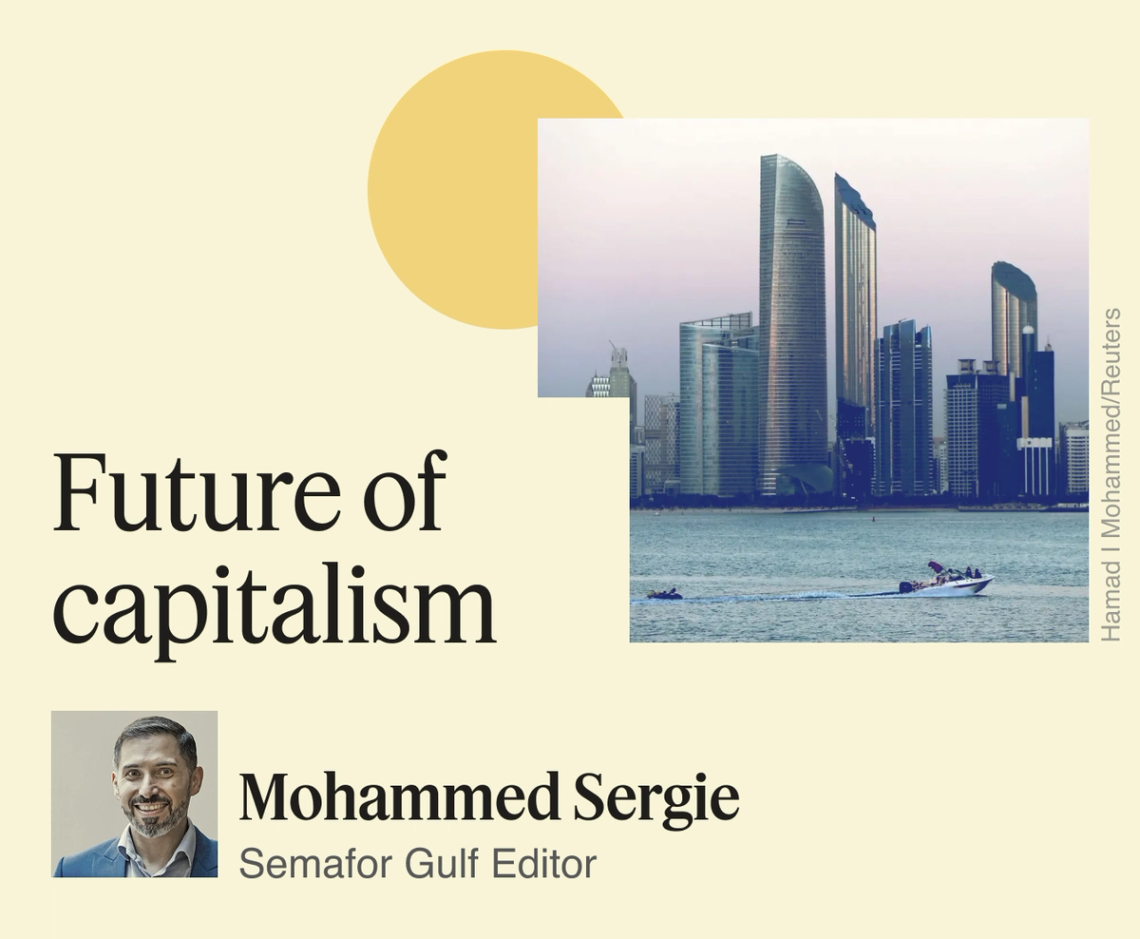 It’s not quite the final work week of the year, but in the Gulf, it feels like they’re throwing the kitchen sink at 2025. Liz, the team, and I are here in Abu Dhabi, where the world’s top asset managers are convening as the government commits tens of billions of dollars to accelerate its ascent as a global financial hub. Meanwhile, Qatar — fresh off its annual diplomacy confab where the bizarre highlight was provocateur Tucker Carlson’s decision to buy a home in Doha — is launching a $20 million digital infrastructure venture to invest in, among other things, data centers. And sovereign funds from Qatar, Saudi Arabia, and the UAE emerged as backers of Paramount’s bid for Warner Bros. Discovery, collectively offering $24 billion. A club deal among the three is rare, maybe unprecedented, and the fact they appeared together in one of the year’s largest transactions underscores how central Gulf capital has become to global markets. That new centrality is the message Abu Dhabi Finance Week wants to project. The gathering has shed its origins as a citywide fintech conference and is now a coming-out party for the emirate. The luxurious financial center ADGM, home to the event, is getting a $16.3 billion expansion — funded by Mubadala and Aldar. The city is planning a new fintech, insurance, digital, and alternative-asset cluster expected to create 8,000 jobs. Hedge fund Brevan Howard is one that committed this week to boost its local headcount. As with most events in the region, there were MOUs, of which we will spare you the details. And there was more than just coffee and talks: The weekend saw a dramatic Formula 1 finale and a Sotheby’s auction that pulled $133 million, including nearly $3 million for an empty handbag. Ok, a Birkin. The takeaway? As Carlyle Group co-founder (and Semafor investor) David Rubenstein put it: “I’ve seen the future of capitalism, and its name is Abu Dhabi.” |
|
Trump gives China (some) chips offering |
The White House will allow Nvidia to export GPUs that are roughly 18 months behind its most advanced offerings, Semafor’s Reed Albergotti scooped Monday. 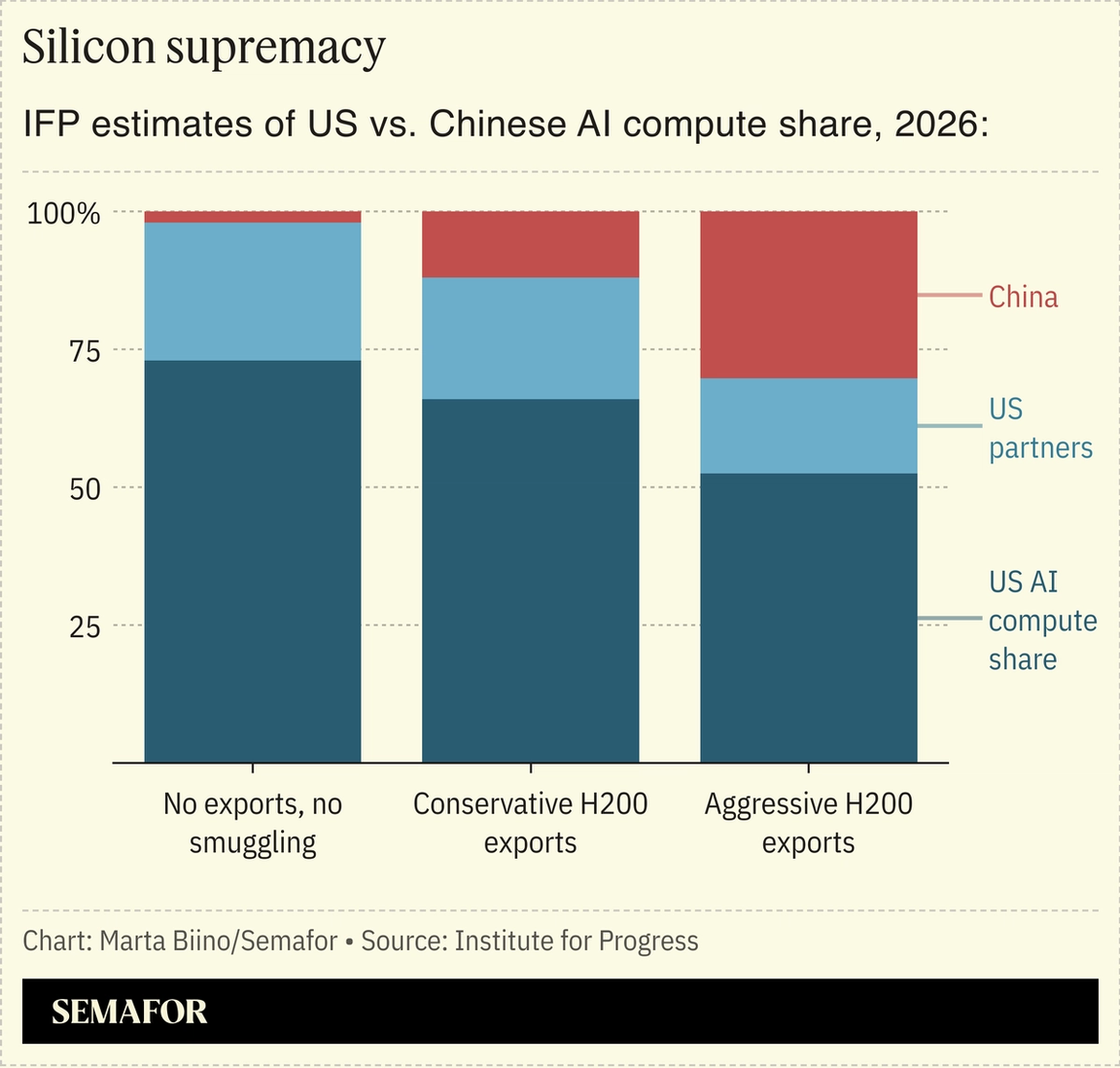 The move, which President Donald Trump confirmed in a Truth Social post that mentions a 25% cut to the US, would allow Nvidia to sell H200s (though not its cutting-edge Blackwell chips) to China, and seeks a compromise between hardliners opposed to exports of any advanced AI chips and pragmatists (like Jensen Huang) who worry that restrictions will cede the global market to Chinese competitors. It also aims to satisfy the Chinese government, which has blocked imports of older-generation Nvidia chips that the US would gladly sell abroad. Nvidia added more than $60 billion in market value on Semafor’s story. But just because the US is open doesn’t mean China is: The FT reported last night that Beijing still plans to limit H200 access as it seeks to bolster homegrown alternatives. |
|
Paramount’s M&A politicking backfires |
Paramount’s aggressive and politically charged pursuit of Warner Bros., which escalated into a hostile $108 billion bid Monday, is backfiring in Washington. Trump administration officials are frustrated with the assumption — by investors, media watchers, and Paramount itself — that a politicized Justice Department would play favorites for the conservative Ellisons, Semafor’s Rohan Goswami and Ben Smith report. Paramount seems to “believe the worst possible tropes” about corruption in the administration, said one person close to the administration’s deliberations. “They thought they were playing 5D chess and they were playing tiddlywinks.” The Ellisons’ financing may also prove to be a trouble spot. They’ve tapped a trio of Mideast sovereign wealth funds for a combined $24 billion, something that alarmed Warners’ board. They’ve tried to structure it in a way that sidesteps a national security review, but the committee in charge of those reviews may still opt to take a close look, experts tell Semafor. 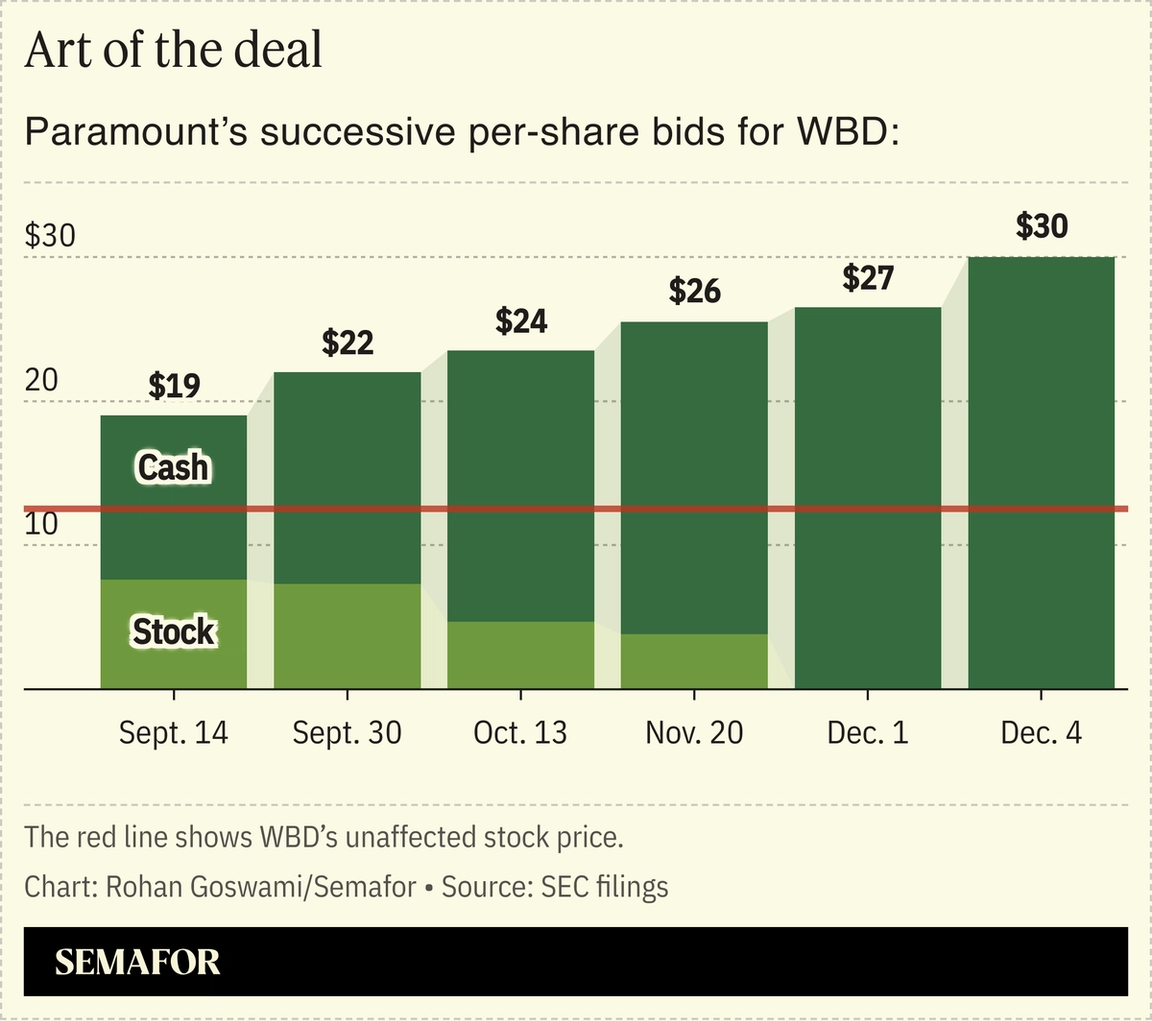 Paramount executives met with Trump in recent weeks to press their case and to argue against a Netflix victory, a person familiar said. FCC Chair Brendan Carr was among those who attended the meeting — but when Trump asked him about his view on the deal, he demurred, saying it would likely be decided by the Justice Department, the person said. (The FCC doesn’t have oversight for studio or streaming, though Carr has tried to exert influence over those sexier corners of media.) |
|
How Scott Bessent took over the global economy |
 Jim Watson/Getty Images/Semafor Jim Watson/Getty Images/SemaforSemafor’s Architects of the New Economy maps Washington economic power, and, along with the package, Editor-in-Chief Ben Smith tries to solve a Trump administration mystery: How did Treasury Secretary Scott Bessent alpha his way past figures like Elon Musk and Howard Lutnick to emerge as the MAGA Bob Rubin? It wasn’t by accident. Bessent sought out Steve Bannon in Hong Kong in 2017, and made him a key ally. The populist former Trump aide was struck by a “hedge fund manager who had a drive to understand populism, economic nationalism, America First, MAGA — and I realized he was also somewhat of a ‘cracker,’” Bannon told Ben. Bessent invested in conservative publishing, in organizing for Trump, and in his own television skills. Then, in April, he accomplished two tough missions for Trump: Papering a resources deal with Ukraine that also papered over a White House blowup; and getting 10-year Treasury yields back under control. Bessent learned from an early, accidental appearance in bitter internal battles to watch out for himself — and to project strength — sometimes physically. “I wasn’t surprised that he got” the Treasury job, Paul Tudor Jones told Ben. “I was surprised he wanted to do it. But he’s a great American.” |
|
Inflation and Fed both stuck in place |
 Kevin Lamarque/File Photo/Reuters Kevin Lamarque/File Photo/ReutersIs the Fed quiet quitting? The central bank is widely expected to cut interest rates tomorrow, despite inflation remaining closer to 3% than the Fed’s long-held (and, for the past four years, missed) target of 2%. Reducing borrowing costs now would risk fueling inflation, and show that the Fed is more concerned about a weakening job market than stubbornly high prices. “While this will never be formalized or admitted publicly, the Federal Reserve’s inflation target has effectively been raised to 3%,” said Tom Hulick, who manages $1 billion for retirees and institutions. Jason Furman, a Harvard economist and former Obama economic adviser, first raised the idea of a Fed throwing its hands up on inflation to Semafor back in 2023: “I could see the Fed shifting to 3% without telling anyone, and not actively trying to wring inflation out of the system beyond that.” (You’ll remember that quiet quitting was a thing then.) CME FedWatch puts the odds of a 25 basis point cut at nearly 90%, but there’s also an expectation that the Fed will then pause at that level for some time. Chair Jerome Powell has struggled all year to balance both sides of the Fed’s dual mandate — keep inflation tamped down and boost employment — especially as his colleagues grow more dovish. |
|
 Bing Guan/File Photo/Reuters Bing Guan/File Photo/ReutersThe White House is making fossil fuels a national security cornerstone, arguing in a new strategy document that increasing domestic oil and gas production is vital to keep the country and its allies safe, Semafor’s Tim McDonnell reports. Simultaneously, the administration is playing down the risk from Beijing and brushing over the low-carbon technologies now a bulwark of China’s own security strategy. The language is a break from previous administrations, including Trump’s own first term, which embraced the US’ role as a guarantor of democracy around the world. It’s instead framing geopolitical competition in more narrowly commercial terms. It places fossil and nuclear energy at the center of that effort, arguing that a key strategy for countering rivals is to outcompete them in legacy energy markets. Decarbonization “ideologies,” meanwhile, are dismissed because they “greatly harmed Europe, threaten the United States, and subsidize our adversaries.” |
|
➚ BUY: Small screen. YouTube remains an “active bidder” for the intensifying Oscars TV rights battle, Variety reports, a symbolism-loaded move as streaming closes in on the movie industry. (You may have also heard that Paramount is trying to buy Warner.) ➘ SELL: Silver screen. AMC offloaded most of its stake in a Nevada gold and silver miner it bought during the meme-stock craze in 2022, and at little profit, for reasons that were hard to explain then and impossible now. |
|
 Companies & Deals- Beg, borrow, deal: CoreWeave priced a $2.3 billion convertible bond offering, upsized thanks to “strong investor demand.”
- Avengers, assemble: JPMorgan’s Jamie Dimon has assembled a council of some of America’s top CEOs to advise the bank on its marquee US investment spree.
- Now there’s a pop: Elliott and PepsiCo. struck a settlement deal where the beverage giant will cut costs and offerings, without conceding board seats to the activist investor.
- Pieces on the board: IBM will buy data-management firm Confluent for $11 billion, its largest deal in years as it seeks to reassert itself in the AI arms race.
- Flight risk: India’s largest airline is facing a crisis after failing to adequately prepare for new rest-hour rules for pilots, leading to the cancellation of thousands of flights and plunging the country into chaos.
- Active, passive: Boaz Weinstein has had a rough year, with his credit-market fund losing 6.5% this year.
Watchdogs- Down under(age): Tech giants are taking steps to mitigate the impact of Australia’s sweeping social media ban for children, which takes effect Wednesday — the latest is Reddit, which rolled out safety features for users under 18 this week, like restrictions on personalized ads.
Markets- This again? The Trump administration unveiled a long-awaited $12 billion aid package for US farmers hurt by China reducing its purchases of American soybeans and other products, which is being paid for with tariff income. Trump’s trade war has pushed Beijing to ramp up sales to other countries — its trade surplus hit $1 trillion this week, bolstered by increased trade with the EU, Japan, and Southeast Asia.
- Cassandra, paywalled: Short-seller Michael Burry is bullish on Fannie Mae and Freddie Mac — he outlines why in a (paid) 6,000-word Substack post.
|
|
|


