| | In today’s edition: Gulf sovereign funds partially blamed for failed Paramount deal, and Abu Dhabi b͏ ͏ ͏ ͏ ͏ ͏ |
| |  | | | Global Capital Edition |
| |
|
 - Gulf funds in Paramount deal
- Keeping fees at home
- Oil still driving economies
- Saudis sour on Tadawul
 Abu Dhabi partners with a concierge service for the ultra-wealthy. |
|
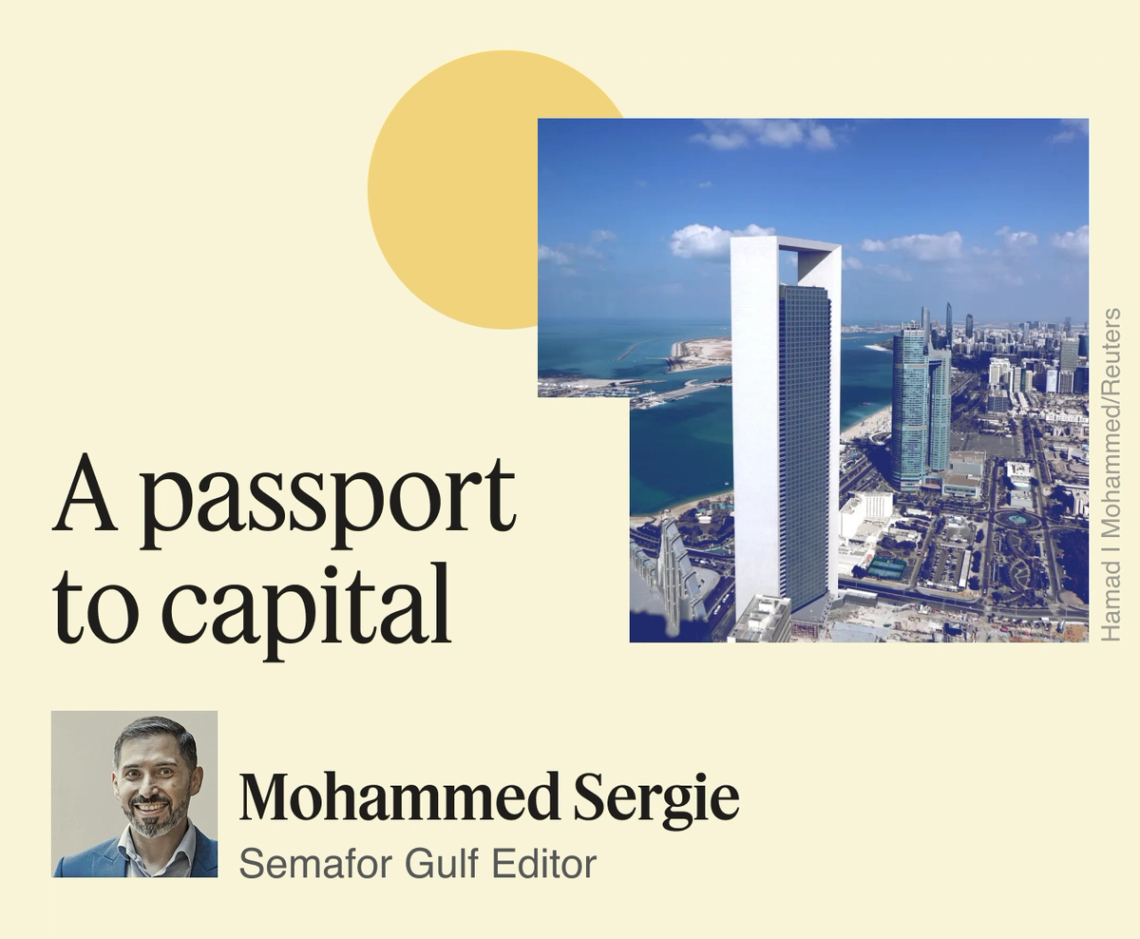 Welcome to the inaugural issue of Semafor Gulf: Global Capital Edition, our weekly briefing that will focus on international financial flows through a Gulf lens. Our launch coincides with Abu Dhabi Finance Week, which is attracting the usual crowd of asset managers, bankers, consultants, and other finance professionals, eager to tap into the opportunities offered by the self-described “capital of capital.” For that effort — deploying Emirati capital and bringing family offices and hedge funds to the country — there are many perks on offer from Abu Dhabi, but the most valuable is reserved for those who’ve already conquered global markets: a UAE passport. A handful of industry titans may be eyeing the document as a geopolitical safety net from a nation with deep ties to Washington and Beijing, Paris and Moscow. This region is going through a golden age: rising wealth, a young educated population, and a rare connectivity to energy, trade, finance, and technology. We see it in ADGM, Abu Dhabi’s financial center, which has become a node of global finance that complements nearly $2 trillion in sovereign wealth. And we see it in Doha, Dubai, Kuwait, Riyadh, and other cities, all of which are investing heavily to become more attractive places to live and visit. At Semafor Gulf, we are chronicling this transformation, and our Tuesday edition will keep a tighter focus on the money. 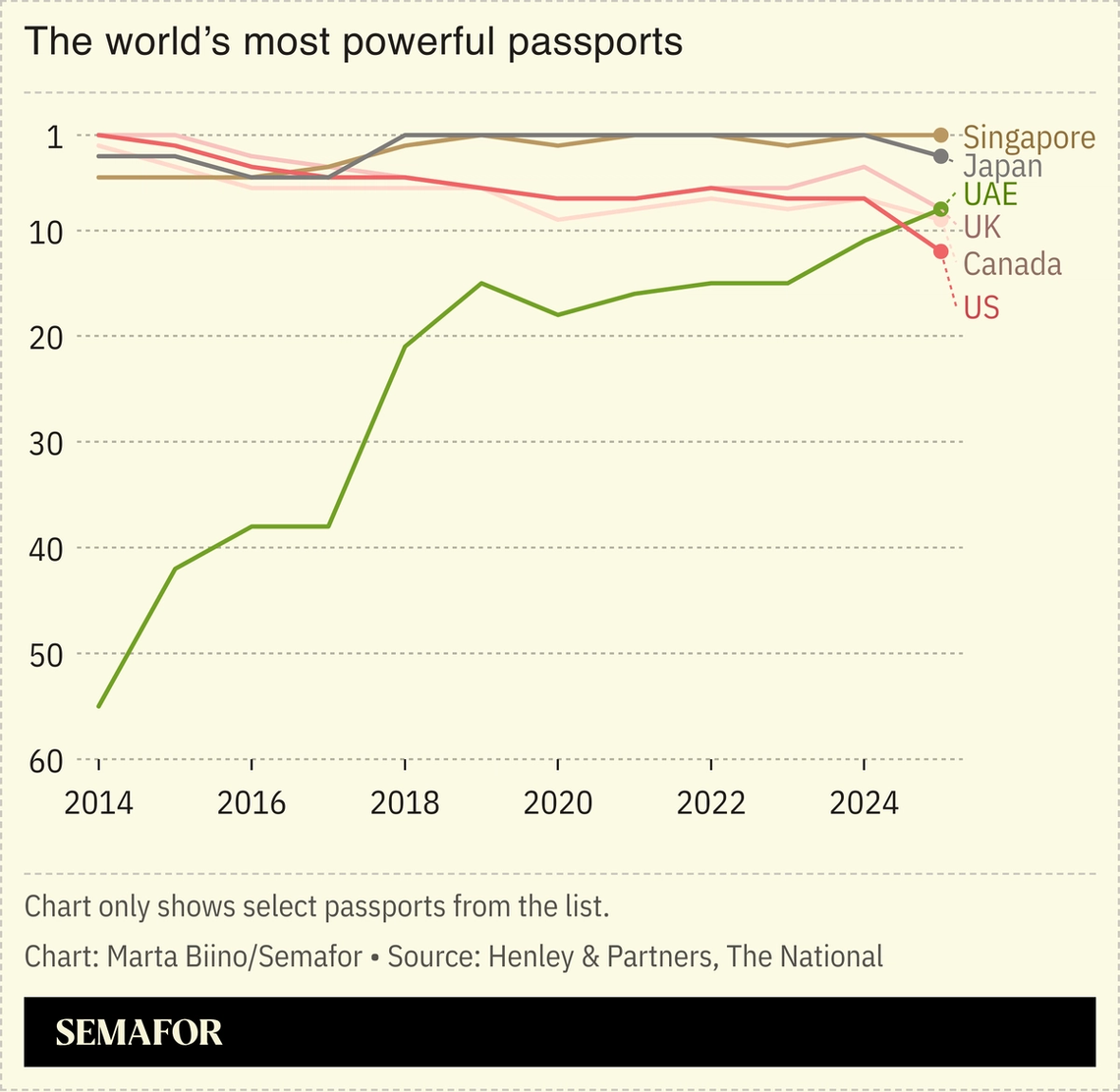 Back to that passport. The UAE’s rise has translated into one of the world’s strongest travel documents: 184 visa-free destinations, surpassing the US and up from just 33 in 2006, according to London-based investment migration consultancy Henley & Partners. And for non-Emiratis, it’s invitation-only. Hedge fund pioneer Ray Dalio, crypto billionaire Changpeng Zhao, Telegram founder Pavel Durov, and Syed Basar Shueb, the Pakistani chief executive of industrial colossus IHC, are among the holders. As more financiers set up in ADGM, more passports will be bestowed. And through them, expect stickier ties to the UAE. |
|
Gulf cash hindered Paramount bid |
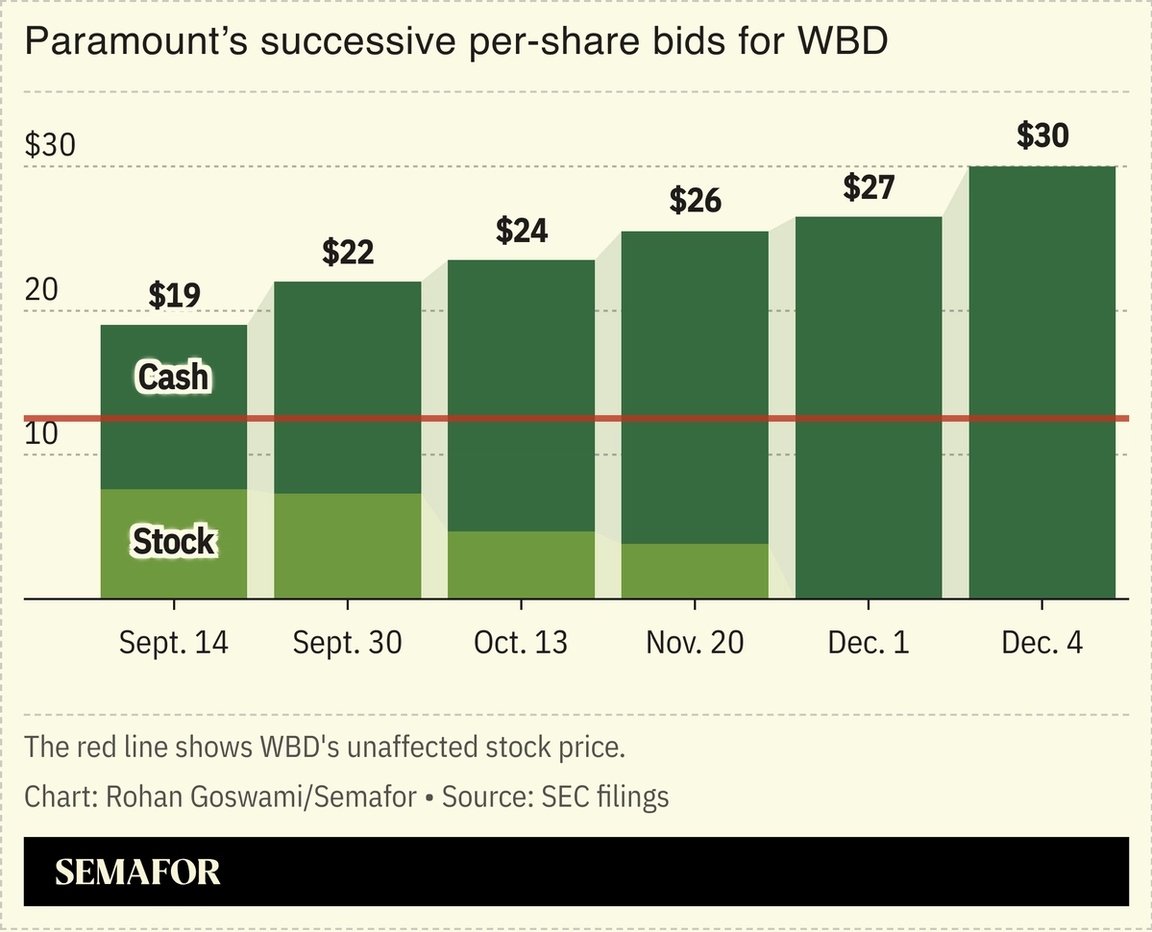 Gulf sovereign wealth funds helped back Paramount’s bid for Warner Bros. Discovery — but may also be to blame for the takeover effort’s apparent failure. Paramount, backed by the wealthy Ellison family, was relying on $24 billion in equity from Qatar Investment Authority, Saudi Arabia’s Public Investment Fund, and L’imad Holding Co., a new Emirati fund whose only known deal was an October agreement to buy a stake in a real estate firm from Sheikh Tahnoon bin Zayed Al Nahyan’s International Holding Co. and sovereign fund ADQ. The guarantees on that money — specifically, on how and when the dollars would clear, according to people familiar with the matter — were fuzzy enough to give Warner’s board one more reason to go with Netflix’s $83 billion offer, according to securities filings and people briefed on boardroom discussions, Semafor’s Rohan Goswami reported. The sovereign wealth funds would not play any management role or have board seats, government filings show, which could help the arrangement avoid a US national security review. The saga over who will buy the owner of major media brands like HBO and DC Comics is now taking a dramatic turn, with Paramount launching a $108 billion hostile bid to push out Netflix’s offer. It’s unclear whether the White House will weigh in, but the competition for such assets in highly regulated sectors is part of a broader theme of consolidation that will only pick up pace, Goldman Sachs President John Waldron told Semafor’s World Economy Summit. |
|
A startup to bring the wealth home |
 Courtesy of ADGM Courtesy of ADGMIt’s a decades-old Gulf problem: Trillions of dollars in regional wealth sit in far-flung global financial hubs, generating returns for owners and fees for foreign asset managers but comparatively little for the Gulf itself. Alpheya, an Abu Dhabi fintech startup backed by BNY Mellon and the UAE’s Lunate, is ramping up efforts to address that. For decades, global hubs dominated wealth management, underpinned by political stability, deep financial systems, and good infrastructure. Alpheya CEO Roger Rouhana said the Gulf has caught up on most of these fronts, and instability elsewhere is creating a draw. Where it hasn’t yet is the infrastructure for local banks to compete with global wealth managers. Alpheya’s software is helping fill that gap, and it’s scaling quickly, with nearly $50 billion in assets already running on its platform — almost double last year. “The Gulf generates tremendous wealth, yet a disproportionate share of those assets is still managed abroad,” Rouhana said. “The opportunity now is to build the capabilities that bring those assets back and anchor them in the region’s financial system.” — Mohammed Sergie |
|
Oil still defines Gulf capital flows |
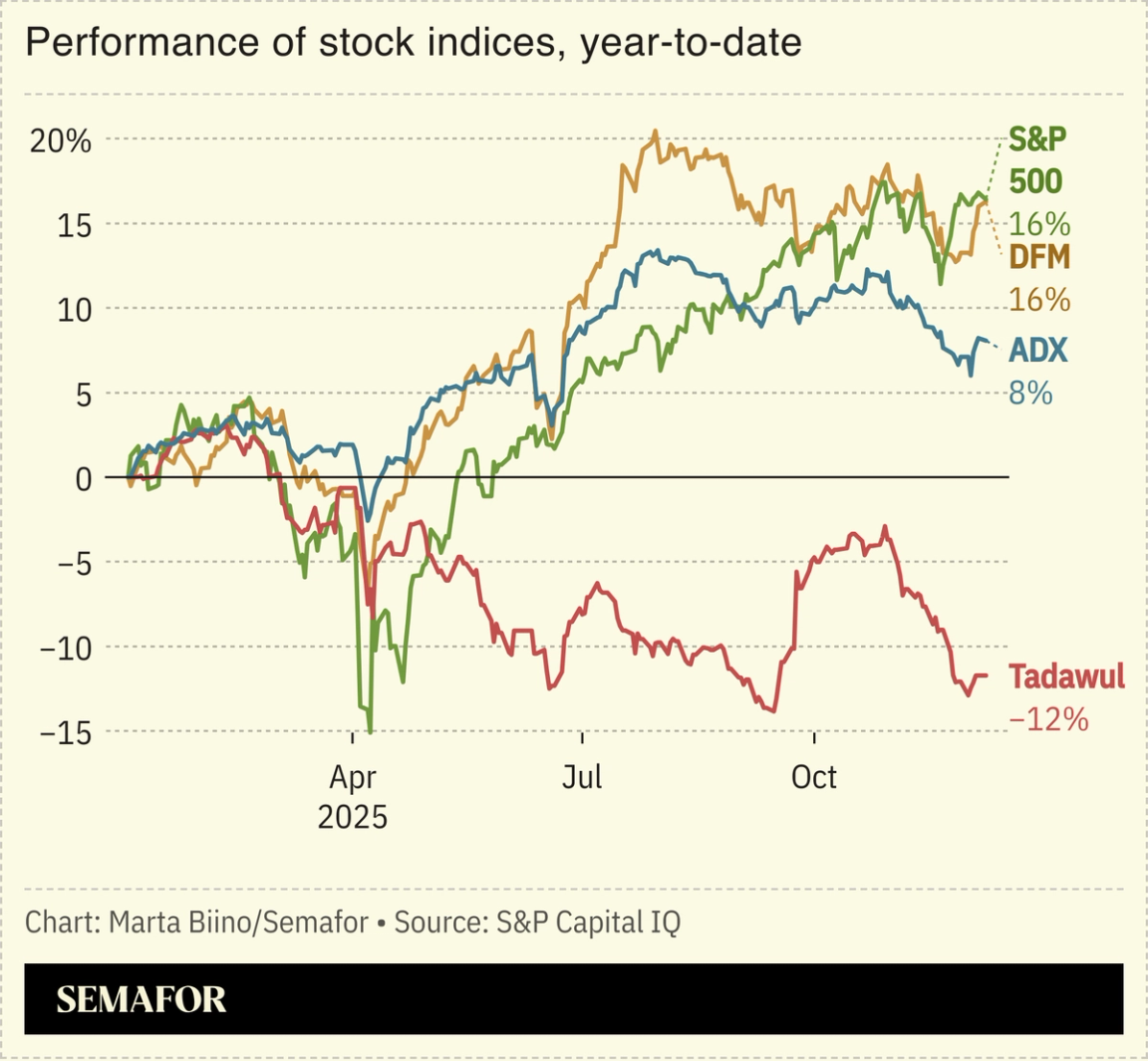 Diversification has been the buzzword in the Gulf, but oil prices — largely a barometer of external forces — remain the defining metric of the region’s future fortunes, even if their impact is not uniform. Changes in crude prices are most acutely felt in Saudi Arabia, where rapid social and market reforms haven’t loosened the economy’s link to oil, Morgan Stanley analysts wrote in a recent report. When prices decline, deficits widen, and Riyadh’s pitch to foreign investors is weakened. By contrast, the UAE is more immune to crude swings. Its broader economy derives more growth from a population boom, tourism, logistics, trade, finance, and technology, according to Morgan Stanley, which is bullish on the country. Even energy is a winner: the New York investment bank has a “buy” on ADNOC Drilling and ADNOC Distribution, the state oil company’s retail arm. UAE banks are also flush, with deposits outpacing lending, and spurring expansion abroad. Some of that cash is increasingly finding its way to Saudi Arabia, where Vision 2030 demands are driving credit needs. Still, relatively lower oil prices haven’t eliminated opportunities in the kingdom: Foreign firms are flocking to Riyadh. Goldman Sachs, Citi, and Morgan Stanley, among others, have all established a regional headquarters, which is required to do business with the Saudi government and the almost-$1 trillion Public Investment Fund. — Kelsey Warner |
|
 The total value of US equities traded through Saudi brokerages over the three months to the end of September. That’s more than double the same period as last year, AGBI reported, as investors seek returns abroad amid subdued local activity. Regulators are trying to reverse the trend and boost trading on the Tadawul, including from foreigners. Restrictions on outside investors buying local shares may be lifted at the start of next year. Saudi Arabia expects dozens of companies to list on its stock market next year, many of them government-owned. To absorb the new glut of shares and boost liquidity, the market will need to attract as many investors as possible. — Kelsey Warner |
|
Every week, we ask a different expert what they’re focused on. Today, we’re talking to Ayham Kamel, president of the Middle East public and government affairs practice at Edelman. 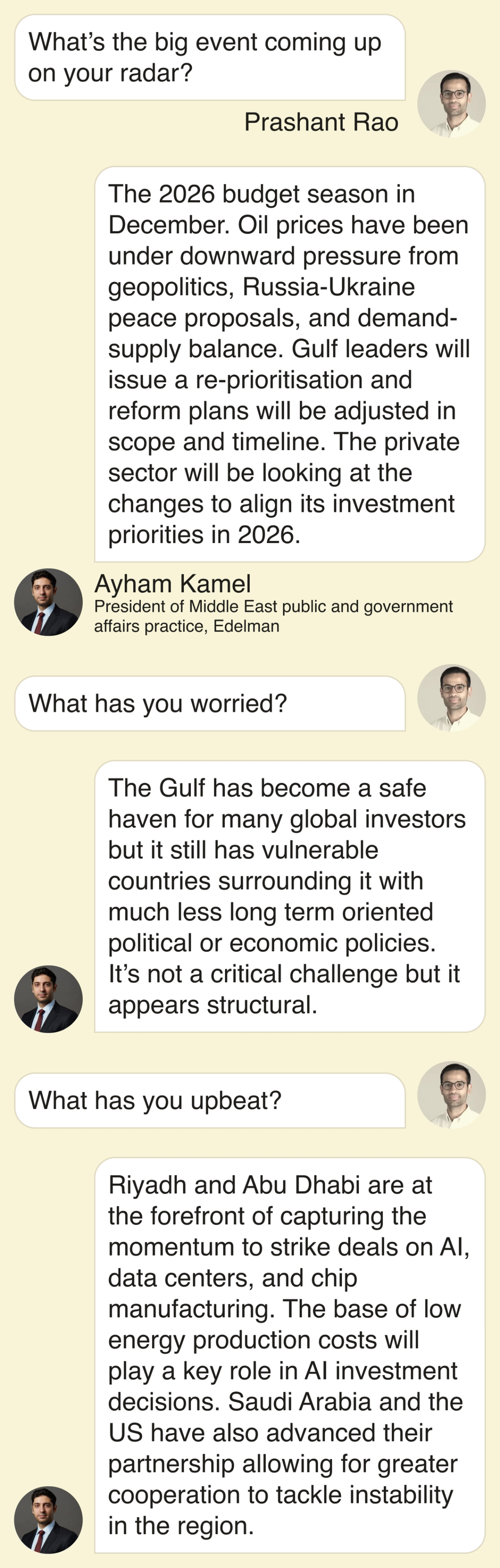 |
|
 Eduardo Munoz/Reuters Eduardo Munoz/ReutersThe super-rich have always been welcome in Abu Dhabi. Now the government is taking steps to make them feel at home even faster by partnering with a firm offering bespoke concierge services to ultra-high-net worth individuals. The oil-rich emirate, which controls sovereign wealth funds worth more than $1.7 trillion, has become a hotspot for the global elite by pitching itself as safe, modern, tax-free, and with year-round sunshine. From finding a home, shipping their furniture or supercars, or picking out fine art to adorn the walls of their luxury beachfront villa, all the way through to reminding them of upcoming anniversaries and booking the most exclusive restaurants or private islands, luxury concierge company Quintessentially — which has signed a deal with the government body promoting the emirate — has services available, Bassel Dahabi, the company’s executive director, said in an interview. — Matthew Martin |
|
|


