| | The White House’s new National Security Strategy ignores a key source of China’s strength.͏ ͏ ͏ ͏ ͏ ͏ |
| |  | Energy |  |
| |
|
 - Energy security doctrine
- Greening air travel
- African e-bike pivot
- US solar boom
- Gas worries
 Gov. Josh Shapiro’s insight on how bipartisan governors should team up on permitting reform. |
|
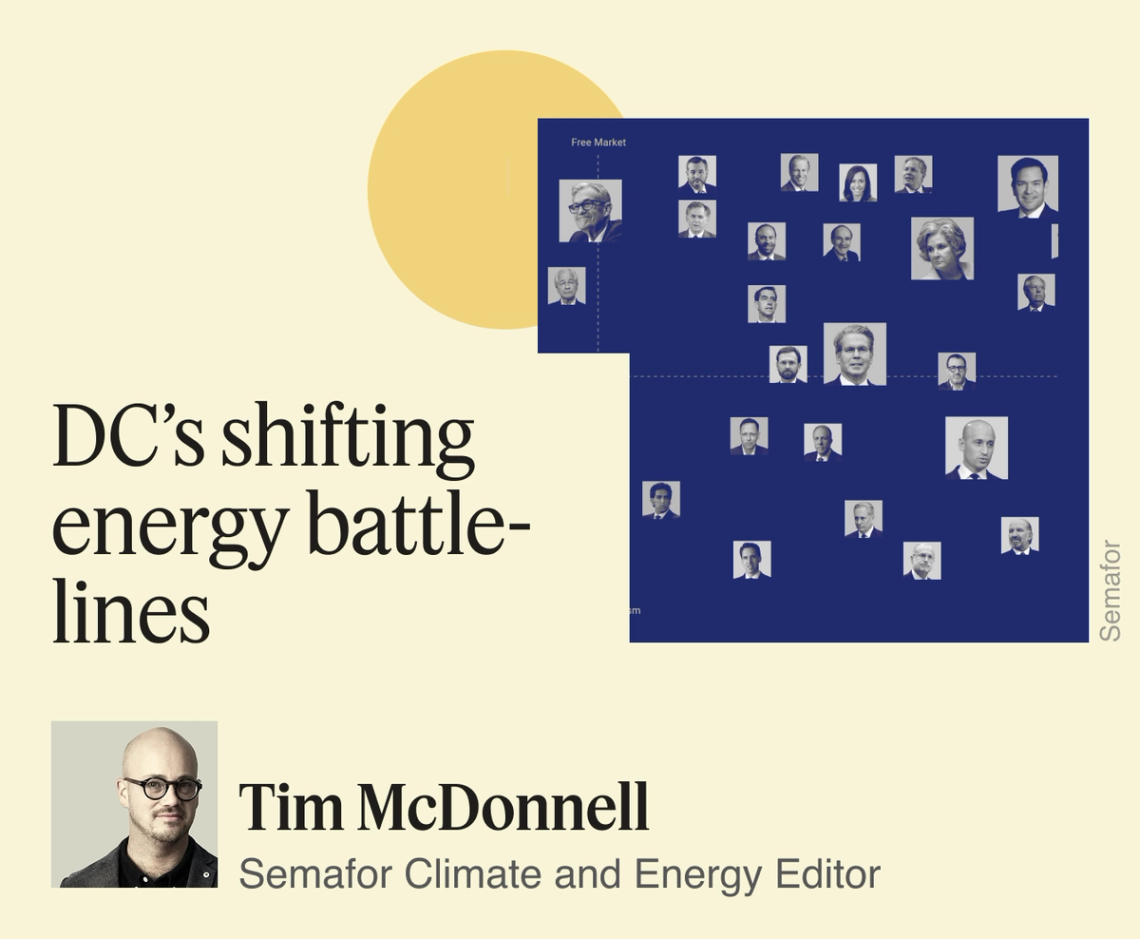 The AI race is changing the energy battlelines between Democrats and Republicans. If you want to understand how decisions get made in Washington these days, I highly recommend taking a spin through Semafor’s new Architects of the Global Economy project, which maps out the constellation of the most important movers and shakers — including their all-important personal proximity to President Donald Trump. This network diverges on a lot of topics, but many of the names share a concern about the energy demands of AI: Both that data centers are making energy less affordable for regular households, and that the red tape that has stymied large energy projects across the US for years has become a critical obstacle to competing with China on AI. Take a look at two names in the matrix, for example: Sens. Mark Warner, D-Va, and Josh Hawley, R-Mo. Warner supported renewable energy programs in the Inflation Reduction Act; Hawley has railed against renewables and climate “hysteria.” More recently, both have raised concerns about AI’s energy costs, and they are even co-sponsoring legislation aimed at quantifying AI’s contribution to job losses. But on the energy supply question, consensus remains elusive, with different players dug in on their own favored solutions: Warner is a fan of nuclear power; Hawley maneuvered to kill a huge transmission line that would have brought more renewables onto the Midwest grid. Put another way: AI has made the longstanding debate about permitting reform more urgent than ever, but it’s not clear the most powerful voices in Washington are any closer to a solution. If you’re in DC, you’ll have a few chances to hear directly from the players themselves this week at two Semafor events: One today on permitting reform featuring two interesting bipartisan pair-ups of governors and senators, and another tomorrow where Hawley and Warner will unpack DC’s new power dynamics. |
|
Trump’s energy security doctrine |
| |  | Tim McDonnell |
| |
 Bing Guan/File Photo/Reuters Bing Guan/File Photo/ReutersThe White House has elevated the role of fossil fuels to a cornerstone of US national security, arguing in a new strategy document that increasing domestic oil and gas production is vital to keep the country and its allies safe, while playing down the risk from Beijing and brushing over the low-carbon technologies now a bulwark of China’s own security strategy. The National Security Strategy downplays the interest that previous administrations, including President Donald Trump in his first term, had expressed in having the US act as a guarantor of democracy, instead framing geopolitical competition in more narrowly commercial terms. It places fossil and nuclear energy at the center of that effort, arguing that a key strategy for countering rivals is to outcompete them in legacy energy markets. Decarbonization “ideologies,” meanwhile, are dismissed because they “greatly harmed Europe, threaten the United States, and subsidize our adversaries.” The document provides a clearer picture of what energy “dominance,” the administration’s oft-stated goal, looks like in practice, said Richard Goldberg, who until August was a senior counselor for the White House National Energy Dominance Council. |
|
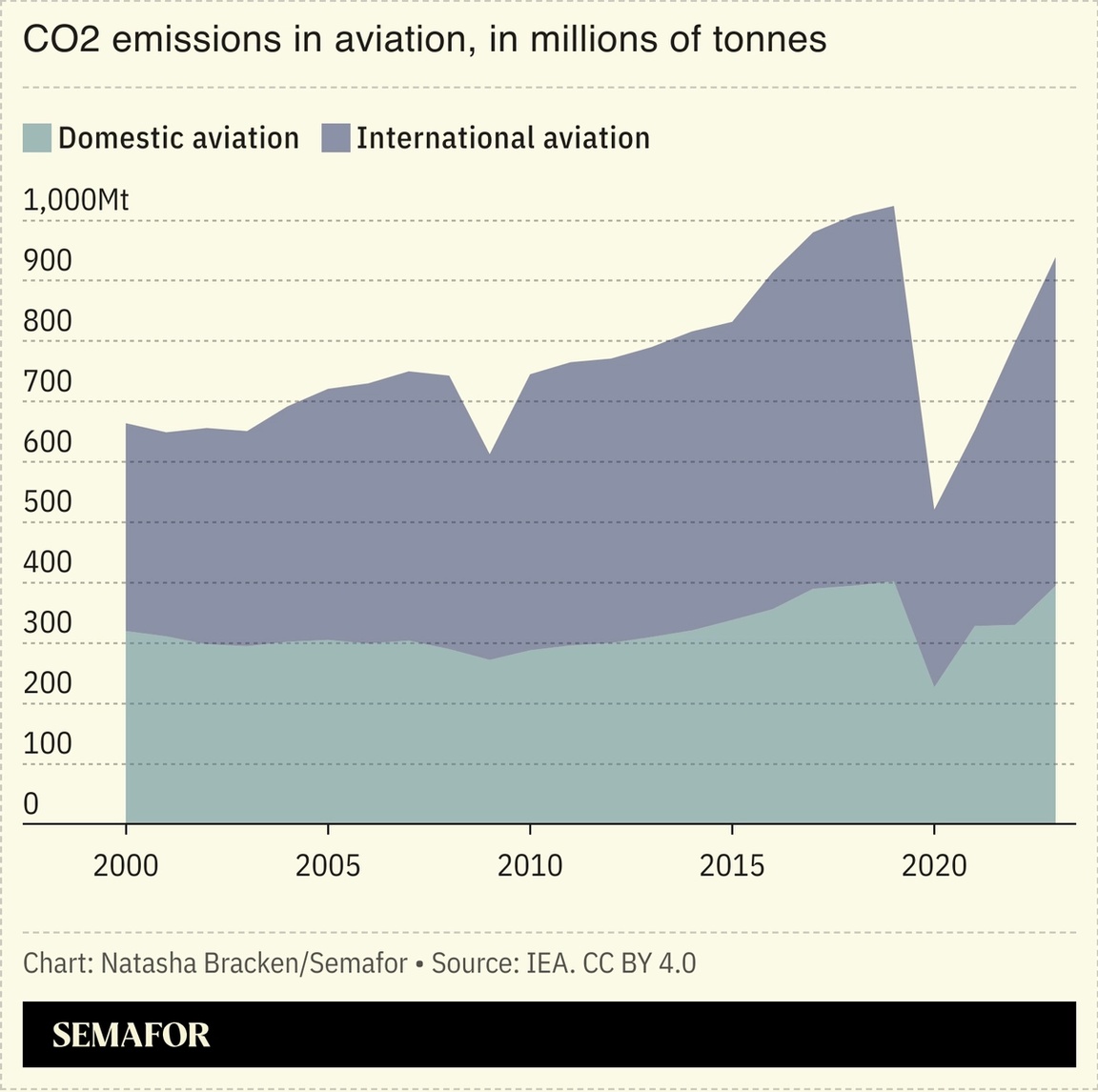 Efforts to curb aviation-related emissions range from far-off hopes for electric aircraft to near-term pressure to fly less, but other solutions exist, including one that would barely affect how passengers experience commercial flight while cutting the fuel outlay of air travel by around a tenth: That, at least, is the case put forward by the head of one of the sector’s biggest data providers. Most flight planning is done in general terms: Aircraft manufacturers provide recommendations on how to fly a particular model, and information about weather conditions is layered on top. But companies like SITA — which counts Singapore Airlines and Air France-KLM among its customers — are now providing more granular information, using a particular plane’s flying history, maintenance schedule, and other factors, combined with far more detailed weather-prediction data in order to help airlines cut fuel use, particularly during the emissions-heavy climbing phase of a flight. The next step, SITA for Aircraft CEO Yann Cabaret said in an interview, was to combine those recommendations across masses of aircraft, taking into account airspace congestion and conditions on the ground in order to advise pilots to begin descent earlier or later (thereby saving fuel, again), or decelerating to avoid having to circle an airport. “This is just the beginning,” Cabaret said. — Prashant Rao |
|
 Courtesy of Ampersand Courtesy of AmpersandOne of Africa’s leading e-mobility startups is shifting strategy in response to mounting competition from Chinese manufacturers, its CEO told Semafor. Ampersand, a Rwanda and Kenya-based manufacturer of electric motorcycles and batteries, will make its network of roughly 70 charging and battery-swap stations open to drivers of motorcycles from competing manufacturers, the company said on Monday, the first startup in Africa’s increasingly crowded e-mobility scene to make that move. The reason, CEO Josh Whale said, was a recognition that the company’s motorcycle manufacturing line is struggling to compete against the economies of scale that China-based competitors, which are rushing into African markets, can achieve. “Going toe to toe with those guys wasn’t a long-term sustainable strategy,” he said. Ampersand has a more defensible edge, he said, when it comes to the design and production of batteries and related software, and the operation of swap stations. Chinese manufacturer Wylex will be the first whose bikes will be compatible with Ampersand batteries, Whale said; others will be added to the roster soon. |
|
 The amount of new solar capacity added in the US in the third quarter of this year, a 49% jump from the previous quarter, according to a new report. The rise follows a period of disruption caused by US President Donald Trump’s tax bill, with most of the gains attributed to utility-scale solar projects that were largely completed in the second quarter, the Solar Energy Industry Association and Wood Mackenzie found. Solar made up 58% of all new electricity-generating capacity added to the grid in the first nine months of the Trump administration, much of it in red states. Still, a separate SEIA report released last month found that 117 GW of solar and storage projects remain in limbo, with pending permits vulnerable to politically motivated delays or outright cancellations. |
|
 Never miss an AI breakthrough, trend, or insight when you sign up for MIT Technology Review’s free weekly newsletter, The Algorithm. Sign up for free today. |
|
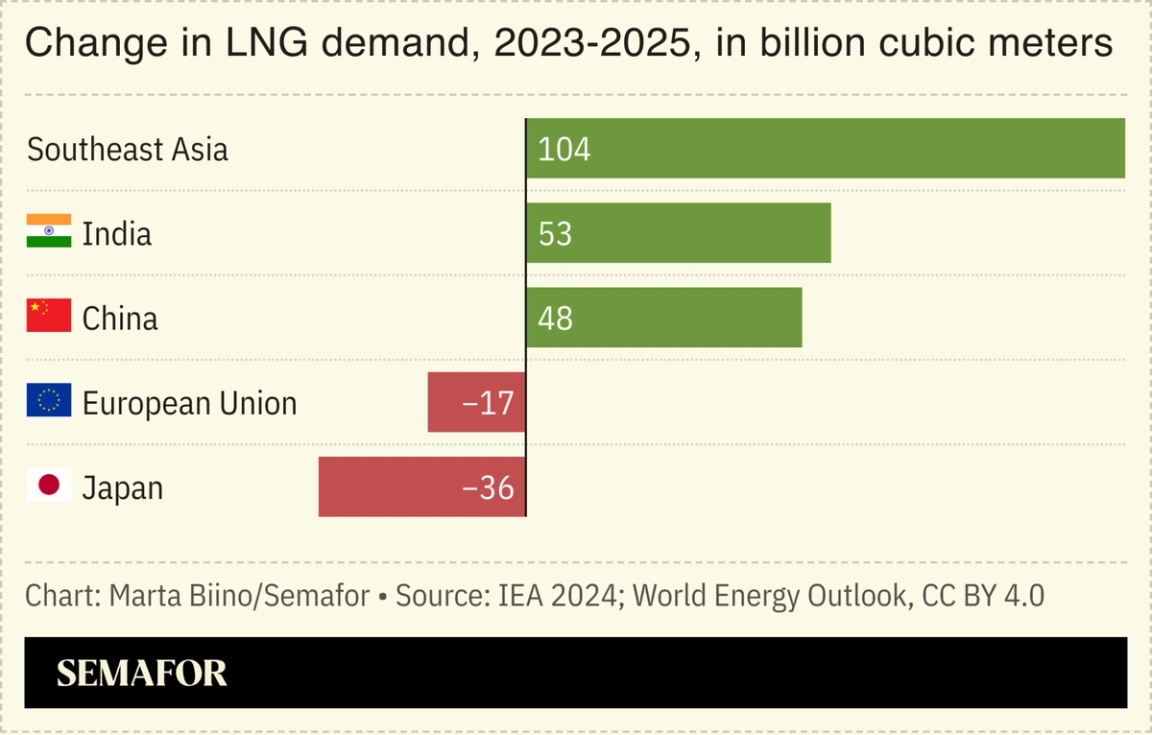 Demand for liquefied natural gas will grow by at least 50% in the next decade, but there isn’t enough new supply in the works to meet that, Qatar’s Energy Minister Saad Sherida Al-Kaabi said. QatarEnergy — the world’s biggest exporter of the fuel, which Al-Kaabi also heads — aims to double its domestic LNG capacity to 142 million tons per year by 2030, making up around one-fifth of the 600-700 million tons in total annual global demand he projects for 2035. Driving the surge: the huge energy needs of artificial intelligence. “Every country we talk to has 10% to 20% of their demand coming from AI,” Al-Kaabi said at the Doha Forum on Saturday, adding that he’s “worried” that not enough is being invested in new LNG projects. The Trump administration’s new national security strategy, meanwhile, marks a change in Washington’s approach to the region: As the US ramps up its own oil and gas output, the Middle East will no longer dominate the US agenda because of crises, the document says, but will become “a place of partnership, friendship, and investment,” as well as “a source and destination of international investment, and in industries well beyond oil and gas — including nuclear energy, AI, and defense technologies,” all of which are already Gulf priorities. — Mohammed Sergie |
|
 New Energy- The UK’s energy system operator is prioritizing hundreds of electricity generation projects considered most likely to help meet the government’s target of decarbonizing the electricity system by 2030.
 Valentyn Ogirenko/Reuters Valentyn Ogirenko/Reuters- Ukraine’s energy security could get a big boost from rooftop solar and batteries, the International Energy Agency reported, but requires a new suite of government policies, including new financial incentives like low-interest loans and investments grants.
- A federal judge ruled US President Donald Trump’s ban on new wind projects illegal.
Fossil Fuels- Oil prices slipped in early trading Tuesday, continuing their downward trend as markets focus on Ukraine peace talks, a supply glut, and US interest rates.
- TotalEnergies made its Wall Street debut, with its shares now listed both on the New York Stock Exchange and the Paris Bourse.
Finance- Indonesia will need roughly $3 billion to rebuild areas hit by recent floods that killed 900 people and displaced almost a million.
Minerals & Mining- Congo introduced a new mandatory quota verification certificate for cobalt exports as the country seeks to increase control over shipments of the battery mineral, Reuters reported.
EVs- Brussels wants to accelerate its sustainable auto industry, but for that, Europe needs a regulatory framework that “provides a realistic and reliable 10-year planning horizon,” the chief executive of Ford Motor Company wrote.
- Six EU leaders urged the European Commission to propose easing the bloc’s vehicle emission rules, which would effectively ban combustion engines by 2035.
Personnel |
|
|


