
|


 |
With America’s 250th anniversary just weeks away, today’s reviews by Thomas Kidd take us on a journey far back into American history. What was this land like before the arrival of European settlers? What role did faith and religion play in the development of the nation? Whether you agree or disagree with their conclusions, these books provide something interesting to consider as Americans reflect on our national origins.
Happy Reading,
Taylor Berglund
Senior Features Editor, Christianity Today
A portion of this newsletter appeared as a column at Christianity Today. Join CT for full access to all our journalism.
This email may contain affiliate links that help support CT at no additional cost to you.

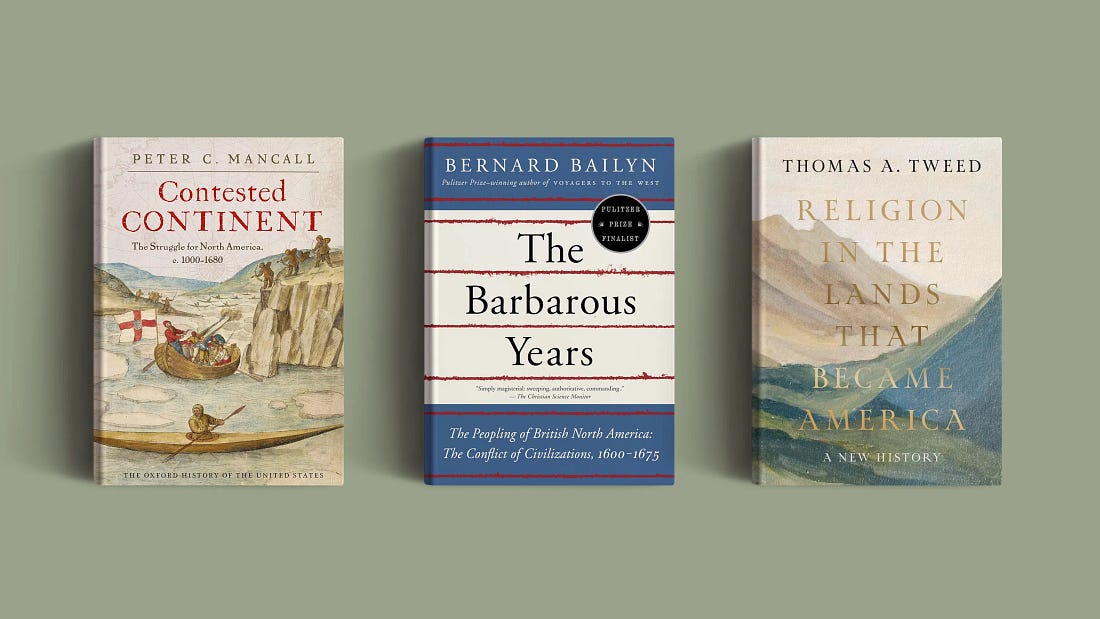 |
Three Books on History
Peter C. Mancall, Contested Continent: The Struggle for North America, c. 1000–1680 (Oxford University Press, 2026)
Peter Mancall’s Contested Continent is a prodigious synthesis of recent scholarship on early American history. As Contested Continent demonstrates, historians increasingly view early North America on its own terms, without seeing the era as a prelude to American independence.
In the new model, early America is fundamentally a site of struggle between Indigenous people and European colonizers. Enslaved Africans take an increasingly prominent role as they arrived by the millions, especially in the 1700s. In the mid-20th century, many scholars saw colonial America as a seedbed of American national identity. Now historians such as Mancall avoid the issue of American nationalism, except to the extent that early America heralded the kinds of ethnic conflict that would mark much of US history.
What makes Mancall’s survey different from previous overviews such as Alan Taylor’s American Colonies (2001) is that Mancall pushes the beginnings of early America back to around AD 1000, when Norse explorers began probing into far-eastern Canada. A lot happened between 1000 and the founding of Jamestown in 1607. Jamestown only appears halfway through Contested Continent, as a minor note amid a chapter on the “Little Ice Age” of the time period. To the general reader, Mancall’s early America will seem like an unfamiliar lost world more than preparation for “American” (i.e., English colonial East Coast) independence.
Thomas A. Tweed, Religion in the Lands That Became America: A New History (Yale University Press, 2025)
Thomas Tweed’s Religion in the Lands that Became America pushes the start of American religious history back even further than Contested Continent, to an episode that happened some 11,000 years ago. At a rock overhang near modern-day Waco, Texas, Paleo-Indians buried a middle-aged man and a girl. The grave, discovered in the 1970s, contained the largest number of items in a burial site from t