
|
 |
Sunday is Fathers Day, and what better way to honor a dad in your life than the gift of sanity? Treat him to a year of honest news, smart analysis, and good faith with a Bulwark+ membership.
The Art of the Yield
Trump says the quiet part out loud: He had to choose between surrender and economic disaster.
|


| ||||||||||||


The U.S.–Iran Memorandum of Understanding is out, and boy is it as bad as advertised. In exchange for Iran simply agreeing to begin negotiations on its nuclear program and to temporarily reopen the Strait of Hormuz without charging fees for sixty days, America is giving away the farm economically: It will immediately end the blockade, issue waivers to allow Iran to immediately resume selling its oil, and work toward dropping all sanctions on the country—both America’s own and international ones. Not only that: America also agrees to become Iran’s biggest global economic booster, committing to rustle up $300 billion to help Iran rebuild. Art of the deal! Happy Thursday.
 |
Trump’s G7 Grump-a-Thon
by Andrew Egger
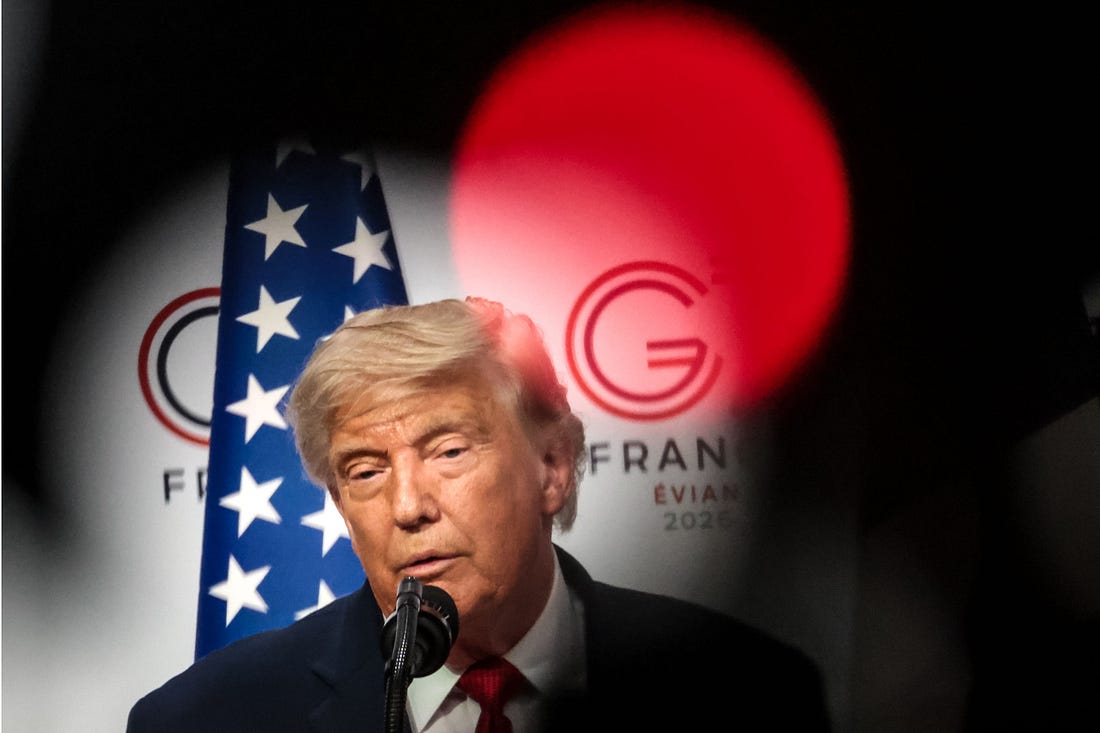
We’ve been writing for months about the no-win bind Donald Trump is in as he struggles to end his misfired war in Iran. But even if you hadn’t read a word of that—even, in fact, if you entered a coma in mid-February and are just returning to your senses now—Trump’s defeated, furious speech at the G7 conference yesterday would have done a lot to bring you up to speed.
Although the president spoke in his usual meandering, free-associating, self-aggrandizing way, the throughline of his argument was unusually straightforward. Its basic thrust: Iran hawks who hate his deal need to shut up and cut him some slack, because failing to strike a deal now would have tipped the economy into global disaster. (Have you even said ‘thank you’ once?)
“The one thing I didn’t want to see was economic catastrophe. If you kept this going, that could have happened,” Trump said. Oil reserves around the world, he suggested, would have been drawn down to critical levels in about four more weeks, and the pain that followed that would have dwarfed what we’ve seen until now. What did you idiots want—for Trump to get blamed for another depression?
“You know, I’ve studied presidents,” Trump said. “The one president I did not want to be was the late great Herbert Hoover. . . . Rather than possibly going into a depression, rather than having your favorite president be Herbert Hoover, we made this deal.”
Even as he tried to focus on selling the supposed pros of the deal, Trump kept getting sidetracked over to what he really wanted to talk about: His grievances with the war hawks in conservative media who have been castigating him as letting Iran off easy. “Some people,” he called them, “some writers that I thought were friends of mine, but I don’t want them as friends anymore, because they’re either stupid or they’re bad people.” At another point, they were “all these so-called geniuses who want to show me how smart they are.” He’s not mad! Don’t put it in the newspaper that he’s mad!
The countries of the G7, he said, are “thrilled that we made a deal, every one of them. There’s not one nation that came to us and said, ‘Please, sir, keep dropping bombs on them.’ Only stupid people say that.”
These people, he suggested, need to know when a negotiating cake is baked: “If we didn’t do this deal, we could have dropped more bombs for another three weeks, two weeks, four weeks, two years. You would never have the Hormuz Strait open. You would never have success.”
It was remarkable to watch Trump, in a fit of pure pique, get up and blab right out the basic realities of America’s terrible negotiating position that nobody in the administration has until now been willing to admit. The world was barreling toward global economic disaster thanks to the closure of the Strait of Hormuz. The aerial bombardment campaign had proven ultimately insufficient to shake any big new concessions out of the Iranian regime. In the end, despite America’s unquestioned military supremacy, it was Iran that held a